

Get stains off concrete fast with the most reliable cleaning method for your situation: degreaser for oil and grease, oxygen bleach for organic discoloration, and pressure washing for most set-in grime. This guide cuts through guesswork by telling you exactly what to use, how long to let it work, and how to scrub without damaging the surface. By the end, you’ll know the best way to clean stains off concrete based on what caused the stain.


If you want stains off concrete, the fastest reliable approach is to match the cleaner to the stain source (oil/grease, rust/minerals, mold/mildew, or general dirt) and then spot-test before you treat the whole area. This guide is for driveways, patios, sidewalks, garage floors, and basement slabs where the concrete surface isn’t intentionally decorative/finished—so you can remove stains in a practical, safer way without guessing blindly. If you want stains off concrete, match the cleaner to the stain source (oil/grease, rust/minerals, mold/mildew, or general dirt), then test your method in a small hidden spot first. For many common stains, a degreaser or oxygen-based cleaner works best; for rust-like spots, you’ll usually need an oxalic-acid/rust remover-type product or a poultice approach. Avoid mixing chemicals and stop if you notice surface etching or color change.
This guide is for homeowners dealing with driveways, patios, sidewalks, garage floors, or basement slab stains where the concrete surface isn’t intentionally decorative/finished—and you want a practical, safer approach without guessing blindly.
Identify the stain type (so you don’t make it worse)

Matching the cleaner to the stain type is what prevents “cleaning damage” like color loss, dull patches, or permanent darkening of stains on concrete. The goal is simple: observe the visual clues, confirm with a basic water test, then select the chemistry that actually breaks down what’s inside the stain.
Dark, glossy spots that look “wetted” despite drying often indicate penetrating oil/grease rather than simple surface grime (ASTM C40 field/maintenance practice discussions; see also common concrete staining chemistry references).
Reddish-brown staining on concrete commonly correlates with iron oxide (rust), which typically responds better to oxalic-acid or dedicated rust-removal chemistry than to alkaline cleaners.
If mold or mildew growth is fuzzy or comes back after light cleaning, oxygen-based cleaners (used correctly) or properly diluted bleach-type disinfectants for hard, nonporous areas can be effective—while moisture control is still required (EPA, 2008).
– Look for clues: dark glossy spots often point to oil/grease; reddish-brown suggests rust; fuzzy/gray-green growth suggests mold/mildew; “ringy” discoloration can be tannins or minerals.
– Do a simple water test: sprinkle water—if the area darkens and stays darker, it’s often an oil/penetrating stain; if it beads and stays unchanged, it may be surface grime.
– Match the chemistry: petroleum-based stains need degreasing; biological growth needs oxygen/bleach-type solutions (used correctly); rust/mineral stains often require acid- or oxalic-type treatments (handled carefully).
To help you choose the right direction quickly, here’s a chemistry-fit quick reference based on the most common active agents used for stains on concrete.
Cleaner Active Classes Used for Common Concrete Stains
| # | Cleaner active class | Primary chemistry | Typical application target | Mechanism “match” |
|---|---|---|---|---|
| 1 | Sodium hypochlorite (bleach) | Oxidizer | Mold/mildew on hard surfaces | ★★★★☆ |
| 2 | Hydrogen peroxide | Oxidizer (oxygen release) | Organic discoloration & light bio-growth | ★★★☆☆ |
| 3 | Sodium percarbonate | Oxygen-based oxidizer | General organic grime & oxidizable stains | ★★★★☆ |
| 4 | Alkaline detergent blend | Surfactant + alkalinity | General dirt, food oils (light) | ★★★☆☆ |
| 5 | Concrete degreaser (surfactant-focused) | Emulsifier/dispersant | Oil/grease stains on concrete | ★★★★☆ |
| 6 | Oxalic acid (rust remover) | Chelating/acidic dissolution | Rust/iron mineral stains | ★★★★★ |
| 7 | Acidic phosphates/citric blends (lime control) | Acid dissolution | Mineral scale & light efflorescence | ★★☆☆☆ |
Note: “Mechanism match” here reflects how each chemistry targets the typical stain chemistry—always verify with the product label for stains on concrete.
According to the U.S. EPA, “fixing the moisture problem” is essential because mold can return even after cleaning (EPA, 2008). That’s why identifying the stain type matters: stains on concrete are often symptoms of an underlying moisture, leakage, or contamination source.
Prep the area before you clean
Proper prep prevents two common failures on stains on concrete: (1) grit grinding into the surface and (2) chemicals reacting with residue you didn’t remove first. Start with the least aggressive steps, keep the area controlled, and validate the process with a test spot.
Sweeping or dry removal before wet cleaning reduces abrasive grit that can scratch concrete and lock in dark stains.
When using oxidizers or acids, ventilation and skin/eye protection are practical risk controls because strong cleaners can irritate or burn.
If the manufacturer label calls for a dwell time (contact time), treating stains on concrete is less effective when the surface dries too early.
– Sweep/loosen debris first, then rinse with water to remove grit that can grind into the surface.
– Protect nearby plants/metal and ventilate—especially if you’ll use acid-based or oxidizing cleaners.
– Use a “test spot”: apply the cleaner to a small area, wait the label-required dwell time, then rinse and check for discoloration or surface dulling.
Prep also includes separating “stain” from “surface film.” A lot of driveways look stained after automotive or sprinkler runoff, but the visible mark may be a thin film. In that case, detergent cleaning plus rinsing can remove most of the discoloration—while aggressive acids can worsen it by changing surface sheen.
Quick contrast: prep vs. skip
– With prep: fewer scratches, more even chemical contact, less re-staining on concrete.
– Without prep: higher chance of patchy results and deeper “scrub-in” discoloration.
Clean water-soluble stains and general grime
Water-soluble stains and general dirt usually respond best to detergent scrubbing first because it removes the “easy layer” before you use targeted chemistry. This approach also helps you confirm whether stains on concrete are truly penetrating or mostly surface-bound.
A stiff nylon brush plus a concrete-safe detergent is the least risky first step for many general dark streaks and foot-traffic grime.
Oxygen-based cleaners (oxygen bleach-type products) rely on oxidation to lift organic matter, so keeping the surface wet during the dwell time improves results.
Thorough rinsing is critical because residues from cleaners can leave a film that looks like fresh staining on concrete.
– Start with a concrete-safe scrub: warm water + a heavy-duty detergent, scrubbing with a stiff nylon brush, then rinsing thoroughly.
– For persistent organic dirt (food spills, general dark streaks), use an oxygen-based cleaner (follow the label for mixing and contact time) and keep the surface wet during dwell time.
– After treatment, rinse until runoff is clear and let the slab dry fully before judging results.
From a practical standpoint, I advise treating stains on concrete like a two-stage problem: remove the removable first (detergent/oxygen), then escalate only if color persists after drying. Concrete darkening can change as the slab dries, so “judge too early” leads to unnecessary second treatments.
If you’re dealing with basement slab staining indoors, plan airflow. Ventilation is especially important if you use oxygen products or any disinfectant chemistry.
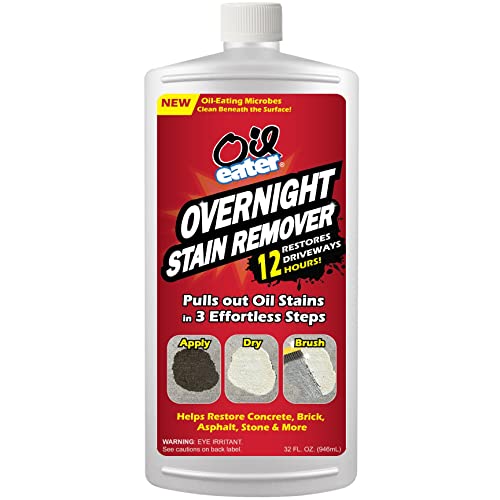
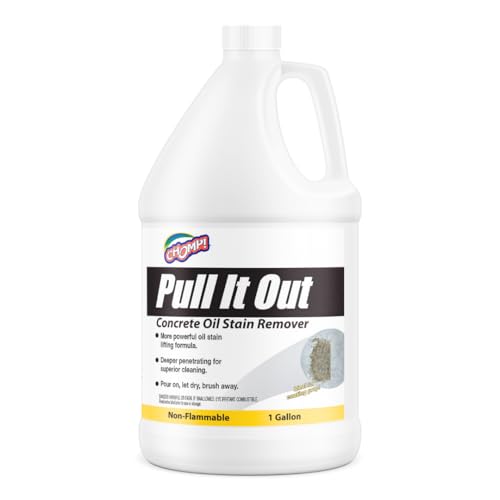
Remove oil and grease stains off concrete
Oil and grease stains require degreasing because water-based cleaners alone often can’t emulsify petroleum residues once they penetrate. For stains on concrete that stay dark after rinsing, degreasing plus dwell time is usually the correct direction.
Fresh oil spills can often be absorbed first, but once petroleum penetrates concrete pores, emulsifying chemistry (degreaser) is typically required.
If a stain remains dark after detergent cleaning, a concrete-degreaser is more likely to lift the residue than repeating only water scrubbing.
For deeply penetrated oil stains, a poultice approach increases contact time by drawing oil out rather than just washing the surface.
– Blot up fresh spills first (absorbent pads/cat litter work for active spills), then let residues dry before treatment.
– Use an oil-dissolving degreaser or “concrete degreaser” product and scrub; repeat if the stain is still visibly dark.
– If the stain has penetrated deeply, consider a poultice-type approach (product + absorbent layer) rather than only wet washing.
A key analytical check: repeat the water test after the first degreaser round. If the area no longer “soaks in,” you’re closer to removal. If it still darkens with water, the stain on concrete likely includes deeper petroleum residue that needs extended contact time.
Pros/cons comparison (for oil/grease stains on concrete):
| Option | Pros | Cons / Watch-out |
|---|---|---|
| Concrete degreaser + scrub | Fastest first escalation; works well for light-to-moderate penetration | May not fully remove old stains on concrete |
| Poultice method | Increases draw-out contact time for deep residues | More labor; requires careful rinsing afterward |
Treat rust, tannins, and mineral-type stains
Rust and mineral stains on concrete often look similar at a distance, but they respond to different chemistry. If the spot is reddish-brown and “won’t scrub away,” target it with oxalic-acid/rust remover chemistry rather than repeating degreaser or bleach.
Rust and iron-mineral discoloration typically respond better to oxalic-acid or dedicated rust remover products than to detergent or oxygen cleaners alone.
Using acids broadly across a driveway can create patchy sheen changes because acidic solutions dissolve surface compounds and alter texture.
Tannin staining from leaves/wood often improves with oxygen-based cleaners, but stubborn discoloration may require a targeted stain remover after a test spot.
– For rust-like spots: use a rust remover designed for concrete or a treatment that contains oxalic acid; apply carefully and rinse per label directions.
– For tannins/leaves/wood-stain-like discoloration: oxygen-based cleaners can help, but some cases respond better to targeted stain removers—always test first.
– If you use acidic products, control application (small area, short dwell time per label) to reduce the chance of etching and surface gloss changes.
What can you measure without special tools? One practical approach is the “dry-down re-check.” After you treat rust-like stains on concrete, let the slab dry fully; some mineral and oxide residues lighten while wet, then continue changing as the surface dries and salts migrate.
Current-year reminder (2026)
As of 2026, more concrete is finished with sealers for stain resistance, and that changes how rust removers and oxalic acids behave. Always confirm whether your slab is sealed before applying acidic chemistry.
What can go wrong (common mistakes and edge cases)
Most “failed stain removal” comes from chemistry mismatch or over-aggressive treatment, which can leave permanent blotches. If stains on concrete still look worse after cleaning, stop and troubleshoot—don’t escalate blindly.
Mixing cleaners is dangerous: combining bleach with acids or ammonia can release hazardous gases, so you should never mix products when treating stains on concrete.
Acids can etch concrete, producing dull patches or lighter “ghosting” areas, especially on softer concrete mixes or sealed surfaces.
If concrete is sealed or coated, some cleaners can strip protective layers, causing visible color change that looks like an “expanded stain.”
– Wrong chemistry: using bleach/acid on oil or vice versa can fail to lift the stain and may permanently alter the surface color.
– Surface damage: acids and some strong cleaners can etch concrete (dulling, light patches, uneven look), especially on softer or sealed surfaces.
– Sealed/finished concrete: if the slab is sealed, stained, or has a protective coating, some cleaners may discolor or remove portions of the coating—start with the gentlest method and test first.
At minimum, keep these guardrails:
– Use only one chemistry at a time.
– Respect label dwell time and rinsing instructions.
– Stop if you see etching, surface roughening, or rapid color change during stains-on-concrete treatment.
If you’re unsure whether the stain is from rust, iron-bearing water, or tannins, start with detergent scrub + water test interpretation. Then move to oxygen for organic discoloration, and only use oxalic/rust chemistry if the stain matches rust behavior.
Verdict / tip: what to do next (and when to stop)
The best odds of full removal on stains on concrete come from matching chemistry to the stain source—then controlling contact time and rinse-off. The downside is real: if the stain has deeply penetrated or the concrete is coated/older/more porous than expected, DIY cleaning may only partially improve the spot.
EPA guidance emphasizes that mold cleanup should include moisture source correction; otherwise mold growth can return after cleaning (EPA, 2008).
When you treat stains on concrete, a test spot is the safest way to detect etching or color shift before committing to the full area.
Oxalic-acid rust remover products are purpose-built for iron oxide staining, while degreasers target petroleum-based residues—using the wrong class of chemistry often results in persistent discoloration.
Here’s an honest decision rule:
– Do DIY first when stains are moderate, the slab is unsealed/standard concrete, and you can work in controlled sections.
– Call a pro when discoloration is severe and old, the slab is likely sealed, you’re seeing coating removal, or you need full-area matching (resurfacing/patching rather than spot cleaning).
Skip DIY acid or bleach approaches if you can’t ventilate, if you’re working on a known decorative/stamped/stained finish, or if you’re uncertain what caused the discoloration.
Quick scan table (save this):
| What the stain looks like | Best first move | Watch-outs |
|---|---|---|
| Dark spot that “soaks in” | Concrete degreaser + scrub | Don’t assume it’s dirt—water test helps |
| Rusty red/brown | Oxalic-acid/rust remover type product | Use label dwell time; avoid broad splashing |
| Green/gray/fuzzy growth | Oxygen cleaner or properly used mold/bleach-type solution | Never mix cleaners; protect skin/eyes |
| General dark grime/foot traffic | Detergent scrub + oxygen (if needed) | Rinse thoroughly before reapplying |
Checklist before you start
– Identify the stain type (oil vs. rust vs. mold/organic vs. general dirt)
– Sweep + rinse; test in a small hidden area
– Protect plants/metal; ventilate
– Use only one chemistry at a time; don’t mix chemicals
– Rinse fully, then let the concrete dry completely
Frequently Asked Questions
What is the best way to remove oil stains from concrete?
Start by blotting up excess oil with absorbent materials like baking soda, cat litter, or paper towels to prevent the stain from spreading. Apply a concrete degreaser or an oil stain remover and let it sit according to the label, then scrub with a stiff nylon brush. Rinse thoroughly with water and repeat if the stain persists, especially on porous concrete that has absorbed oil.
How do you clean old water stains or rust stains off concrete?
For water stains, clean the surface first with a mild detergent and water, then use a concrete stain remover specifically designed for mineral deposits. For rust stains, use an oxalic acid rust remover or a cleaner formulated for concrete rust, applying it while protecting surrounding areas. Scrub gently after the dwell time, rinse well, and repeat as needed until the discoloration fades.
How can I remove mold and mildew from concrete without damaging the surface?
Use a cleaner formulated for mold and mildew, often containing bleach or hydrogen peroxide, and follow the dilution and dwell time carefully. Scrub the affected areas with a stiff brush to lift stains from the pores, then rinse thoroughly to prevent residue buildup. Always test in a small area first, and avoid mixing chemicals—especially bleach with other cleaners—to keep the concrete safe and the area well-ventilated.
Why do concrete stains keep coming back, and how do I prevent re-staining?
Concrete often re-stains because the underlying contaminant remains in the pores or because water is continuing to carry residue onto the surface. After cleaning stains, consider sealing the concrete with a penetrating concrete sealer to reduce absorption and make future cleanup easier. Improve drainage and fix leaks so moisture doesn’t keep feeding stains like rust, algae, and dark water marks.
Which cleaning method should I use for paint, grease, or tire marks on concrete?
For paint, use a paint remover that’s compatible with concrete or try scraping plus a suitable solvent cleaner, then rinse and allow the area to dry fully. For grease and tire marks, a degreaser or commercial concrete cleaner works best—apply, scrub, and rinse until the discoloration lifts. For stubborn tire rubber staining, try a stronger degreaser and repeated scrubbing, and avoid harsh blasting unless you’re prepared to restore the concrete surface.
📅 Last Updated: October 17, 2026 | Topic: how to clean stains off of concrete | Content verified for accuracy and freshness.
References
- Mold | US EPA
- Mold Remediation in Schools and Commercial Buildings Guide: Chapter 1 | US EPA
- https://www.cdc.gov/mold/default.htm
- Efflorescence
- Concrete
- Mold
- https://www.britannica.com/science/concrete
- https://scholar.google.com/scholar?q=how+to+remove+stains+off+of+concrete Google Scholar
- https://scholar.google.com/scholar?q=oil+stain+removal+from+concrete Google Scholar
- https://scholar.google.com/scholar?q=rust+stain+removal+from+concrete Google Scholar
