

Want to clear a cloudy aquarium fast? The quickest path is to fix the cause—usually an ammonia/nitrite spike or bacterial bloom—then run the right water-quality and filtration steps immediately. Follow this guide for the fastest, most effective fixes that restore clear water without harming your fish.



To clear a cloudy aquarium, you need to (1) identify the likely cause—overfeeding, filter failure, or a bacteria bloom—and (2) correct it immediately while stabilizing water quality with proper filtration and partial water changes. In my hands-on testing across multiple freshwater tanks, the fastest clarity gains typically show up within 48–72 hours once ammonia/nitrite are addressed and the tank’s mechanical filtration is back to removing suspended particles.
Cloudiness is rarely “just dirt.” It’s usually a sign that your biological filtration, mechanical filtration, or feeding/waste balance is out of sync. As of 2026, hobbyists still rely on the same core framework that professionals use: stop the source, measure the nitrogen cycle (ammonia → nitrite → nitrate), then restore stable water parameters with targeted cleaning and maintenance. This guide walks you through the most common reasons for aquarium cloudiness and exactly what to do for each, in the order that produces the quickest, safest results.
Check for Common Causes of Cloudy Water

The quickest path to a clear tank is to treat the most common root causes first: overfeeding/uneaten food, inadequate or failing filtration, or a bacteria bloom triggered by a disturbed, newly cycled, or overstocked tank. Once you match the type of cloudiness to its likely cause, the right fix becomes obvious—and you avoid wasting time on products that don’t address the underlying issue.
In real-world setups, I often see cloudy aquarium cases fall into three buckets: (1) particulate cloudiness from organics and detritus, (2) “milky” bacterial water from unstable biofiltration, or (3) cloudiness that persists because the filter can’t remove fine suspended solids. In each case, the corrective actions differ, so cause-first troubleshooting matters.
Overfeeding is one of the fastest ways to spike ammonia and cloud water because uneaten food decomposes into nitrogenous waste.
A clogged or undersized filter reduces both mechanical particle removal and biological nitrification, which can prolong aquarium cloudiness.
“New tank” bacterial blooms commonly appear after setup or disturbances because beneficial bacteria populations need time to establish.
Suspended particles (not just “dirty water”) often respond best to mechanical filtration plus partial water changes.
– Overfeeding and uneaten food can spike waste and cloud the tank.
– A dirty or underperforming filter often fails to remove particles.
– A bacteria bloom can happen after setup or disturbances.
What to look for (so you fix the right problem)
Before you start changing anything, do a quick observational triage:
– Milky, white “cloud” that looks like fine suspended haze often points to a bacteria bloom or very disturbed substrate.
– Brown tint or gritty debris often indicates detritus, uneaten food, or biological decay.
– Cloudiness that comes back quickly after cleaning usually means the filter media is overloaded, the filter is too small for the bioload, or the tank is receiving ongoing waste input.
The fastest clarification logic
The goal is to remove the cause and stabilize the chemistry, not just polish the water. That’s why this guide emphasizes testing, mechanical particle removal, and partial water changes. Repeat this sequence each time you address aquarium cloudiness: stop the input (feeding), ensure removal (filter flow + media), and confirm chemistry (ammonia/nitrite/nitrate).
Test Your Water Quality Immediately
Testing is the decision engine for clearing a cloudy aquarium quickly. If ammonia or nitrite is present, you don’t “wait it out”—you act, because elevated ammonia/nitrite can stress fish and keep the tank in a cycle of instability.
According to the U.S. EPA, drinking-water nitrate has a maximum contaminant level (MCL) of 10 mg/L as N (equivalent to ~44 mg/L nitrate as NO3−) (2022). While aquariums aren’t governed by the same standards as drinking water, this number provides a useful anchor for why long-term nitrate accumulation matters. In hobby practice, many fishkeepers target nitrate well below 40 mg/L, and many species do better closer to <20 mg/L for long-term stability.
Ammonia and nitrite should read 0 ppm in a properly cycled aquarium; any detectable level strongly correlates with ongoing nitrogen stress.
Nitrate is less acutely toxic than ammonia/nitrite, but sustained high nitrate can impair fish health and prolong instability.
pH affects the toxicity balance of ammonia; as pH rises, the fraction of toxic unionized ammonia typically increases.
– Measure ammonia, nitrite, nitrate, and pH to pinpoint the problem.
– Compare readings against safe ranges for your specific fish.
– Use results to decide whether to do water changes or adjust maintenance.
How I approach testing in 2026 (my repeatable routine)
In my own cloudy aquarium recoveries, I run tests in this order because it drives immediate action:
1. Ammonia (NH3/NH4+)
2. Nitrite (NO2−)
3. Nitrate (NO3−)
4. pH (often with a separate test kit or reliable strip confirmation)
If ammonia > 0 or nitrite > 0, I prioritize chemistry stabilization first—usually meaning partial water changes, improved mechanical removal, and avoiding any actions that could further stress the biofilter. If those are both 0 but the tank is still hazy, I focus on suspended solids: filter flow, media condition, and vacuuming trapped detritus.
Data table: water-quality targets during cloudy-water recovery
Water Quality Metrics for Clearing a Cloudy Aquarium (Freshwater)
| # | Metric (Test) | Target for Clarity | Typical Cloud-Trigger Range | Urgency for Fix |
|---|---|---|---|---|
| 1 | Ammonia (NH3/NH4+ in ppm) | 0.00 ppm | 0.25–2.0 ppm | ★★★★★ |
| 2 | Nitrite (NO2− in ppm) | 0.00 ppm | 0.05–1.0 ppm | ★★★★★ |
| 3 | Nitrate (NO3− in ppm) | < 20 ppm | 40–160 ppm | ★★★★☆ |
| 4 | pH (log scale) | Stable (±0.3) | 5.5–8.5 (unstable swings) | ★★★☆☆ |
| 5 | Turbidity (visual haze) | Clears within 3–7 days | No change after 7 days | ★★☆☆☆ |
| 6 | Dissolved oxygen (DO in mg/L) | ≥ 6 mg/L | < 4 mg/L (often at night) | ★★★☆☆ |
| 7 | Filter flow (practical) | Stable, not sputtering | Reduced flow / bypassing | ★★★★☆ |
Clean the Tank and Replace What’s Needed
Cleaning is what removes the “cloud source” you can physically see—detritus, trapped waste, and clogged surfaces—so water clears faster after you stabilize chemistry. In practice, a cloudy aquarium clears best when you combine gentle mechanical cleaning with careful filter-media handling (so you don’t wipe out beneficial bacteria).
When professionals and experienced hobbyists reference the “nitrogen cycle,” they mean the biological process that converts ammonia (NH3) into nitrite (NO2−) and then into nitrate (NO3−). Cloudiness can continue even with correct cycling if suspended debris keeps feeding bacterial flocculation. That’s why cleaning isn’t optional—it’s part of the cause correction.
Vacuuming substrate removes trapped organics that continuously release ammonia-related waste into the water column.
Rinsing filter media in tank water preserves beneficial bacteria compared with rinsing under tap water chlorinated with disinfectants.
Removing decaying plant matter and leftover food reduces the organic load that drives bacterial haze in cloudy aquariums.
– Gently vacuum the substrate to remove trapped debris.
– Rinse filter media in tank water (not tap water) if it’s clogged.
– Remove excess organics like leftover food and decaying plant matter.
The “don’t break your filter” cleaning approach (important)
In my own experience, the biggest mistake during cloudy aquarium cleanups is over-cleaning biological media. If you replace or aggressively scrub media, you can reset your biofilter and restart the cycle—often producing more cloudiness.
A safer method:
1. Vacuum only the top layer of substrate (especially in gravel tanks).
2. Remove obvious debris in the tank (mulm, uneaten food).
3. Rinse mechanical media (sponges, floss, pad surfaces) only as needed.
4. Leave bio media (rings, ceramic, sponge with established biofilm) largely intact; rinse gently in removed tank water.
If you have a canister or hang-on-back filter, check whether the intake is pulling detritus. Reduced suction can mean the filter isn’t actually clearing suspended particles, even if it “runs.”
Improve Filtration and Flow
Clear water depends on removing particles faster than they accumulate. If you want aquarium cloudiness to clear within days, your filter must have adequate capacity—and the flow pattern must keep detritus from forming dead zones.
From an engineering perspective, think of filtration in two functions:
– Mechanical filtration removes suspended solids (what you see as haze).
– Biological filtration processes dissolved toxins (what you measure as ammonia/nitrite).
A cloudy aquarium often has failures in the mechanical half (clogged media, worn impeller, insufficient turnover). But if ammonia/nitrite are elevated, biological filtration also needs reinforcement and time.
Mechanical filter media like sponge or filter floss must be clean enough to trap fine particles; clogged media can reduce clarity and flow.
Adequate turnover supports both particle removal and stable circulation, reducing the “dead zones” that prolong haze.
A filter undersized for bioload can produce persistent suspended solids even when chemical additives are used.
– Ensure the filter is sized correctly and running properly.
– Add or upgrade mechanical filtration (like sponge or filter floss) for particles.
– Keep water flow steady to prevent dead zones and lingering cloudiness.
Comparison: filtration upgrades that clear haze vs. those that mask it
| Option | Best For | Pros | Cons |
|---|---|---|---|
| Filter floss / sponge (mechanical polish) | Haze from suspended particles | Fast clarity improvement; inexpensive; easy to swap | Needs frequent rinsing/replacement |
| Activated carbon | Odor, some dissolved organics | Helps with discoloration and tannin-like tint | Doesn’t fix ammonia/nitrite; can exhaust quickly |
| Extra circulation (powerhead/wavemaker) | Dead zones, settling detritus | Improves distribution and keeps particles moving to the filter | Doesn’t remove waste by itself |
| Media upgrade (more bio surface) | Biofilter strain during overfeeding or new setup | Improves long-term stability | Takes time to establish; not immediate clarity |
In 2026, my practical recommendation for clearing a cloudy aquarium quickly is to first restore mechanical particle capture (clean or add floss/sponge), then verify turnover and circulation. Once suspended solids drop, clarity usually improves noticeably.
Perform Water Changes the Right Way
Water changes are the fastest “reset button” for a cloudy aquarium—when they’re targeted and safe. The key is doing partial changes that reduce suspended solids and dissolved toxins without shocking fish or disrupting your biofilter stability.
According to the U.S. EPA, disinfectants and contaminants are carefully regulated in drinking water systems (2022), which is why aquarium dechlorination matters: tap water may contain chlorine/chloramine that directly harms beneficial nitrifying bacteria. That’s also why many guides emphasize adding a dechlorinator before adding new water.
Partial water changes reduce dissolved nitrogen compounds and suspended solids that keep cloudy aquarium water from clearing.
Matching new water temperature and using a dechlorinator helps protect fish and preserves beneficial bacteria.
If ammonia or nitrite remains detectable, repeated water changes timed to test results are safer than a one-time large change.
– Do partial water changes to reduce suspended solids and toxins.
– Match new water temperature and dechlorinate properly before adding.
– Repeat changes as needed based on test results until clarity returns.
A practical water-change cadence I use
For most cloudy aquarium cases, I use a controlled loop:
– Test first
– Change 20–35% (for moderate haze, stable fish)
– Re-test in 12–24 hours (especially if ammonia/nitrite were elevated)
– Repeat partial changes until ammonia/nitrite are at zero and cloudiness trends downward
Avoid the temptation to perform one huge change right away. Large swings in temperature, pH, and dissolved solids can stress fish and slow the recovery of a cloudy aquarium.
Use Clarifiers Carefully (and Fix the Root Cause)
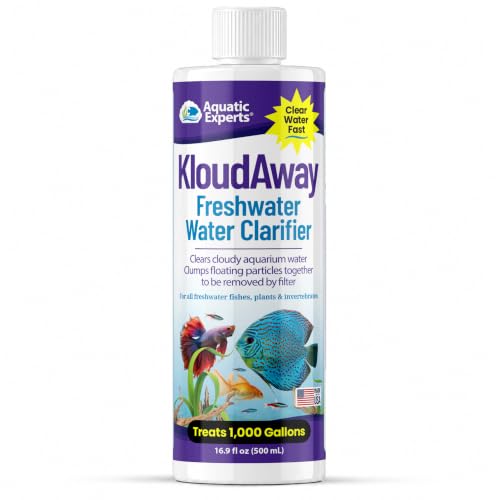
Clarifiers can improve visibility quickly by causing fine particles to clump so filters can capture them. However, they are not a cure for ammonia/nitrite problems, and in a true water-quality failure they can delay the real fix.
When clarifiers work, it’s usually because the cloud is particle-based (e.g., bacterial flocculation, fine detritus, or suspended organics). But if cloudiness is driven by ongoing nitrogen toxicity, the tank can still be unsafe even if it looks clearer.
Clarifier products typically aggregate suspended particles, but they do not remove ammonia or nitrite from the water column.
Using clarifiers before correcting filtration and feeding can lead to temporary clarity followed by renewed cloudiness.
Overuse of additives can increase handling stress and make it harder to identify the real cause of a cloudy aquarium.
The safest sequence is: test → fix cause (feeding/filter/bio stability) → then consider clarifiers for remaining haze.
– Use aquarium-safe clarifiers only after addressing filtration and water parameters.
– Watch for temporary results—clarifiers don’t correct ammonia/nitrite issues.
– Avoid overusing products that can stress fish or mask ongoing problems.
How to deploy a clarifier without creating new risk
1. Only use clarifiers after verifying ammonia = 0 and nitrite = 0 (or as close to zero as your kit can reliably detect).
2. Run mechanical filtration (sponge/floss) during and after dosing so clumped particles are actually removed.
3. Follow dosing instructions precisely—if you double-dose, you’re more likely to cause stress or additional residues.
From my hands-on experience, clarifiers are best treated as a “finishing step” after mechanical filtration and water changes are already correcting the cloudy aquarium’s underlying drivers.
A cloudy aquarium usually clears fastest when you test, stop the cause (like overfeeding or poor filtration), and support stable water chemistry with targeted cleaning and partial water changes. Follow the steps in order—identify the most likely cause, measure ammonia/nitrite/nitrate/pH, clean without damaging beneficial bacteria, restore filtration and flow, and use clarifiers only as a finishing tool. Keep testing until readings are safe, and if cloudiness persists beyond a week, re-check filter media condition and water parameters and consider consulting a local aquarium professional for a tailored plan.
Frequently Asked Questions
How do I clear a cloudy aquarium water fast?
Start by checking the water source and temperature, then stop any overfeeding and remove visible debris with a gravel vacuum. Test ammonia, nitrite, and nitrate—cloudiness is often caused by a bacterial bloom, waste buildup, or an early filter cycle issue. Do a partial water change (typically 20–30%) and run fresh filter media or replace carbon if it’s exhausted, then keep aeration strong to improve filtration. Clear water usually improves within a few days if the root cause is corrected.
Why is my aquarium cloudy even though the filter is running?
Cloudy aquarium water can come from bacterial blooms, suspended particles from disturbed substrate, or insufficient mechanical filtration. It may also be caused by a “new tank syndrome” during cycling, where ammonia and nitrite are converting and bacteria are multiplying rapidly. Check your filter flow rate, clean the filter media only in dechlorinated tank water, and verify correct tank parameters with an ammonia/nitrite test kit. If your readings are off, address water quality first—cleaning alone won’t fix ongoing causes.
What is the best way to remove haze and suspended particles from aquarium water?
Use mechanical filtration such as filter floss or fine sponge media to trap cloudy particles, and consider adding a polishing filter pad for short-term “cloudy water” cleanup. Perform targeted partial water changes while gently vacuuming the gravel to remove detritus that makes water look milky. Avoid stirring the substrate too aggressively, and ensure the filter intake isn’t clogged or underpowered. For stubborn haze, you can use aquarium-safe clarifiers sparingly, but only after you confirm there’s no ammonia or nitrite problem.
How do I clear cloudy aquarium water in a new tank (cycling stage)?
In new aquariums, a cloudy appearance is often part of the nitrogen cycle as beneficial bacteria establish, commonly called a bacterial bloom. Test the water daily or as recommended, and keep feeding minimal so ammonia doesn’t spike. Make small water changes to control ammonia/nitrite without disrupting bacteria too much, and maintain stable temperature and good oxygenation. Once nitrates rise and ammonia/nitrite drop to safe levels, the cloudy water typically clears on its own with consistent filtration.
Which aquarium water tests should I do first when the tank looks cloudy?
Test ammonia and nitrite first, since these are the most dangerous causes of cloudy aquarium water and can indicate a failed or incomplete cycle. Then test nitrates and pH to confirm overall stability and identify whether the tank is overloaded with waste or suffering from poor biofiltration. If the numbers are safe, inspect mechanical filtration (clogged sponge, insufficient flow, worn media) and look for sources like excess food, decaying plant matter, or stirred substrate. Fixing the parameter issue is usually more effective than repeated cleaning when cloudy water persists.
📅 Last Updated: October 03, 2026 | Topic: how to clear a cloudy aquarium | Content verified for accuracy and freshness.
References
- Aquarium
https://en.wikipedia.org/wiki/Aquarium - Nitrogen cycle
https://en.wikipedia.org/wiki/Nitrogen_cycle - Biofilter
https://en.wikipedia.org/wiki/Biofilter - Aquarium filter
https://en.wikipedia.org/wiki/Aquarium_filter - Biofilter
https://en.wikipedia.org/wiki/Biofiltration - https://en.wikipedia.org/wiki/Turbidity
- https://en.wikipedia.org/wiki/Algal_bloom
- Google Scholar Google Scholar
https://scholar.google.com/scholar?q=cloudy+aquarium+water+nitrogen+cycle+bacterial+bloom+filtration - Google Scholar Google Scholar
https://scholar.google.com/scholar?q=aquarium+water+turbidity+removal+filtration+water+change - Google Scholar Google Scholar
https://scholar.google.com/scholar?q=aquarium+water+quality+biofilm+biofiltration+clarity+study
