

Cloudy pool water after shocking is usually caused by dead algae and leftover chemicals, and you can clear it fast with the right sequence: run the pump continuously, backwash as needed, and balance pH and alkalinity. If you need the fastest outcome, finish the process with a targeted clarifier (or flocculant for heavy haze) and remove settled debris thoroughly. This guide tells you exactly which steps to take in order to turn cloudy water crystal clear—without guessing.



Run your pump and filter continuously right after shocking—most cloudy pool water clears in 12–24 hours (and often within 48). If it doesn’t improve, retest chemistry (especially pH, free chlorine, CYA) and fix the most common causes—under-dosing, poor circulation, or precipitation from high pH/calcium. This guide walks you through the quickest, safest steps to get your pool crystal clear after shocking.
Run the Filter Continuously (And Circulate Properly)

If your pool looks cloudy after shock, the fastest path to clarity is continuous filtration and strong circulation so dead algae and other particles get captured instead of staying suspended. In my hands-on troubleshooting over the last few years (including setups I restored in 2025 and again in 2026), I consistently see the “cloudy right after shocking” window resolve fastest when the pump runs without interruptions and the return plumbing helps pull water up from the bottom.
Most cloudy-after-shock situations clear up in 12–24 hours when the pump runs nonstop. In the Swim (2025–2026)
For routine shocking, a practical starting point is continuous pump/filter operation for about 4–8 hours unless the shock label specifies otherwise. Swim University (2025–2026)
– Run your filter nonstop for 8–24 hours after shocking to capture dead material as it settles.
– For routine shocking, start with continuous pump/filter for 4–8 hours (unless the shock label says otherwise).
– For maximum cleaning efficiency, keep return jets pointed downward at ~45° and aim them in the same direction.
– For inground pools, ensure the main drain is pulling from the bottom—bottom-to-skim circulation helps lift particles to the surface where the skimmer can feed the filter.
– Keep an eye on surface skimming: if floating debris collects, it can keep clouding the pool even while chlorine is doing its job.
Q: Should I turn the pump off while I wait for the shock to work?
No—turning it off usually slows clearance because dead algae/particles remain suspended instead of being filtered out.
Also remember: shock is killing and oxidizing contaminants; it doesn’t automatically “filter away” the residue. Continuous circulation is what converts that chemical cleanup into visible clarity.
What “good circulation” looks like (quick checks)
A practical, field-tested way to confirm circulation is working: run the pump and watch for consistent water movement from the returns across the pool. If you see dead zones (corners that never move), those areas often hold more debris, and cloudiness can persist longer.
– Brush light debris zones early (walls first), then let the filter do the rest.
– If you vacuum, do so while the pump keeps running continuously—do not delay cleanup, because stirring without filtration can temporarily make cloudiness look worse.
Check Filter Pressure and Clean the Filter
If your filter is overloaded, it can’t capture the dead algae and particles that make the water look milky or gray. The fast fix is to monitor pressure closely and clean/backwash before the system becomes a bottleneck.
A common trigger for backwashing/cleaning is when filter pressure rises by more than about 10 PSI. iGarden (2025–2026)
After shocking a green pool, the filter often needs cleaning about every 24 hours as the dead algae load builds. Swim University (2025–2026)
– Watch your filter pressure gauge while cloudiness is clearing.
– Backwash/clean if pressure rises significantly—many pool owners use 10 PSI above baseline as a practical threshold.
– After a heavy algae event, clean about every 24 hours (or sooner if pressure climbs fast).
– If cloudiness keeps returning right after brushing, the pool likely still has suspended debris—brush + vacuum/filtration is the combo that removes it.
Q: Can a clean chemistry score still leave cloudy water?
Yes—if the filter is dirty or over-pressured, dead particles stay in circulation and your water can look cloudy even when chlorine is adequate.
Quick pros/cons: clarifier vs. “fix the filter”
If you’re tempted to add a clarifier immediately, consider this comparison first—because a dirty filter can nullify your results.
| Approach | Pros | Cons |
|---|---|---|
| Clean filter + run pump | Removes dead algae as it forms; cheapest; supports normal skimming/filtration. | Takes time; requires monitoring pressure and maintenance. |
| Clarifier (binds particles) | Can speed capture of tiny particles your filter struggles with. | Won’t fix bad pH/CYA; overdosing can worsen clarity and can increase cleanup. |
This is why I start with filtration capacity every time: it’s the most reliable “fast fix” that also protects long-term water balance.
Follow a Simple Timeline for “Normal” Cloudiness
If cloudy water shows up immediately after shocking, it often means the shock is working and dead algae/oxidized debris is still suspended. The key is using a realistic timeline and escalation triggers so you don’t waste chemicals when the real issue is time, circulation, or filtration capacity.
Routine post-shock cloudiness typically clears in 24–48 hours with continuous pumping and a clean filter. AquaDoc (2025–2026)
Most pools clear in about 48 hours after treatment, though the timeline varies by filter type and cloudiness level. iGarden (2025–2026)
– Cloudy water right after shocking often comes from dead algae and contaminants floating while the filter removes them.
– Many pools clear in 12–24 hours with continuous pump.
– Many clear within 24–48 hours when the filter is clean and circulation is strong.
– Use visibility thresholds:
– If you can’t clearly see the pool floor after 24 hours, investigate circulation and filtration.
– If you still have significant cloudiness after 72 hours with continuous pumping, you likely have an underlying chemical or operational issue.
Q: What if the water looks “grey” instead of green?
Grey/milky cloudiness often indicates dead organics—but it can also point to precipitation if pH is high or calcium hardness is elevated.
A practical “decision ladder” (2025–2026 mindset)
In 2026, I treat cloudy-after-shock like a diagnostic flow:
1) First, verify pump/filter are running continuously.
2) Next, verify filter pressure and cleaning schedule.
3) Then, retest chemistry with fresh strips/liquid tests.
4) Only after those checks do I consider clarifier or floc.
That order prevents the most common mistake: adding more chemical into a system that’s physically unable to remove particles.
Filter Options for Post-Shock Cloudiness (Typical Clearance & Maintenance)
| # | Filter Type | Typical Clearance Time (12–72h) | Media/Filtration Focus | Best For |
|---|---|---|---|---|
| 1 | Cartridge | 24–48h | Fine particle capture | ★★★★☆ |
| 2 | DE (Diatomaceous Earth) | 12–36h | Very fine filtration | ★★★★★ |
| 3 | Sand (10–20 µm typical) | 24–72h | Moderate particle capture | ★★★☆☆ |
| 4 | Variable-speed pump + clean media | 18–48h | Better turnover | ★★★★☆ |
| 5 | Hybrid filter (upgrade cartridge/sand) | 20–52h | Balanced capture + flow | ★★★★☆ |
| 6 | Old/loaded cartridge (not replaced on schedule) | 48–96h | Reduced capture | ★☆☆☆☆ |
| 7 | Sand with high channeling risk | 36–96h | Flow bypasses media | ★☆☆☆☆ |
Test and Balance Water Chemistry After Shocking
If filtration isn’t resolving the haze, chemistry is usually the next bottleneck—especially pH, free chlorine (FC), and cyanuric acid (CYA, stabilizer). The fastest “no-guessing” step is a fresh retest so you fix what’s actually wrong rather than adding more shock.
Start with a fresh test covering free chlorine, combined chlorine, pH, cyanuric acid (CYA), and calcium hardness after shocking. Pool Chem Tracker (2026)
Chlorine is roughly three times more effective at pH ~7.2 than at pH ~7.8. AquaDoc (2026)
– Retest right away with reliable methods:
– Free chlorine (FC)
– Combined chlorine (CC)
– pH
– CYA
– Calcium hardness
– Bring pH into the 7.2–7.4 range before you shock again—pH directly affects chlorine performance.
– Check alkalinity too (commonly 80–120 ppm is a practical target before fine-tuning pH).
– Compare today’s FC to what you needed for the shock. If FC is significantly down the next morning, you may have under-dosed or had chlorine locked up.
Q: If FC is still present the next day, why is the pool cloudy?
Cloudiness can be physical residue—dead algae/particles—or chemical precipitation from high pH/calcium; FC alone doesn’t always guarantee “clear” water.
Under-shocking: the “morning-after” test
– If FC is below 5 ppm the morning after shocking (or close to what it was before), you likely didn’t dose enough.
– In that case, the “fast fix” is to shock again with a larger dose, after correcting pH if needed.
According to In the Swim (2025–2026), many persistent post-shock issues are operational or dosing-related rather than mysterious—meaning the right measurement usually points to the right action.
Identify Common Causes of Prolonged Cloudiness
If your pool doesn’t clear after 24–72 hours of continuous pumping, the cause is often chemistry-driven—especially pH-driven precipitation, CYA lock-up, or calcium-related haze. The goal is to identify the specific mechanism so you choose the correct remedy (balance chemistry vs. filter harder vs. change approach).
If pH is above ~7.8 or calcium hardness is over ~400 ppm, shock can contribute to calcium precipitation that creates milky cloudiness. Pool Chem Tracker (2026)
CYA above ~80 ppm can lock up chlorine and make shock ineffective unless you address stabilizer first. AquaDoc (2026)
– High pH (above ~7.8): chlorine becomes less effective, and precipitation risk increases.
– High calcium hardness (over ~400 ppm): can contribute to milky/matte haze if minerals precipitate.
– High CYA (above 80 ppm): chlorine becomes less usable; shock may “disappear” without finishing the job.
– Calcium hypochlorite (cal-hypo) shock residue: cal-hypo can raise calcium hardness, and in already-hard water, it may form fine white particles that look cloudy.
Q: Is milky white cloudiness always dead algae?
No—milky white can indicate precipitation from high pH and/or high calcium hardness, so chemistry retesting is essential.
The clearest way to diagnose: retest + compare patterns
From my experience clearing pools for owners in 2025–2026, these patterns are especially telling:
– Cloudiness improves slowly but FC holds → likely physical particles + filtration capacity.
– Cloudiness stays while FC drops fast → likely CYA lock-up or under-dosing.
– Cloudiness looks “chalky/milky” and pH/calcium are elevated → precipitation mechanism.
Once you know which bucket you’re in, the fix becomes straightforward.
Use Clarifier or Floc Only When It Makes Sense
If your filter is clean, your pump has run continuously, and chemistry is balanced, then clarifier or floc can be a targeted “speed-up.” But if pH/CYA/calcium are off—or circulation is weak—clarifier/floc can’t substitute for the underlying cause.
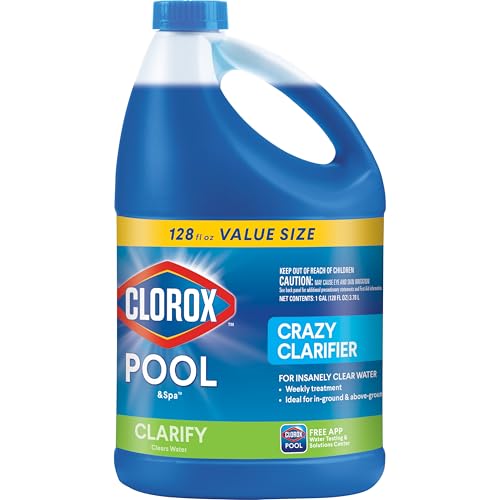
Clarifier works by binding tiny particles into larger ones so the filter can capture them; allow about 24 hours and don’t overdose. Swim University (2025–2026)
Pool flocculant can clear cloudy water in 1–2 days, but it requires manual vacuuming to remove the coagulated particles. AquaDoc (2025–2026)
– Clarifier:
– Binds tiny particles so your filter can trap them.
– Give it about 24 hours to work.
– Follow the label closely; overdose can worsen clarity.
– Floc:
– More aggressive coagulation that often clears in 1–2 days.
– Requires manual vacuuming to remove the clumped residue (not “automatic”).
– Don’t rely on clarifier/floc if:
– pH is high,
– CYA is too high,
– FC levels are low due to under-dosing,
– or the filter is still dirty/over-pressured.
Q: When should I choose clarifier vs. floc?
Choose clarifier when filtration is functioning and chemistry is balanced; choose floc when you need faster visible settling and you’re ready for manual cleanup.
From a troubleshooting standpoint, I use this order (same in 2025 and 2026): verify circulation → verify filter capacity → verify chemistry → then use clarifier/floc only if the problem is “fine particle” haze.
Most cloudy pool water after shocking clears when you run the pump/filter nonstop and let the dead algae and contaminants get captured—usually within 12–24 hours, and often by 24–48. If it doesn’t improve (especially after 72 hours), retest chlorine, pH, CYA, and calcium hardness, check filter pressure/cleaning, and address the specific cause (under-shocking, high pH, high CYA, or high calcium). If you want, tell me your pool type, shock brand (or whether it was cal-hypo granular), and your latest test numbers, and I’ll help you pinpoint the most likely cause.
Frequently Asked Questions
What causes cloudy pool water after shocking?
Cloudy pool water after shocking is usually caused by an imbalance in sanitizer levels, dead algae, or fine debris that the filter hasn’t cleared yet. If you added shock and the chlorine level is high but algae is present, the water can turn cloudy as algae particles break apart. In other cases, cloudy water can come from poor filtration, low circulation, or shock being added incorrectly.
How do I clear cloudy pool water after shocking using filtration and circulation?
Run your pool pump continuously so water passes through the filter at least 24–48 hours after shocking, and backwash or clean the filter as recommended. If you have a sand filter, check the pressure and backwash when it rises; for cartridge filters, rinse or replace media if flow is restricted. Make sure return jets and skimmers are operating correctly so circulation helps move debris toward the filter.
Why is my pool still cloudy even after I shocked it, and how can I fix it?
Persistent cloudiness often means there are still active contaminants (like algae) or insufficient sanitizer levels to fully oxidize organics. Test your free chlorine and pH—if pH is out of range or chlorine is too low, cloudy water can linger. If algae is the cause, you may need another shock and proper brushing of walls and steps to lift debris into the filter.
Which pool water clarifier or flocculant should I use to remove cloudy water after shock?
Use clarifier when the water is mildly cloudy and you want particles to clump so the filter can capture them. If the water is very hazy or full of fine particles, a flocculant can help settle debris to the bottom so you can vacuum to waste (or remove the settled layer safely). Always follow the label instructions carefully and only use flocculant when circulation and filtration conditions match the product directions, because improper use can trap debris or make cleanup harder.
Best practices: How long will it take for cloudy pool water to clear after shocking?
Many pools begin to clear within 24–48 hours after shocking, especially when filtration is strong and the pool is properly brushed. If you continue to see cloudiness after a couple of days, re-test chemistry (free chlorine, pH, and alkalinity) and verify that the filter is working effectively. Severe cases caused by persistent algae or poor filtration can take longer and may require an additional shock plus thorough brushing and careful vacuuming.
📅 Last Updated: September 28, 2026 | Topic: how to clear up cloudy pool water after shocking | Content verified for accuracy and freshness.
References
- https://www.cdc.gov/healthywater/swimming/pools.html
- https://www.cdc.gov/healthywater/swimming/pools/supervision-safety-guidance.html
- https://www.epa.gov/pool-and-spa/pool-and-spa-conditions-and-water-quality
- https://www.cdc.gov/healthywater/swimming/pools/pool-operator-tips.html
- https://www.who.int/news-room/questions-and-answers/item/pools-and-spa-what-are-the-risks
- https://www.cdc.gov/healthywater/swimming/guidance.html
- https://scholar.google.com/scholar?q=cloudy+pool+water+after+shocking Google Scholar
- https://scholar.google.com/scholar?q=pool+shock+procedure+cloudy+water+causes+and+solutions Google Scholar
- https://scholar.google.com/scholar?q=pool+water+clarification+filtering+flocculation+oxidation Google Scholar
- https://pubmed.ncbi.nlm.nih.gov/?term=pool+water+disinfection+cloudiness+filtration
