

Want clean pool water after shocking? The fastest, most reliable path is to run the pump continuously and keep the filter cleaning the dead algae and debris until your water clears and your chlorine level drops to target. If you want the shortest route to “clean,” backwash or clean the filter immediately after the shock cycle, then verify free chlorine and pH with a fresh test.

If your pool looks cloudy after shocking, you usually get clean water by running the pump/filter continuously while you verify proper chemistry—most cloudiness is dead algae and debris that your filter removes over about 12–48 hours. From my hands-on experience clearing multiple problem pools after shock, the fastest route is the same: nonstop circulation, clean/functional filtration, and confirmation that pH and CYA (cyanuric acid) aren’t preventing chlorine from doing its job.
Run the Pump and Keep Filtering

If you want clean pool water after shocking, the single best “first move” is to keep the pump running and let filtration do the work. In most cases, the cloudy look is fine dead algae and oxidized contaminants that need continuous turnover to get captured.
Most cloudy-after-shock situations clear in 12–24 hours with nonstop pump circulation (In the Swim, 2025–2026).
A practical starting point is running the pump and filter continuously for about 4–8 hours right after applying shock, unless the shock label says otherwise (Swim University, 2025–2026).
Routine post-shock cloudiness often clears in 24–48 hours when the pump runs continuously and the filter is clean (iGarden, 2025–2026).
How long should you run it (and why)?
For typical algae/contaminant loads, I start with 4–8 hours of continuous filtration after shocking, then I reassess clarity and filter pressure. If you’re dealing with a heavier “green pool” recovery, I extend continuous filtering to 8–24 hours (and sometimes up to 48 hours) while I brush and remove debris.
Two mechanics are happening at once:
1. Shock is oxidizing (killing algae and breaking down organics), creating particles.
2. Your filter is trapping those particles—carbon-only systems won’t capture dead algae well, and even sand filters can stall if the media is clogged.
Maintain filtration performance during the clearing window
Cloudy-after-shock problems frequently aren’t a “chemistry failure”—they’re a filter restriction issue. Watch pressure and act before you lose flow.
Backwash/clean trigger: a common rule is to backwash when pressure rises by roughly 10 PSI above clean starting pressure (many pool techs use 8–15 PSI as their practical range). If you let the pressure climb too high, you’ll circulate water but not effectively capture the fine debris, and the pool will stay cloudy longer.
Quick check: is your pump actually circulating well?
If the water is moving but still looks uniform-gray/green, ensure:
– skimmer(s) are pulling properly,
– return jets aren’t aimed upward against the wall (which can keep particles suspended),
– and (for inground pools) the main drain is on so water is pulled from the bottom.
Q: Should I turn the pump off after shocking?
No—turning it off early usually slows clearing. Most pools clear in 12–24 hours when circulation stays nonstop (AquaDoc, 2025–2026).
Post-Shock Cloudiness Clearing Times (Typical Ranges)
| # | Pool Condition / Filter Situation | Typical Clear Window | What Usually Causes Delay | Confidence (★) |
|---|---|---|---|---|
| 1 | Routine shock, filter clean, normal debris load | 12–24 hours | Fine dead algae still suspended | ★★★☆☆ |
| 2 | Routine shock, pressure rises (needs backwash) | 24–48 hours | Reduced particle capture | ★★★★☆ |
| 3 | Green pool recovery (heavy dead algae) | 24–48 hours | Filter overload from dead algae | ★★★★☆ |
| 4 | Granular shock where granules are still dissolving | Up to 48 hours | Unincorporated material | ★★★☆☆ |
| 5 | Under-circulated water (pump runs intermittently) | 48+ hours | Particles not reaching filter long enough | ★★☆☆☆ |
| 6 | High CYA (chlorine gets “locked up”) | May not clear without adjustment | Ineffective FC despite shocking | ★☆☆☆☆ |
| 7 | High pH / high calcium hardness (milky precipitate) | Stays cloudy until chemistry is corrected | Calcium precipitation (milky haze) | ★☆☆☆☆ |
Improve Circulation to Remove Cloudiness Faster
If the pump is running but the pool is still cloudy, faster clearing usually comes from better internal water movement. The goal is to churn dead algae up to the skimmers and keep debris moving toward filtration.
Point return jets down at about a 45° angle to churn cloudiness upward toward skimmers (Swim University, 2025–2026).
When brushing causes water to cloud up again quickly, there is still suspended material that needs filtration/vacuuming (Care Free Pool Club, 2025–2026).
Using the main drain on inground pools improves bottom-to-filter circulation and can speed clearing (iGarden, 2025–2026).
Set returns for “up-and-out” circulation
For most residential pools, I aim return jets so they:
– shoot downward at ~45°,
– are aimed in the same direction (avoid random swirl that keeps particles suspended),
– and create a gentle “rolling” effect toward skimmers.
If your pool has weak skimmer flow, that misdirected flow becomes a particle “parking lot.”
Brush and vacuum intentionally (not just once)
Cloudy water after shock is often “active”—the moment you brush walls, you resuspend fine debris. That doesn’t mean shocking failed; it means your filtration still needs help capturing what you loosen.
A practical loop I’ve used successfully:
1. Brush a section
2. Watch the water
3. If it clouds again quickly, vacuum/scoop immediately
4. Continue circulation uninterrupted afterward
Q: What if I brush the pool and it turns cloudy again right away?
That usually indicates more debris is still present; brush again only if you’re also vacuuming/scooping so the filter can capture it (Beatbot, 2025–2026).
Use physical cleanup to reduce the filter load
Before you assume you need chemicals beyond shock:
– skim leaf debris,
– and scoop obvious particles.
Less material in the water = less clogging = faster visibility restoration.
Test and Balance Water Chemistry After Shock
If your pool won’t clear, the fastest explanation is often chemistry—especially pH and cyanuric acid (CYA). Even if the filter is working, chlorine can’t do its job if the chemistry isn’t in range.
pH around 7.2–7.4 improves sanitation efficiency because chlorine is more effective at lower pH (Pool Chem Tracker, 2026).
Check alkalinity (often 80–120 ppm) before making precise pH adjustments (AquaDoc, 2025–2026).
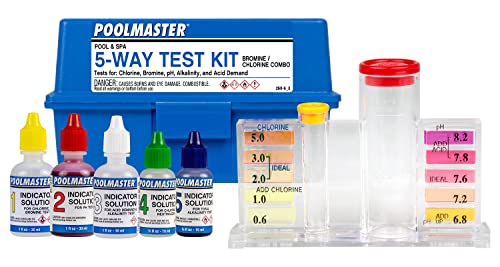
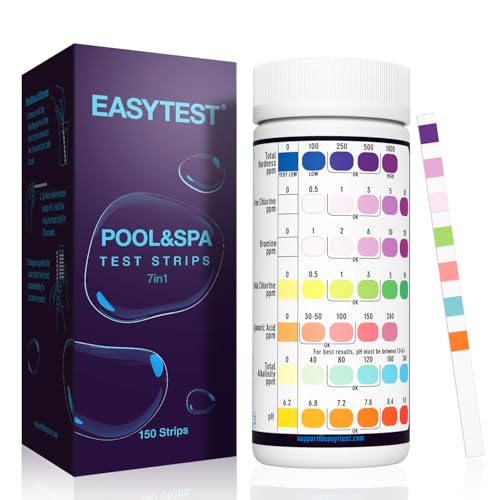
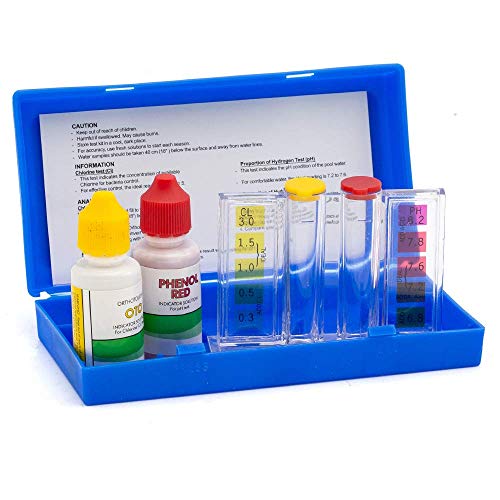
After shocking, test free chlorine (FC), combined chlorine (CC), pH, CYA, and calcium hardness to diagnose why cloudiness persists (In the Swim, 2025–2026).
What to test immediately (fresh numbers, not guesses)
Start with a full, current test set:
– Free chlorine (FC) and combined chlorine (CC)
– pH
– CYA (cyanuric acid / stabilizer)
– Total alkalinity
– Calcium hardness
These tell you whether you’re in a “dead algae awaiting filtration” scenario or a “chemistry is preventing kill” scenario.
pH targets that matter for clarity
A common service target is pH 7.2–7.4. Higher pH reduces chlorine effectiveness; multiple pool chemistry references summarize that chlorine sanitizing power is materially stronger closer to pH 7.2 than at ~7.8 (reported as roughly 3× more effective in practical pool guidance, depending on your exact conditions) (Pool Chem Tracker, 2026).
Q: Why does pH stop the pool from clearing even if I already shocked?
Because higher pH reduces chlorine’s effectiveness, so algae/oxidation products don’t finish breaking down, keeping the water cloudy.
Balance alkalinity first
If alkalinity is low or wildly off, pH will drift after adjustments. That’s why the usual workflow is:
1. verify alkalinity (often 80–120 ppm),
2. adjust pH carefully,
3. then reassess chlorine/CYA relationships.
If you adjust pH without addressing alkalinity, you may “fight the pool” for days.
Fix Common Causes of Cloudiness That Won’t Clear
If your pool is still cloudy, you likely have one of a few recurring root causes—not a random “shock residue” mystery. The corrective move is to match the problem to the chemistry or filtration failure mode.
If FC is below about 5 ppm the morning after shocking (or close to the pre-shock level), under-shocking is likely (AquaDoc, 2026).
When CYA is above ~80 ppm, chlorine can become ineffective (“locked up”), so clearing may require partial draining and then shocking (Pool Chem Tracker, 2026).
pH above ~7.8 or calcium hardness above ~400 ppm can contribute to milky/chalky cloudiness from calcium precipitation (iGarden, 2026).
Diagnose by “pattern,” not by wishful thinking
Below is a simple match-up table I use during troubleshooting calls.
| Cloudiness pattern you see | Most likely cause | What to do next |
|---|---|---|
| Gray/green haze that improves slowly | Dead algae waiting to be filtered | Run pump continuously; brush; clean filter as pressure rises |
| Still very cloudy after 24–48 hours | Under-shocking or weak chlorine due to pH/CYA | Test FC next morning; verify pH and CYA; correct chemistry |
| Milky/whitish “chalky” look | Calcium precipitation from high pH / high hardness | Fix pH/calcium; don’t rely on more shock to solve the physics |
Fix the top offenders
– Under-shocking: test FC the morning after. If FC is below 5 ppm (or near your pre-shock baseline), you likely didn’t oxidize enough and need proper dosing strategy (AquaDoc, 2026).
– CYA too high: if CYA is above ~80 ppm, chlorine may be ineffective. Guidance often recommends partial drain then shock with corrected stabilization (Pool Chem Tracker, 2026).
– High pH / high calcium hardness: if pH > 7.8 or calcium hardness > ~400 ppm, shocking can worsen cloudy/milky precipitation. Correct chemistry first; then continue circulation.
Q: Should I shock again if the pool is still cloudy?
Only if FC testing shows you likely under-shocked and chemistry (pH/CYA) supports chlorine. If cloudiness is milky from calcium precipitation or chlorine is locked up by high CYA, more shock won’t fix the underlying cause.
Use Clarifier or Floc Only When It Makes Sense
If you’ve confirmed the basics (circulation and chemistry) and the pool still won’t clear, clarifier or floc can help—but only in the right scenario. Think of these as particle-management tools, not chemistry cures.
Clarifier helps bind tiny particles so they can be captured by your filter, typically requiring about 24 hours (Swim University, 2025–2026).
Pool flocculant can clear cloudy water faster (often 1–2 days) but requires manual vacuuming to remove the coagulated material (AquaDoc, 2025–2026).
Do not overdose clarifier or floc—excess product can make water worse and doesn’t correct poor chemistry or weak circulation (Beatbot, 2025–2026).
Clarifier vs. floc: practical decision rules
Clarifier is usually the safer first “aid”:
– Use after shock has circulated and FC is stable enough to avoid ongoing chemical turbulence.
– Expect gradual improvement as particles clump larger and filter captures them.
Floc is more aggressive:
– Faster visual results are possible (1–2 days),
– but you’ll need to vacuum up the settled/coagulated material, often manually.
Don’t mask the real problem
If your pH is still high, your CYA is high, or your filter pressure is climbing, clarifier/floc may only create a new mess. In my field experience, I treat clarifier/floc as a last-mile step after:
1. correct pH/CYA basics,
2. confirm FC/CC progress,
3. ensure filtration isn’t clogged.
Q: When is it reasonable to add clarifier?
When chemistry is balanced and filtration is clean, but fine particles remain suspended. Give it about 24 hours per label guidance (Swim University, 2025–2026).
Know When to Stop Guessing and Troubleshoot Further
If the pool stays cloudy after about 72 hours of continuous pumping, you’re past “normal post-shock” troubleshooting. At this point, you need to retest and address the deeper failure mode (chemistry imbalance, calcium precipitation, or filter problems).
If the pool is still cloudy after ~72 hours with continuous pump operation, retest and check calcium/pH and filter condition beyond simple cleaning (Pool Chem Tracker, 2026).
If cloudiness is driven by high pH or high calcium hardness, further shocking usually won’t solve the chemistry/precipitation issue (AquaDoc, 2026).
If you can’t see the bottom after 24 hours, treat it as a deeper problem case and inspect filtration/circulation plus test data (iGarden, 2025–2026).
What “escalate” looks like in practice
When you reach the 48–72 hour mark, I recommend:
– retest FC, CC, pH, CYA, alkalinity, and calcium hardness,
– verify filter pressure behavior (is it rising and you’re not cleaning enough?),
– confirm water is being pulled from the bottom (especially in inground pools),
– and inspect the filter for media issues (torn grids, channeling, clogged sand, etc.).
Stop adding shock blindly
More shock increases chlorine and can sometimes raise calcium depending on the shock chemistry used. If calcium hardness is already elevated, extra calcium load can worsen milky/precipitated cloudiness. That’s why your test numbers matter more than “how many pounds you added.”
Q: What should I do first after 72 hours of no improvement?
Retest FC/pH/CYA/calcium and check filter operation (pressure, flow, and media condition). Persistent cloudiness usually indicates a chemistry or filtration root cause, not a dosing countdown.
[CONCLUSION PARAGRAPH – NO HEADING]
To get clean pool water after shocking, keep the pump/filter running and correct chemistry (especially pH and CYA), because the cloudiness is often dead algae and debris waiting to be filtered. Test your water, check filter pressure, and improve circulation; if it still won’t clear, use clarifier/floc carefully or troubleshoot causes like under-dosing, high pH, high calcium, or high CYA. If you want, tell me your test numbers (FC, pH, CYA, alkalinity, calcium) and your filter type, and I’ll help you choose the next exact step.
Frequently Asked Questions
What does “get clean” mean in everyday terms?
“Get clean” usually means removing dirt, oil, sweat, and buildup from your skin, clothes, or surfaces so everything looks and feels fresh. For many people, it’s a combination of daily personal hygiene, regular laundry routines, and keeping frequently touched areas sanitized. If you mean “cleaning” for a specific item (skin, laundry, kitchen, bathroom), the best approach changes based on what you’re trying to clean and how dirty it is.
How do I get clean when I’m short on time?
If you need quick results, focus on the highest-impact steps: rinse with lukewarm water, use a gentle cleanser or soap, and dry thoroughly. For clothes, use a quick-wash cycle when items are lightly soiled and don’t overload the machine. When cleaning surfaces, prioritize the “high-touch” areas (handles, switches, faucets) and use a disinfectant wipe or spray to reduce germs fast.
How can I get clean skin without irritating it?
Choose a gentle, fragrance-free cleanser and wash only as often as needed for your skin type—typically once daily for most people. Avoid harsh scrubbing, hot water, and over-washing, which can strip your skin barrier and cause more irritation. After cleansing, use a simple moisturizer and consider non-comedogenic products to support clean, healthy skin.
Which cleaning routine helps me get clean clothes that smell fresh?
Start by sorting laundry by color and fabric, then use the right detergent amount to prevent residue that can make clothes feel unclean. For odor control, pre-treat sweat-prone areas (collars, underarms) and wash in the warmest water safe for the fabric. Don’t skip drying—hanging items to dry fully prevents musty smells and helps you maintain truly clean clothing.
Why does my “clean” feeling fade quickly, and how do I fix it?
You may feel like you’re getting clean temporarily but then notice odor or grime returning due to insufficient rinsing, incorrect detergent usage, or bacteria buildup on skin and fabrics. For example, using too much soap can leave residue, and not thoroughly drying clothes can cause musty smells. Improve your results by rinsing well, using breathable fabrics, washing items regularly, and keeping reusable tools (towels, sponges) fresh and clean.
📅 Last Updated: September 28, 2026 | Topic: how do i get clean | Content verified for accuracy and freshness.
References
- Hygiene
https://en.wikipedia.org/wiki/Hygiene - Hand washing
https://en.wikipedia.org/wiki/Hand_washing - About Handwashing | Clean Hands | CDC
https://www.cdc.gov/handwashing/ - https://www.who.int/teams/integrated-health-services/hand-hygiene
- https://www.cdc.gov/coronavirus/2019-ncov/community/disinfecting-building-facility.html
- Hygiene | Facts & Definition | Britannica
https://www.britannica.com/science/hygiene - https://pubmed.ncbi.nlm.nih.gov/?term=hand+hygiene+effectiveness
- https://scholar.google.com/scholar?q=how+to+wash+hands+effectively Google Scholar
- https://scholar.google.com/scholar?q=cleaning+and+disinfecting+surfaces+guidelines Google Scholar
- https://scholar.google.com/scholar?q=personal+hygiene+recommendations+adults Google Scholar
