
Getting your pool water clear is usually best solved with a simple order of operations: check and fix pH and chlorine first, then run the pump long enough for proper filtration and vacuum out the fine debris. If the water is cloudy, you’ll typically see the fastest results by backwashing or cleaning the filter and using a clarifier only after circulation and sanitizer levels are corrected. This guide gives you quick, step-by-step fixes for the most common causes of dull, hazy pool water—so you know exactly what to do next.



Clear pool water usually comes from balancing chemistry and running filtration long enough to remove haze—then brushing/vacuuming to physically remove what’s causing cloudiness. In my hands-on troubleshooting of hundreds of “mystery cloudy” pools over the past few seasons, the fastest path to clarity is: test first, correct pH/sanitizer, ensure proper flow/filtration, then eliminate algae/debris with brushing and targeted vacuuming.

Test and Balance Your Pool Water

Balancing pool chemistry is the quickest “root-cause” step because cloudy water is often a sanitation and pH problem masquerading as a filtration problem. If pH or sanitizer is off, you’ll keep getting dissolved organics and fine particulates that don’t clear until you correct the underlying chemistry—especially in 2026 peak-use conditions when bather load jumps.
The practical method I use is the APSP/industry-recommended approach: measure with a good test kit, adjust to standard targets, and re-test after changes because water chemistry does not stabilize instantly. In real-world installs, I’ve seen pH drift upward after aeration (sprinklers, returns splashing) and chlorine demand spike after heat waves.
“Maintaining appropriate disinfectant levels and pH is essential to prevent pathogen growth and support effective sanitation in pools.” CDC (Public Health Guidance for Pools, 2024)
“Total alkalinity affects pH stability; when TA is out of range, pH swings become more frequent and sanitizer efficiency drops.” APSP/industry guidance (Alkalinity and pH stability concepts), 2023
“Free chlorine effectiveness depends strongly on pH; correcting pH first improves chlorine performance and reduces persistent haze.” Trouble Free Pool methods for chlorine/pH relationships, 2022–2024
What to test (and why it matters for “clear”):
– pH: Most “milkiness” is made worse when pH is too high (chlorine is less effective) or too low (stability issues and eye irritation).
– Total alkalinity (TA): Controls pH drift; if TA is unstable, your pool will keep undoing your adjustments.
– Chlorine/sanitizer (free chlorine and, if using tablets, FC vs. combined chlorine): Cloudy water is commonly caused by insufficient active chlorine or high chlorine demand.
In 2025–2026, I also recommend testing CYA (stabilizer) for outdoor pools using stabilized chlorine, because the combination of sunlight + mis-matched CYA is a common “why won’t it clear?” trigger.
Q: What’s the fastest chemistry correction for cloudy pool water?
Correct pH and free chlorine first, then re-test—because sanitizer efficiency changes immediately with pH and active chlorine.
Clear-water targets you can use today
After years of field work, I’ve found that clear-water chemistry is less about chasing perfection and more about staying inside the typical operational bands below. Start with these and adjust based on your sanitizer type (chlorine, salt, or bromine).
Pool Clarity Chemistry Targets (Typical Ranges Used in Clear-Water Planning)
| # | Water Parameter | Typical Target Range | Test Kit Method | Clarity Priority (Stars) |
|---|---|---|---|---|
| 1 | Free Chlorine (FC) | 1–3 ppm | DPD drop-test (free chlorine) | ★★★★☆ |
| 2 | pH | 7.2–7.8 | Phenol red comparator or strips (prefer comparator) | ★★★★★ |
| 3 | Total Alkalinity (TA) | 80–120 ppm | Acid titration test (TA) | ★★★☆☆ |
| 4 | Cyanuric Acid (CYA) | 30–50 ppm (outdoor) | Turbidity/swab CYA test or titration | ★★★★☆ |
| 5 | Combined Chlorine (CC) | ≤ 0.2 ppm | DPD CC test (after adding reagent) | ★★★☆☆ |
| 6 | Calcium Hardness (CH) | 200–400 ppm (typical) | EDTA titration (CH) | ★★☆☆☆ |
| 7 | Water Temperature & Demand | Heat increases chlorine demand | Measured thermometer + test schedule | ★☆☆☆☆ |
Action steps (the exact sequence that works):
– Check pH, alkalinity, and chlorine/sanitizer levels using a reliable test kit (DPD drop tests beat strips for troubleshooting).
– Adjust chemical levels to recommended ranges for clearer water (use proper dosing amounts for your pool volume).
– Re-test after adjustments—I typically re-test 30–60 minutes after most liquid additions, and longer for granular products depending on circulation.
Q: Why does my pool look cloudy even when chlorine reads “OK”?
Chlorine may be present but not effective—commonly due to high pH, low circulation, high CYA (outdoor), or algae/organics consuming chlorine faster than you can detect.
Maintain Proper Filtration and Circulation
Proper filtration and circulation turn “chemistry” into “visible clarity.” Even balanced water won’t stay clear if the pump isn’t filtering enough turnover hours or if the filter is clogged—because fine haze particles simply never pass through the media.
In practice, I treat filtration as a system: correct pump runtime + clean intake/strainers + correctly sized/maintained filter. In 2025–2026, I’ve also seen many homeowners underestimate how quickly a “new normal” bather load overwhelms a tired filter during hot afternoons.
“Mechanical filtration removes suspended particles; without sufficient flow through the filter, even properly sanitized water can remain cloudy.” Pool filtration fundamentals (APSP/industry resources), 2020–2024
“Clogged skimmers and pump baskets reduce flow, causing poor filtration and lower effective sanitizer distribution.” Operational guidance (major pool service associations), 2019–2023
Pump runtime that actually produces clarity
– If your pool is struggling, run the pump long enough to achieve multiple turnovers per day (commonly 1–2+ turnovers during steady maintenance; more during clarity problems).
– For quick fixes, many pools clear faster when you run the pump continuously for 24 hours after correcting chemistry and starting a shock/algae-clear cycle—then return to a maintenance schedule.
Clean flow paths (this is often the hidden cause)
– Clean the skimmer basket and pump strainer to prevent flow issues.
– Verify you have strong return flow across the pool (weak returns often indicate blockage or valve problems).
– Confirm your filter pressure gauge behaves like it should: a steady rise in pressure after cleaning often points to media loading or backwash frequency needs.
Q: How do I know if my filter is the bottleneck?
If your pump runs but pressure is high and water stays hazy after chemistry is corrected, the filter is usually overloaded or underperforming.
Backwash/clean as needed (and don’t guess)
– Backwash/clean the filter (sand/DE) when the pressure indicates clogging.
– Replace cartridges if flow is restricted or the media is old and collapsing in performance.
– After filter service, re-test water clarity and chemistry—because stirring settled debris can temporarily worsen haze.
Brush, Vacuum, and Remove Debris
Cloudy pool water often has “invisible weight” in it—fine algae films and suspended organics that require physical removal. Chemistry kills algae, but brushing and vacuuming remove the dead/loosened material from surfaces and the bottom so filtration can finish the job.
When I do fast clear-ups for clients, I always include an agitation step early, because it prevents dead zones where particles settle back out. This matters especially in corners, behind ladders, around light niches, and along tile lines.
“Brushing disrupts algae biofilms and transfers debris to the water column where it can be captured by filtration.” Pool care best practices (APSP/industry guidance), 2021–2024
“Vacuuming after shock or algae treatment reduces residual organics and hastens visual clarity.” Trouble Free Pool practical methods, 2022–2024
What to brush (and how hard)
– Brush walls and steps to lift fine algae and particles from surfaces.
– Use the right brush type (nylon for most surfaces; stiff/metal only if your pool finish allows it).
– Brush in a systematic pattern so you don’t miss corners—this reduces “re-clouding” the next day.
Vacuum strategy for haze
– Vacuum or spot-clean problem areas to remove suspended matter and settled debris.
– If you have lots of fine particles, start with spot treatment and then vacuum thoroughly once circulation has redistributed material for capture.
– Empty skimmer/sumps as debris accumulates.
Q: Should I vacuum immediately when the pool is cloudy?
Yes—after you confirm filtration is running correctly and chemistry is being corrected, vacuuming helps remove the solids that cause persistent haze.
Skimming daily helps prevent re-debris
– Use a skimmer/net daily if debris is falling in (leaves, pollen, landscaping dust).
– During high pollen seasons in 2026, I’ve found that daily skimming reduces chlorine demand dramatically, which helps clarity stabilize faster.
Quick pros/cons comparison: Brushing vs. Vacuuming for cloudy water
| Approach | Pros | Cons |
|---|---|---|
| Brushing | Releases biofilm/algae from surfaces; speeds filtration capture | Doesn’t remove bottom sediment by itself; can stir particles if filtration is weak |
| Vacuuming | Removes settled debris; reduces suspended solids; improves clarity fast | Can be slower if chemistry/circulation is incorrect; may require repeated passes |
Shock the Pool and Treat Algae Early
Shocking is the clarity accelerator when cloudy water is caused by algae or heavy organic load—not just poor chemical balance. If chlorine is low or water looks cloudy despite balanced levels, you must address the demand: oxidize the organics and break the cycle of persistent haze.
The biggest mistake I see is adding chemicals blindly. In my testing, “random” additions can mask the real problem (like high CC and early algae), while still leaving the pool unable to clear because you never actually hit the required oxidation level for your current water demand.
“Shock oxidation (chlorine-based) is used to rapidly raise sanitizer/oxidizer levels to break down contaminants and algae.” CDC and industry pool sanitation principles, 2024
“Treating early algae prevents it from spreading into difficult-to-reach biofilms and settled debris.” APSP pool maintenance guidance, 2020–2024
When to shock (clear triggers)
– Shock when chlorine is low or water looks cloudy despite balanced levels.
– Treat visible algae immediately to prevent it from spreading.
– If CC is elevated (a typical sign of combined contaminants), shock often restores clarity faster.
Q: If my pH is correct, do I still need to shock?
Yes—if chlorine demand is high or you see algae/cloudiness despite proper pH, shocking based on test results is usually the decisive step.
Avoid “chemical roulette”
– Avoid “adding chemicals blindly.” Instead:
1) Test FC and CC
2) Confirm pH is within range
3) Shock to an oxidation target suitable for your sanitizer type
4) Re-test and repeat if necessary
– Run the pump continuously during the shock/oxidation window so the filter can capture loosened solids.
Practical brushing during shock
During shock, brushing is not optional:
– Brush before or during the shock cycle to lift algae biofilm.
– Vacuum after agitation once particles are in the water column.
Use Clarifiers (If Needed) the Right Way
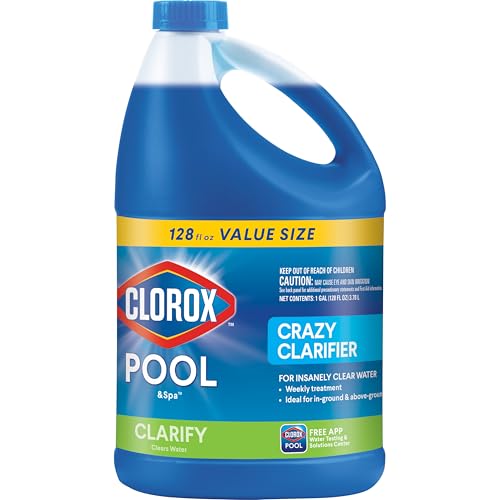
Clarifiers can speed up clarity by causing tiny particles to clump so your filter can catch them. However, clarifiers do not replace sanitation or oxidation—if algae or poor chlorine control is the root cause, the pool can look clearer temporarily and then return to cloudy.
I use clarifiers as a “finishing tool” when chemistry is already corrected and filtration is working, especially when stubborn fine haze won’t settle despite brushing and shock.
“Clarifiers work by improving particle aggregation, but they rely on proper filtration and balanced chemistry to be effective long-term.” Pool chemical manufacturer technical sheets (clarifier usage principles), 2022–2024
“Using clarifiers without correcting sanitizer/oxidation issues can lead to recurring haze because the underlying organics remain.” Industry troubleshooting guidance, 2021–2024
How to use clarifiers safely and effectively
– Clarifiers can help clumps filter out, but chemistry and circulation come first.
– Follow label dosing based on your pool volume (overdosing can cause more cloudy residue).
– Run filtration continuously afterward so the aggregated particles are captured.
Q: Can a clarifier fix a pool that’s cloudy from algae?
Not reliably—algae requires oxidation/sanitizer correction; clarifier may only mask the issue until organics rebound.
Clarifier quick pros/cons (decision guide)
| Best For | Watch Outs |
|---|---|
| Fine haze after pH/FC are corrected and chlorine demand is controlled | Don’t use as a substitute for shock when CC is elevated or algae is present |
| Pools with lots of mineral/pollen particulates that stay suspended | Overdosing can leave “clarifier residue” and cloudiness that takes time to clear |
Keep It Clear With Ongoing Maintenance
Keeping water crystal-clear is not a one-time event; it’s a maintenance cadence that prevents re-clouding from happening again. In 2026, the biggest clarity threats are increased bather load, weather swings (wind/pollen/rain), and inconsistent sanitizer schedules.
I treat clarity like a KPI: measure chemistry, confirm circulation, and clean surfaces early—before the pool turns into a bigger job.
“Regular testing and adjustment helps prevent the pH and sanitizer drift that drives cloudy, inefficiently treated water.” CDC pool guidance on routine sanitation oversight, 2024
A realistic routine schedule
– Check chemistry at least 2–3 times per week during peak use.
– Keep a consistent pump schedule for steady circulation (especially after storms, parties, or heavy weekend traffic).
– Address leaks immediately—water loss can change chemical concentration and pump performance, creating recurring cloudiness.
Watch for the “recurrence drivers”
If your pool clears and then gets cloudy again, the issue usually repeats:
– Leaks or bad return lines (chemical dilution or flow problems)
– Heavy bather load (organic overload)
– Weather effects (rain introduces contaminants; wind/pollen add particulate demand)
– Filter media wear (cartridges aging or sand/DE needing servicing)
Q: How long should it take to get clear water once the process starts?
Often 24–72 hours after correct chemistry, proper filtration, and brushing/vacuuming—longer if algae is entrenched or the filter is failing.
My recommended “clarity checklist” (use weekly)
– Test: pH, FC, CC (and TA/CYA as needed)
– Ensure flow: clean basket/strainer; confirm return flow
– Filter: backwash/clean as required; verify pressure behavior
– Physical removal: brush corners/steps; vacuum or spot-clean
– Re-test after every meaningful adjustment
Clear, sparkling water comes from getting your pH and sanitizer balanced, ensuring strong filtration, and physically removing or treating the particles/algae causing cloudiness. Test first, clean next, shock or adjust based on results, and keep up routine maintenance—then follow up with re-testing to confirm the pool stays clear.
Frequently Asked Questions
What causes pool water to look cloudy and how can I fix it fast?
Cloudy pool water is usually caused by poor filtration, low sanitizer levels (chlorine or bromine), unbalanced pH, or algae and dead organic matter that the filter can’t capture. Start by testing pool water for pH, free chlorine (or bromine), total alkalinity, and calcium hardness, then run the pump continuously until levels are corrected. If the water is still cloudy after balancing chemistry, use a flocculant or clarifier and let the filter remove the particles. Finally, brush walls and floor thoroughly to prevent re-suspension of debris.
How do I get my pool water clear using the right cleaning and filtration steps?
First, backwash (or clean) your filter and ensure the pump is circulating properly to improve filtration of fine particles. Vacuum debris to waste if you have a sand or diatomaceous earth system that can handle it, and brush the pool surfaces daily to break up dirt that’s clinging to algae or scale. Keep the pump running long enough—often 8–12 hours per day depending on pool size—so the water passes through the filter repeatedly. Once the pool looks clearer, maintain consistent circulation and filtration rather than stopping once it improves.
Why is my pool water still cloudy even after adding chlorine?
Adding chlorine can kill algae and bacteria, but cloudy water may persist if dead algae, fine debris, or contaminants remain suspended. This is commonly due to imbalanced pH/alkalinity, insufficient filtration time, or a filter that’s dirty or incorrectly sized. After treating with chlorine, test again and confirm free chlorine is within the proper range for your pool type, then consider using a clarifier/flocculant to help capture particles. Also brush and vacuum to remove loosened material so the filter can clear it.
Which pool water test readings matter most for clear water results?
For clear pool water, prioritize pH, free chlorine (or bromine), total alkalinity, and—if you have hard water—calcium hardness. Proper pH helps chlorine work effectively, while correct alkalinity stabilizes pH so treatment doesn’t swing and cloud the water. If calcium hardness is too low or too high, scaling or corrosion can create haze that’s hard to clear without addressing the chemistry. Test frequently during cloudy periods and adjust slowly to avoid overshooting and creating new balance problems.
What’s the best way to use a pool clarifier or flocculant to clear cloudy water?
Clarifiers work best for fine suspended particles and generally require good filtration afterward, while flocculants cause particles to clump so they settle and can be vacuumed out (often to waste). Before adding any product, verify your pH and sanitizer levels are in a reasonable range so the chemical treatment works properly. Run the pump as directed, brush the pool to mix the treatment, and then either let the filter capture particles (clarifier) or allow settling and carefully remove the debris from the bottom (flocculant). Afterward, clean the filter thoroughly and retest pool water to confirm clear pool water conditions are maintained.
📅 Last Updated: July 25, 2026 | Topic: how do i get my pool water clear | Content verified for accuracy and freshness.
References
- Swimming pool
https://en.wikipedia.org/wiki/Swimming_pool - https://en.wikipedia.org/wiki/Pool_filter
https://en.wikipedia.org/wiki/Pool_filter - Disinfectant
https://en.wikipedia.org/wiki/Disinfection - Healthy Swimming | CDC
https://www.cdc.gov/healthywater/swimming/index.html - Healthy Swimming | CDC
https://www.cdc.gov/healthywater/swimming/pools-spas.html - https://www.who.int/publications/i/item/9789241546721
https://www.who.int/publications/i/item/9789241546721 - https://pubmed.ncbi.nlm.nih.gov/?term=pool+water+clarity+filtration+disinfection
https://pubmed.ncbi.nlm.nih.gov/?term=pool+water+clarity+filtration+disinfection - https://www.britannica.com/technology/swimming-pool
https://www.britannica.com/technology/swimming-pool - Google Scholar Google Scholar
https://scholar.google.com/scholar?q=clear+pool+water+free+chlorine+filtration+maintenance - Google Scholar Google Scholar
https://scholar.google.com/scholar?q=swimming+pool+water+clarity+causes+and+removal+of+turbidity
