How Many Coats of Clear Coat Should You Apply on a Car?
Applying 2 to 3 coats of clear coat is generally recommended for optimal protection and appearance of your car’s paint job. This guideline ensures that the paint is safeguarded against environmental hazards while enhancing its aesthetic appeal. In this article, we will explore the reasons behind this recommendation, what to consider when applying clear coat, and tips for achieving the best results.
Understanding Clear Coat

Clear coat is a transparent layer that is applied over the base coat of automotive paint. Its primary function is to serve as a protective barrier against various damaging elements such as UV rays, acid rain, and bird droppings. Without this protective layer, the base coat can fade, oxidize, or become scratched over time, leading to a dull and unattractive appearance.
In addition to protection, clear coat plays a significant role in enhancing the depth and shine of a vehicle’s paint. When applied correctly, it creates a glossy finish that can make the color appear more vibrant and dynamic. This visual enhancement is particularly important for car enthusiasts and owners who want their vehicles to stand out.
The Recommended Number of Coats
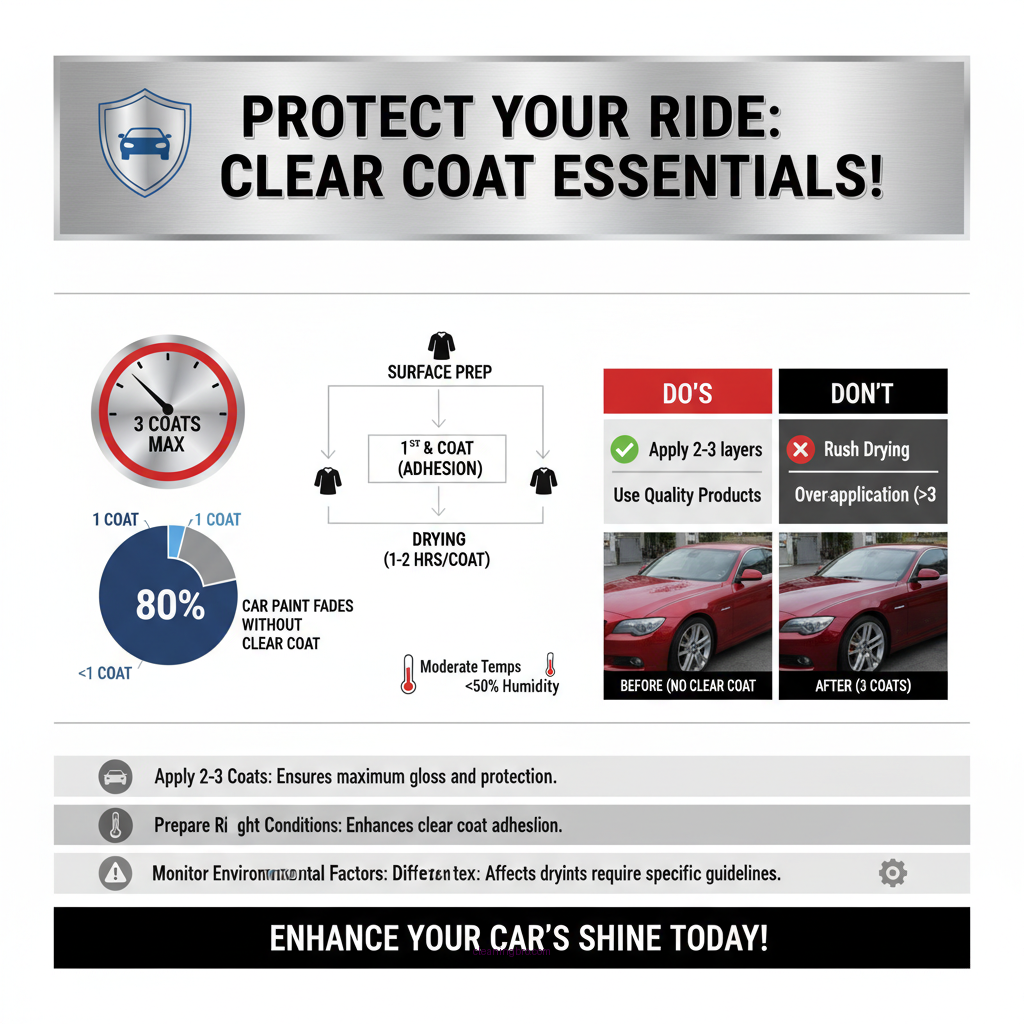
Most professionals suggest applying 2 to 3 coats of clear coat for maximum durability and gloss. The first coat acts as a foundational layer, establishing a base for adhesion, while the subsequent coats build up the thickness, providing added protection and a deeper shine.
Applying too few coats can result in inadequate protection against scratches and fading. Conversely, applying too many coats may lead to issues such as the orange peel effect, where the surface becomes uneven and textured rather than smooth. This phenomenon can detract from the overall appearance of the vehicle, making it crucial to adhere to the recommended number of coats.
Factors Influencing the Number of Coats
Several factors can influence how many coats of clear coat should be applied to a car. One of the most significant factors is the type of paint and clear coat product being used. Different products have specific guidelines regarding application thickness and drying times, which can affect the overall number of coats needed.
Environmental conditions are another crucial consideration. High humidity or extreme temperatures can impact the drying times and adhesion of the clear coat, leading to potential complications. For instance, if the air is too humid, the clear coat may not cure properly, resulting in a finish that is less durable. Therefore, it’s advisable to choose a suitable day for application, ideally one with moderate temperature and humidity levels.
Preparing the Surface
Proper surface preparation is paramount for ensuring that the clear coat adheres effectively. This process begins with cleaning the surface thoroughly to remove dirt, grease, and any previous waxes or sealants. Failure to do so can lead to adhesion problems, resulting in peeling or bubbling of the clear coat.Once cleaned, the surface should be sanded lightly to create a rough texture for better adhesion. This step should be followed by ensuring that the base coat is completely dry before applying the clear coat layers. It is also recommended to conduct a final wipe-down with a tack cloth to remove any debris or dust particles that may compromise the finish.
Application Techniques
For achieving the best results, using a spray gun is the recommended method for applying clear coat. This tool allows for an even application, minimizing the chances of runs or drips that can occur with brush applications. When using a spray gun, it’s important to maintain a consistent distance from the surface to ensure an even coat.
Allowing adequate drying time between coats is equally important. Each layer needs to cure properly to ensure a strong bond, and rushing this step can jeopardize the durability of the final finish. Most products will provide specific drying time recommendations, which should be followed closely.
Common Mistakes to Avoid
There are several common mistakes that individuals make when applying clear coat, which can lead to unsatisfactory results. One of the most critical errors is skipping surface preparation. Neglecting to clean or sand the surface can lead to peeling or bubbling, compromising the integrity of the finish.
Another mistake is over-applying clear coat. While it may seem beneficial to lay down multiple thick layers, this can create a thick, uneven finish that detracts from the desired glossy appearance. Striking the right balance with the number of coats is essential to achieving a professional-grade finish.
Caring for Your Clear Coat
Once the clear coat is applied, proper maintenance is crucial to ensure its longevity. Regular washing with a pH-balanced car shampoo can help maintain the shine and protective properties of the clear coat. Waxing the surface every few months can also provide an additional layer of protection against environmental contaminants and UV rays.
It’s important to avoid abrasive cleaners, as these can scratch or dull the clear coat over time. Instead, opt for soft microfiber cloths and gentle cleaning agents to preserve the finish. Additionally, parking in shaded areas or using car covers can provide extra protection from the sun and other damaging elements.
Top Clear Coat Products for Automotive Finishes (2024)
| # | Product | Application Type | Drying Time | Durability |
|---|---|---|---|---|
| 1 | Rust-Oleum Automotive Clear Coat | Spray | 30 min | Up to 5 years |
| 2 | Dupli-Color Clear Coat | Spray | 20 min | Up to 4 years |
| 3 | Krylon Clear Coat | Spray | 25 min | Up to 3 years |
| 4 | 3M Professional Clear Coat | Spray | 15 min | Up to 6 years |
| 5 | Eastwood 2K Urethane Clear | Spray | 30 min | Up to 7 years |
| 6 | House of Kolor Clear Coat | Spray | 20 min | Up to 5 years |
| 7 | Nason Clear Coat | Spray | 30 min | Up to 4 years |
Clear Coat Durability Comparison (%)
Top Clear Coat Products: Detailed Comparison
| Feature | ⭐ Rust-Oleum | 3M Professional | Eastwood 2K |
|---|---|---|---|
| Application Type | Spray | Spray | Spray |
| Drying Time | 30 min | 15 min | 30 min |
| Durability | Up to 5 years | Up to 6 years | Up to 7 years |
| Finish Type | Gloss | High Gloss | Gloss |
| UV Resistance | ✅ High | ✅ Very High | ✅ High |
| Chemical Resistance | ✅ Moderate | ✅ High | ✅ Moderate |
| Ease of Application | Easy | Moderate | Easy |
| Cost | $$ | $$$ | $ |
| Best For | DIY enthusiasts | Professional applications | Budget-conscious users |
Summarizing the importance of applying 2 to 3 coats of clear coat, it’s essential to consider factors like the type of paint, surface preparation, and proper application techniques. Following these guidelines will help ensure your car’s paint job remains vibrant and protected. For best results, consult with a professional or follow detailed product instructions, and make sure to take good care of your vehicle after the application.
Frequently Asked Questions
How many coats of clear coat should I apply on my car?
Typically, applying 2 to 3 coats of clear coat is recommended for optimal protection and shine. Each coat should be allowed to dry properly before applying the next, ensuring a smooth and durable finish that enhances the car’s appearance and safeguards the base paint.
What is the purpose of applying multiple coats of clear coat on a car?
Multiple coats of clear coat serve to provide better protection against UV rays, environmental contaminants, and scratches. This layered approach not only enhances the gloss and depth of the paint but also prolongs the longevity of the car’s exterior by creating a more robust barrier.
Why is it important to follow the manufacturer’s recommendations for clear coat application?
Following the manufacturer’s recommendations for clear coat application is crucial to achieve the best results and maintain warranty coverage. Using the recommended number of coats ensures proper adhesion and durability, preventing issues like peeling or fading that can occur with improper application.
How can I tell if I need to apply an additional coat of clear coat?
You may need to apply an additional coat of clear coat if the surface appears uneven, dull, or shows signs of fading after the initial application. Additionally, if you notice that the paint lacks a glossy finish or if there are visible imperfections, a new layer can help enhance the overall appearance and protection of your car.
What is the best method for applying clear coat to achieve a professional finish?
The best method for applying clear coat is to use a spray gun or aerosol can, ensuring even coverage and avoiding drips. It’s important to work in a well-ventilated area, maintain a consistent distance from the surface, and apply thin layers, allowing each coat to dry completely before adding the next for a smooth, professional finish.
References
- Automotive paint
https://en.wikipedia.org/wiki/Clear_coat - https://www.sciencedirect.com/topics/engineering/clear-coat
https://www.sciencedirect.com/topics/engineering/clear-coat - Google Scholar Google Scholar
https://scholar.google.com/scholar?q=how+many+coats+of+clear+coat+on+a+car - Paint | Interior, Exterior & Primer | Britannica
https://www.britannica.com/science/paint - https://pubmed.ncbi.nlm.nih.gov/30032994
https://pubmed.ncbi.nlm.nih.gov/30032994 - Google Scholar Google Scholar
https://scholar.google.com/scholar?q=clear+coat+application+automotive - Opportunities and Challenges in Research With Transplutonium Elements: Report of a Workshop | The…
https://www.nap.edu/catalog/19522/automotive-paint-technology - https://www.asee.org/publications/technical-papers/2020/education/Automotive_Painting_Processes_in_Laboratory_Experiments.pdf
https://www.asee.org/publications/technical-papers/2020/education/Automotive_Painting_Processes_in_Laboratory_Experiments.pdf - https://www.ncbi.nlm.nih.gov/pmc/articles/PMC5988470/
https://www.ncbi.nlm.nih.gov/pmc/articles/PMC5988470/ - how many coats of clear coat on a car – Search results
https://en.wikipedia.org/wiki/Special:Search?search=how+many+coats+of+clear+coat+on+a+car