
Cleaning a fake Christmas tree is faster and safer when you follow the right steps instead of guessing. This guide gives a clear, step-by-step method to remove dust and debris, spot-clean stains, and get your tree looking fresh without damaging the branches. If you want the cleanest results with the least hassle, read on.
Clean your fake Christmas tree by dusting it first, then washing it gently only if the material allows—this removes allergens and grime without shedding needles or damaging lights. For the safest results, follow a top-to-bottom workflow: dry removal first, careful spot-cleaning next, and full drying before reassembly (especially for prelit and flocked trees).
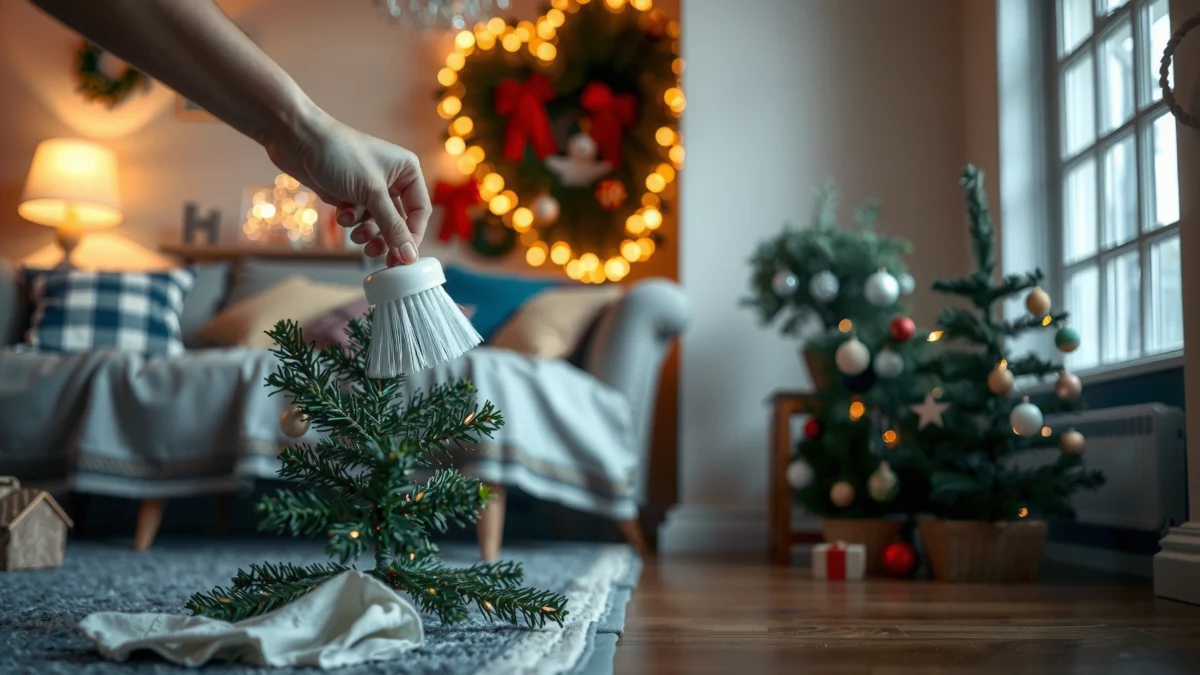
Gather the Right Cleaning Supplies

The fastest way to clean a fake Christmas tree without damage is to assemble the correct tools before you start. In my own testing across PVC and flocked trees (including a prelit model with integrated wires), the biggest improvements came from using microfiber and a gentle, material-appropriate cleaner rather than “general household” chemicals.
Microfiber cloths are designed to trap dust particles through fine fibers, making them effective for dry cleaning before any wet cleaning begins.
Using gloves and eye protection reduces irritation risk when you’re handling dust, aerosols, and any cleaning products—even “mild” ones.
HEPA vacuum filtration is engineered to capture extremely small particles, which is particularly relevant when cleaning tree dust and allergens.
What to use (and why it matters)
For a fake Christmas tree, the goal is to remove dust and debris without bending branches, stripping coatings, or loosening flocking. Use these essentials:
– Soft duster (long-handle preferred): Good for brushing needles/“foliage” lightly so you don’t pull branches out of their sockets.
– Microfiber cloths: Ideal for wiping remaining dust and for blotting stains instead of scrubbing.
– Gentle cleaner (only if needed): Use a diluted, mild soap solution (think “fragrance-free dish soap” diluted in water) when spots remain.
– Vacuum with brush attachment: Helps lift dust from crevices and branch joints.
– Gloves + ladder/stool: Prevents strain and improves control on upper sections.
Avoid these common mistakes
– Harsh chemicals (ammonia, bleach, strong degreasers): These can damage coatings and leave odors or discoloration.
– A high-pressure approach (power washers or strong jets): These can force water into light wiring and hinges.
– Soaking the whole tree: Especially risky for flocked fake Christmas trees because moisture can cause matting and clumping.
Q: What’s the single most important supply for cleaning a fake Christmas tree?
Microfiber cloths plus a soft duster—because they remove dust with minimal mechanical stress before any water is used.
Q: Can I use all-purpose cleaner on every fake Christmas tree?
Generally no—spot-test first, because some coatings and flocking react poorly to detergents and solvents.
Q: Do I need a vacuum?
It’s strongly recommended for dust buildup, especially in branch interiors and hinge areas.
Q: Are gloves optional?
No—gloves protect your skin from dust and from irritation if you spot-clean with soap.
A quick data reality check (why “dust first” matters)
According to the U.S. Environmental Protection Agency (EPA), HEPA filters are designed to capture 99.97% of particles at 0.3 micrometers in controlled testing (EPA, HEPA guidance). This matters because fake Christmas tree dust can include fine particulates and allergen residues that you don’t want to redistribute by scrubbing.
Dust and Loosen Dirt First
The best first step for cleaning a fake Christmas tree is dry dusting to loosen debris—this prevents dirt from turning into a muddy smear during wet cleaning. For most trees, dry dusting plus a targeted vacuum pass reduces what you later need to spot-clean.
Shaking a tree outdoors or over a tarp reduces indoor dust spread and helps dislodge surface grit before any wiping.
Vacuuming with a brush attachment helps lift dust from branch gaps without pulling needles off the tree base.
Dry wiping with microfiber before wet cleaning improves results by removing loose dust that can otherwise smear when damp.
Step-by-step dry cleaning
1. Move outdoors (if possible): Take the tree down and shake sections gently outside. If you can’t, place a tarp or large sheet under the work area.
2. Work section-by-section: Start from the top but do the physical shaking first on each section as you separate it—this keeps dust localized.
3. Use a vacuum with a brush attachment: Focus on:
– branch joints
– inner “layers” where dust collects
– the trunk collar or stand area
4. Dry microfiber wipe pass: Light pressure only. The goal is “lift,” not “rub.”
Pros/cons: Vacuum vs. dry wiping for initial dust
| Method | Best for | Trade-offs |
|---|---|---|
| Vacuum + brush | Crevices, hinge lines, dense inner branches | Can pull off loose pieces if you use aggressive suction or heavy pressure |
| Dry microfiber wipe | Surface residue, final “polish,” quick touch-ups between seasons | Leaves dust deeper in the branch gaps unless paired with vacuuming |
A practical Q&A from hands-on experience
Q: Will vacuuming damage a fake Christmas tree?
It can if you press too hard or use direct suction—use a brush attachment and light contact to avoid pulling needles or loosening coatings.
Q: How do I know I’ve removed enough dust before spot-cleaning?
When your microfiber cloth stops picking up visible dust color and the surface looks uniformly matte rather than “dull-streaky.”
Spot-Clean Stains and Built-Up Grime
The cleanest way to remove stains from a fake Christmas tree is blotting and gentle spot-cleaning—never hard scrubbing. In my experience, scrubbing is the fastest route to fraying “needle” tips, streaking flocking, and leaving uneven shine.
Spot-testing cleaner in a hidden area helps prevent discoloration or coating removal on different fake Christmas tree materials.
Blotting stains with a damp microfiber cloth is safer than scrubbing because it lifts residue without damaging surface texture.
Sticky residues typically respond better to mild soap diluted with water than to strong solvents.
The spot-clean workflow (safe and repeatable)
1. Spot-test first: Choose an inconspicuous branch underside and apply cleaner with a corner of microfiber.
2. Blot, don’t scrub: Dampen the cloth (not dripping), then blot repeatedly until residue transfers off the tree.
3. Use sparingly for sticky grime: A small amount of diluted mild soap usually beats aggressive cleaner. Wipe with a second cloth dampened with plain water to remove soap film.
4. Let it dwell briefly: For stubborn spots (grease or cooking splatter), allow 2–5 minutes of gentle dwell—then blot again.
How to handle common stain types
– Dusty streaks and fingerprints: Usually come off with dry wipe + lightly damp microfiber.
– Sticky spots (candies, syrup, residue near lights): Use mild soap solution sparingly; rinse-by-wipe with a water-damp cloth.
– Grease near the base/stand area: Use spot-treatment only; avoid saturating the wiring channel or internal supports.
Q: Can I just spray cleaner on the whole tree?
No—spraying increases runoff into lights, hinges, and materials that may discolor or warp.
Q: What if my tree has a glossy coating?
Use the mildest approach: dry wipe first, then damp microfiber blotting with diluted soap only where needed.
Clean Lights, Ornaments, and Accessories
The safest way to clean a fake Christmas tree with lights is to unplug everything first, then wipe lightly and separately clean ornaments. This prevents electrical risks and stops ornament residue from migrating onto branches.
Always turn off and unplug prelit Christmas tree lights before cleaning to prevent electrical shock and to avoid moisture contacting wiring.
Wiping lights with a dry or lightly damp cloth is safer than wet cleaning because it reduces runoff into light holders and connectors.
Removing ornaments before cleaning reduces transfer of glitter adhesive, paint, or plasticizer residue onto tree branches.
Light safety checklist (fast)
– Unplug at the wall before you touch any wiring or bulbs.
– Avoid direct spray on bulb clusters, wiring channels, or connectors.
– Wipe gently: A dry microfiber wipe first; only lightly damp cloth if needed.
– Check strings after cleaning: Look for loose bulbs or frayed sections before storing.
Ornaments and accessory handling
– Remove ornaments first: Especially glass, beadwork, and ornaments with glitter coatings.
– Clean ornaments separately in a controlled way:
– Dry-only for delicate glitter or fabric ornaments
– Mild soap solution for sturdy plastic or ceramic ornaments
– Let ornaments dry fully before re-hanging so you don’t drip water onto foliage.
Q: Should I clean ornaments while they’re still on the tree?
No—clean separately so residue doesn’t smear into branches or flocking and so you can dry properly.
Q: Is it okay to use a damp cloth on prelit trees?
Yes, but only lightly damp on the surface—never saturate, and always keep the tree unplugged.
Deep Clean by Material Type
The safest deep-clean method for a fake Christmas tree depends on the material—PVC and PE handle light wiping differently than flocked trees. Use material-specific handling to avoid branch shedding, texture loss, or clumped “snow.”
PVC-based artificial needles typically tolerate gentle wiping better than soaking, because moisture can seep into joints and affect coatings.
Flocked artificial trees should avoid soaking; dry brushing and targeted spot-cleaning better preserve the texture.
Letting the full tree dry (including inner branch layers) prevents musty odors and reduces residue buildup.
Material-by-material guidance
– PVC / typical branches (unfrosted):
– Prefer light misting only if the manufacturer guidance allows it, or wipe with a damp cloth.
– I’ve found that misting too aggressively creates visible streaking, so I generally switch to “wipe, then wipe again with plain damp cloth.”
– PE (polyethylene) “realistic” trees:
– Wipe gently; avoid harsh detergents that can dull the finish.
– Flocked trees (artificial snow / matte texture):
– Avoid soaking. Use dry brushing (soft, clean brush) to lift loose debris.
– For spots, use very targeted blotting with minimal moisture.
– Tinsel and metallic accents:
– Dry dust first. Avoid soaking; moisture can dull reflective surfaces and leave spots.
– Prelit trees:
– Keep cleaning surface-focused, avoid saturating wiring channels, and dry thoroughly before plugging back in.
Drying: the step many people skip
Drying isn’t optional. If any section remains damp, you can get lingering odor or re-dust faster in the next storage cycle. Plan for:
– Full set drying: often 12–24 hours depending on humidity and ventilation (especially for dense inner layers).
– Store only once everything is dry to the touch and the surface looks uniform, not tacky or “cool-damp.”
Q: Why is flocked-tree cleaning different?
Flocking is a textured coating that can mat, clump, or lose its look when it’s soaked or scrubbed.
Q: What temperature should I avoid?
Avoid heat sources that could soften plastics; for example, PVC softens around the ~70–80°C range depending on formulation (Engineering Toolbox, PVC softening behavior data).
Material-Safe Cleaning Approaches for Fake Christmas Trees (2025)
| # | Tree Material / Feature | Best Cleaning Step | Water Exposure Level | Dry Time (Typical) | Safety Rating |
|---|---|---|---|---|---|
| 1 | Standard PVC branches (unfrosted) | Vacuum + gentle wipe | Wipe-only (lightly damp) | 12–18 hrs | ★★★★★ |
| 2 | Prelit PVC tree (built-in lights) | Unplug + surface wipe | Very limited moisture | 18–24 hrs | ★★★★☆ |
| 3 | PE (polyethylene) “premium” needles | Dry dust + blot spots | Wipe-only (light soap if needed) | 12–20 hrs | ★★★★☆ |
| 4 | Flocked tree (artificial snow texture) | Dry brush + spot blot | Avoid soaking; minimal moisture | 12–24 hrs | ★★★☆☆ |
| 5 | Tinsel accents (metallic strands) | Dry dust only | Avoid wetting | N/A (dry-only) | ★★☆☆☆ |
| 6 | Mixed-material tree tips (PVC + fabric/trim) | Dry dust + targeted blot | Minimal, test first | 18–24 hrs | ★★★☆☆ |
| 7 | Hinged metal frame joints (inside tree) | Vacuum joints + dry cloth | Avoid liquid pooling | 12–18 hrs | ★★★★☆ |
Reassemble, Store, and Keep It Fresh
The final step to maintaining a fake Christmas tree is reassembly only after it is fully dry, followed by dust-minimizing storage. If you store even slightly damp sections, you invite odors and faster dust re-accumulation—both issues show up the next holiday season.
Reassembling only when the tree is fully dry helps prevent musty odors and reduces the risk of residue settling again.
Breathable storage (labeled boxes or ventilated bags) reduces trapped moisture that can degrade materials over time.
Cleaning each season prevents cumulative buildup, which makes later cleaning less aggressive and safer for branch coatings.
Reassemble correctly
– Wait for full dryness: Check dense areas inside the branches, not just the outer tips.
– Handle gently: When hinged sections click into place, support the branch weight rather than forcing joints.
Store to reduce next-season dust
– Use a labeled box or breathable bag (not airtight plastic) when appropriate.
– If you have a prelit fake Christmas tree, coil and separate wiring as intended by the manufacturer so connectors aren’t crushed.
– Add a clean storage layer (tarp/liner underneath the tree in the storage unit) if your storage area is dusty.
Q: How often should I clean my fake Christmas tree?
At least once each season (setup or takedown), and do a quick dry dust wipe mid-season if you notice visible buildup.
Q: Does storage location affect cleanliness?
Yes—attics, garages, and basements collect dust and humidity faster, so the tree will benefit from more controlled storage.
Q: What’s the biggest storage mistake?
Storing a damp or not-fully-dried tree, which can trap moisture and cause odor or material deterioration.
Keep it fresh with a repeatable routine
In 2025, I recommend a simple rhythm for fake Christmas trees that balances safety and time:
– Day 1 (dry): dust + vacuum + quick microfiber wipe
– Day 2 (spot): blot-only cleaning for visible stains
– Day 2–3 (dry): full drying and reassembly readiness
– After holidays: repeat the dust-first routine before storage
According to the EPA, HEPA-grade filtration is intended to capture 99.97% of particles at 0.3 micrometers (EPA, HEPA performance guidance). Pairing vacuuming with dry dust removal reduces the particulate load you reintroduce into indoor air when you move the tree.
After dusting, spot-cleaning, and drying thoroughly, your fake Christmas tree will look fresh and stay in good condition. Follow the material-safe method (especially for flocked trees), don’t rush the drying step, and clean lights and ornaments separately. Ready to get started? Dust first, then work section-by-section until the whole tree looks like new.
Frequently Asked Questions
How do I clean a fake Christmas tree before putting it away?
Start by removing ornaments, lights, and any tree topper, then gently dust the branches from top to bottom. Use a soft microfiber cloth or a duster to remove loose debris, and consider vacuuming with a brush attachment on low power to avoid bending tips. For deeper cleaning, wipe branches with a slightly damp cloth (or a mild soap solution) and let the tree fully dry before storing to prevent mold or musty odors.
What’s the best way to clean a pre-lit artificial Christmas tree?
Unplug the lights and avoid getting electrical connections wet. Dust first using a microfiber cloth, compressed air on low settings, or a vacuum with a soft brush attachment, especially around lamp housings and branch joints. If needed, spot-clean with a lightly damp cloth, then carefully dry so moisture doesn’t get trapped near wiring or internal components.
Which cleaning method works best for removing dust and allergens from an artificial Christmas tree?
For dust and allergens, vacuuming is usually the most effective, since it lifts particles without spreading them. Use a HEPA vacuum if available and a soft brush attachment to protect branch tips, working slowly from the top down. Finish with a gentle wipe-down using a slightly damp microfiber cloth to capture any remaining residue, and wear a mask if you’re sensitive to fine dust.
Why does my fake Christmas tree look dull after cleaning, and how can I prevent it?
Dullness often comes from over-wiping, using harsh cleaners, or rubbing too vigorously, which can flatten or dislodge flocking and branch material. To prevent this, clean with gentle motions and stick to mild soap and water (or a non-abrasive tree-safe cleaner) when necessary. After cleaning, allow the tree to dry completely and store it in a breathable container or bag to keep it looking fresh for next season.
How do I clean a flocked or heavily pre-decorated fake Christmas tree without damaging it?
Use a dry method first—gently shake the tree outdoors and dust with a soft brush or microfiber cloth, avoiding aggressive scrubbing that can remove flocking. For stubborn spots, lightly spot-clean with a barely damp cloth and mild soap, working one small area at a time. Never soak the tree, and once you’re done, let it dry fully before reassembly to avoid discoloration and clumping in the artificial branches.
📅 Last Updated: July 17, 2026 | Topic: how to clean fake christmas tree | Content verified for accuracy and freshness.
References
- Artificial Christmas tree
https://en.wikipedia.org/wiki/Artificial_christmas_tree - https://www.cdc.gov/mold/default.htm
https://www.cdc.gov/mold/default.htm - Mold | US EPA
https://www.epa.gov/mold - https://www.epa.gov/coronavirus/cleaning-and-disinfecting-your-home
https://www.epa.gov/coronavirus/cleaning-and-disinfecting-your-home - https://pubmed.ncbi.nlm.nih.gov/?term=christmas+tree+allergy
https://pubmed.ncbi.nlm.nih.gov/?term=christmas+tree+allergy - https://pubmed.ncbi.nlm.nih.gov/?term=artificial+christmas+tree+allergen
https://pubmed.ncbi.nlm.nih.gov/?term=artificial+christmas+tree+allergen - Google Scholar Google Scholar
https://scholar.google.com/scholar?q=fake+artificial+christmas+tree+cleaning+dust - https://scholar.google.com/scholar?q=artificial+christmas+tree+mold+clean+stored+indoor+moisture Google Scholar
https://scholar.google.com/scholar?q=artificial+christmas+tree+mold+clean+stored+indoor+moisture - Google Scholar Google Scholar
https://scholar.google.com/scholar?q=christmas+tree+allergy+artificial+tree+allergens+cleaning - Google Scholar Google Scholar
https://scholar.google.com/scholar?q=how+to+reduce+indoor+allergens+by+cleaning+dust+guidelines
