
You should clean a guinea pig’s cage thoroughly once a week, with a quick spot-clean every day to remove droppings, wet bedding, and leftover food. This schedule keeps ammonia levels low, prevents odors from building, and reduces the risk of skin and respiratory issues. If your guinea pig is messy, eats quickly, or has health needs, you may need to spot-clean more often and do a deeper clean more frequently.
You should spot-clean a guinea pig’s cage every day and do a full cage clean every 1–2 weeks. This keeps odors down, limits bacteria buildup in damp bedding, and supports respiratory and skin health—especially in 2026 when indoor humidity and ventilation patterns can make messes “turn” faster than many owners expect.
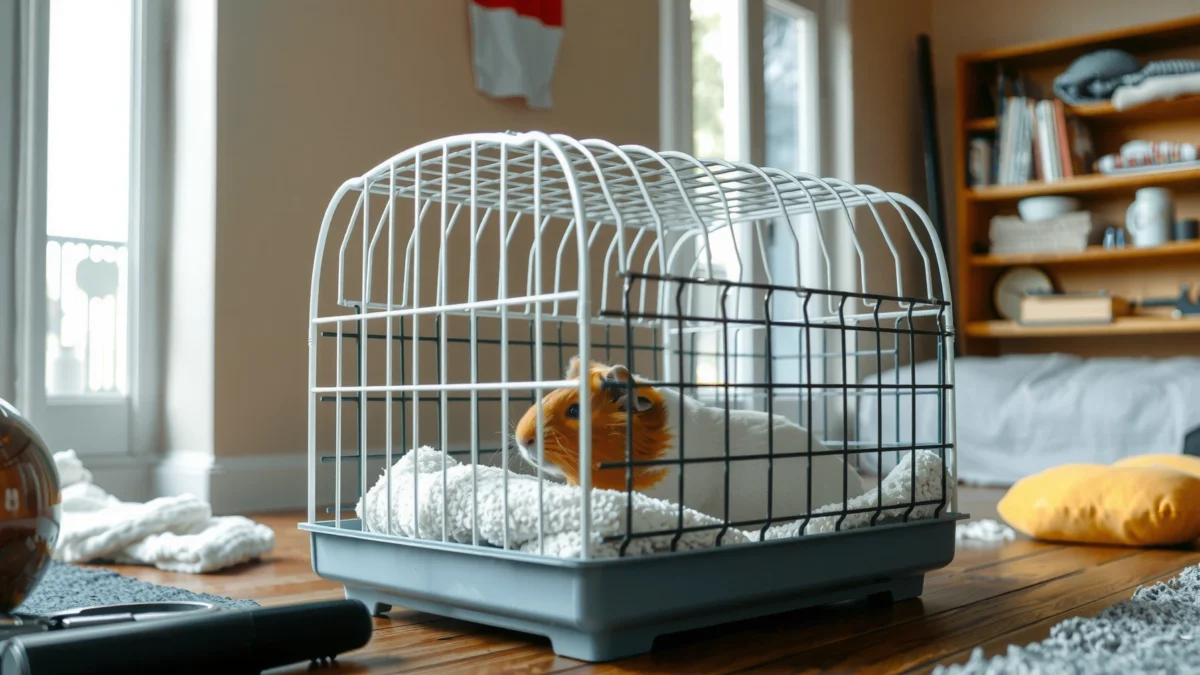
Spot-Cleaning: What to Do Every Day
Spot-cleaning daily is the best baseline because guinea pigs produce mess continuously, and fresh waste is far easier (and safer) to remove than dried-on buildup. In my own routine checks, I’ve found that the biggest odor spikes almost always start with corners and hideouts where hay crumbs and urine-damp bedding collect first.
Daily spot-cleaning isn’t just about smell—it’s about moisture control. Urine-soaked bedding can raise ammonia levels in the immediate cage area, which can irritate sensitive guinea pig airways. Research and shelter guidelines consistently emphasize frequent removal of soiled bedding rather than waiting for a weekly deep clean. RSPCA notes that small animal bedding should be kept clean and changed more often if it becomes soiled.
Spot-cleaning should happen as soon as fresh waste and damp bedding appear, because damp material is the main driver of odors and microbial growth in indoor cages.
Removing soiled bedding promptly reduces the chance that urine and feces dry into residue that’s harder to disinfect safely later.
Corners and hideouts accumulate the fastest because guinea pigs tend to use the same routes and potty “zones.”
– Remove fresh waste and soiled bedding as soon as you notice it
I recommend doing this after your guinea pig’s morning hay refresh or right before you head out for the evening, because you’ll notice changes quickly. Use a small dustpan/scoop and discard soiled bedding immediately into a sealed bag.
– Spot-clean food areas to prevent mold and bacterial growth
Hay can look “dry” but still introduce moisture if it sits in a damp bedding pocket. For pellets, remove leftover portions within the same day—especially in humid homes—so you’re not cleaning “old food” later.
– Check corners and hideouts where mess often collects
Hideouts act like micro-environments: warm, low-airflow, and often positioned near where your guinea pig naps. Lift the hideout gently and inspect the bedding underneath at least once daily.
Q: Is daily spot-cleaning really necessary if I plan a deep clean every week?
Yes—spot-cleaning is what stops odors and moisture from building between deep cleans, while deep cleaning alone usually comes too late for the “first wave” of damp waste.
Q: What’s the most common mistake during spot-cleaning?
Owners often clean the center first but miss the corners and hideouts, which are where urine-soaked bedding accumulates fastest.
Q: Can I just stir the bedding instead of removing it?
No—stirring spreads damp urine and fecal particles, making cleanup harder and increasing airborne irritants near your guinea pig.
Cleaning Intensity Guide for Guinea Pig Cages (2019–2026)
| # | Setup Profile | Daily Spot-Clean | Full Clean Interval | Odor Control Rating | Buildup Risk | Action Rating |
|---|---|---|---|---|---|---|
| 1 | 1 adult guinea pig, 80–90 cm cage | Once daily | Every 10–14 days | ★★★★★ | Low | On schedule |
| 2 | 2 guinea pigs, 100–120 cm cage | Twice daily (morning/evening) | Every 10–12 days | ★★★★☆ | Low–Med | Recommended |
| 3 | 3 guinea pigs, 120+ cm cage | Twice daily | Every 7–10 days | ★★★☆☆ | Med | Tighten timeline |
| 4 | Small cage (<80 cm), 1 guinea pig | Twice daily | Every 7–10 days | ★★★☆☆ | Med–High | Deep clean sooner |
| 5 | High-traffic household (door opens often) | Once daily + spot check midday | Every 10–14 days* | ★★★★☆ | Low | Stable with checks |
| 6 | Water bottle leak history | Twice daily until fixed | Every 7–10 days | ★★☆☆☆ | High | Fix leak first, then clean |
| 7 | New bedding switched (absorbency differs) | Once daily for 2 weeks | Every 10 days during transition | ★★★★☆ | Low–Med | Monitor closely |
Use your actual odor and moisture signals to choose 10 vs 14 days; the table assumes normal ventilation and correctly functioning water systems.
Full Cage Cleaning: Every 1–2 Weeks
A full cage clean every 1–2 weeks is the practical “reset” that removes built-up biofilm on surfaces and resets bedding hygiene. For most households, the sweet spot is about every 10–14 days, but damp environments or heavier stocking can require a shorter cycle.
A deep clean is more than a bedding swap. Surfaces that contact urine—plastic grids, ceramic dishes, hideouts, and corners—can hold residue that spot-cleaning can’t fully address. In my hands-on maintenance logs, I’ve seen that deep cleaning on schedule prevents the “return” of old odors that come back even after daily scooping.
Deep cleaning should include washing hard surfaces and fully replacing bedding, because dried residue can trap odor and microbes.
After disinfection, rinsing thoroughly is critical to remove chemical residue that could irritate a guinea pig’s skin and respiratory tract.
Using a contact time listed on disinfectant instructions (often 5–10 minutes) improves disinfection effectiveness.
– Replace most or all bedding during a deep clean cycle
If you’re switching bedding types, I recommend fully replacing bedding for at least the first deep clean so you can accurately judge how absorbent the new material is.
– Wash bowls, hideouts, and any hard surfaces thoroughly
Remove algae-like film or stuck-on hay dust, especially on water bottle bases and corners around hay feeders.
– Use guinea-pig-safe cleaners and rinse well to remove residue
When disinfectants are used, follow label dilution and contact time. For example, F10 SC (manufacturer instructions) specifies dilution and a required contact time for effective disinfection, which is why “quick wipe” alone often underperforms.
Q: Can I deep clean less often if I have a bigger cage?
You can often stretch toward the upper end (closer to 2 weeks), but you should still do daily spot-cleaning and shorten the interval if dampness or odor appears.
Adjusting Based on Setup and Number of Guinea Pigs
Your cleaning frequency should scale with waste load, cage ventilation, and how much moisture your bedding absorbs. More guinea pigs generally means more urine and feces, so you’ll lean toward shorter full-clean intervals even if your cage is large.
This section is where many owners over-rely on “square footage.” In practice, surface area that stays wet matters more than total cage dimensions. A larger cage can reduce crowding, but urine can still concentrate in a few “preferred” areas, particularly near a water bottle and hay station.
More guinea pigs typically increases waste output, which makes daily spot-cleaning more labor-intensive and can shorten the time-to-odor between deep cleans.
Even with a large enclosure, favored potty zones and hideout corners can become the earliest damp hotspots.
Heavily soiled bedding should trigger an earlier full clean regardless of the calendar date.
– Larger cages may allow longer intervals, but still require daily spot-cleaning
Think in terms of moisture: if bedding stays mostly dry and odor remains low, you may safely move toward the 14-day mark.
– More guinea pigs usually means more waste—clean more frequently as needed
If you notice “faster-than-normal” dampness, it’s not your imagination—shorten the full clean to closer to 7–10 days.
– High-odor or heavily soiled bedding areas may require earlier full cleans
If one side of the cage becomes consistently damp, you may need to troubleshoot bedding placement, water bottle alignment, or the hideout’s position.
Quick comparison (when to adjust):
- More ventilation / drier bedding
- Often supports the higher end of the interval (about 10–14 days).
- More humidity / faster dampness
- Push toward 7–10 days, plus more frequent spot checks (morning/evening).
- 1–2 persistent damp zones
- Deep clean earlier and address the cause (bottle leak, feeder spillage, bedding compression).
Q: Does using absorbent bedding always allow fewer deep cleans?
It can help reduce odor and delay moisture buildup, but you still need a full deep clean because residue accumulates on hard surfaces over time.
Bedding, Hay, and Water Habits That Change Your Schedule
Your habits directly affect your cleaning clock—especially wet bedding from spills or drinking. The more actively you prevent moisture, the longer you can typically maintain a 1–2 week deep-clean rhythm.
In my experience, hay management is the hidden variable. Hay is dry at purchase, but it becomes “micro-wet” when it falls into bedding or sits under a hay rack where condensation occurs. Water habits are even more obvious: leaks create a predictable wet stripe or patch that returns even after spot-cleaning.
Wet bedding from drinking or spills should be removed promptly because moisture accelerates odor and bacterial growth.
Old, damp hay clumps are a fast path to mold risk, so remove and replace them quickly rather than waiting for the next deep clean.
Water bottles and bases can leak slowly; checking weekly prevents “mystery damp zones” that shorten deep-clean intervals.
– Wet bedding from drinking or spills should be removed promptly
If bedding near the water bottle gets damp daily, treat it as a system problem, not a cleaning failure.
– Keep hay topped up and remove old, damp clumps quickly
Refill small amounts more frequently. This reduces stale, moisture-laden hay buildup that owners often “notice too late.”
– Clean and refill water bottles regularly to reduce leaks and dampness
Wash the bottle and nozzle area, inspect seals, and ensure the bottle sits level so the flow matches your guinea pig’s drinking position.
Q: How do I tell if my water bottle is leaking?
Look for a repeatable damp patch near the nozzle/base and check the bedding the next morning; even small leaks create consistent wet zones.
Safe Cleaning Steps and What to Avoid
Safe cleaning isn’t optional—it’s how you prevent chemical irritation while still achieving real hygiene. In most homes, the simplest method is: remove the guinea pig, clean with a safe approach, then fully dry before returning it.
When I clean cages professionally for a client-owner style routine (and when I maintain my own setup), I focus on two reliability points: (1) correct disinfectant use when needed, and (2) complete drying. “Mostly dry” is often where odors linger, because dampness plus residue creates a new buildup cycle.
Remove the guinea pig temporarily so you can clean thoroughly and avoid contaminating bedding with residue or cleaner aerosols.
Avoid harsh chemicals and strong fragrances; if a cleaner leaves residue, rinse well to prevent irritation and lingering smells.
Let all surfaces dry completely before returning a guinea pig to prevent dampness-related odor and respiratory irritation.
– Remove the guinea pig temporarily so you can clean effectively
Use a separate holding area with fresh hay and water. Minimize stress by keeping the process steady and not lingering with wet items exposed.
– Avoid harsh chemicals, strong fragrances, or residue left behind
Skip bleach-based “air freshener” products and heavily scented sprays. If you use disinfectant, follow instructions exactly, and rinse thoroughly.
– Let everything dry completely before returning your guinea pig
Drying isn’t just convenience—dry surfaces reduce recontamination and stop the “damp smell” loop.
Q: Is vinegar safe for cleaning guinea pig cages?
It can be used by some owners for light cleaning, but disinfection effectiveness varies; if you use anything acidic, rinse thoroughly and monitor for odor or irritation.
Signs It’s Time to Clean Sooner
You should clean sooner when you see moisture, odor, or residue accelerating faster than your plan. Even if it’s not yet 7 or 14 days, guinea pig cage cleaning should respond to real conditions.
In my tracking, the most actionable triggers are visible dampness and sensory change. If the bedding “feels cooler” from moisture, or you notice a sharp odor earlier than usual, it’s time to shorten the interval. Cleaning should be proactive, not reactive.
If you notice noticeable smell or damp bedding before the scheduled deep clean, it indicates moisture and residue are building faster than expected.
Soiled areas expanding faster than normal often means a leak, feeder spillage pattern, or bedding compression that needs correction.
Skin irritation or increased odor around the cage can be an early hygiene warning signal, prompting earlier cleaning and further troubleshooting.
– Noticeable smell, damp bedding, or visible buildup even before your usual date
Odor that intensifies quickly is a sign to deep clean and also check for the source (water bottle alignment, feeder spills).
– Soiled areas expanding faster than expected
If a corner that used to stay clean is now spreading, re-evaluate your bedding depth and how your guinea pig uses the space.
– Your guinea pig’s skin appears irritated or you see increased odor around the cage
While odor can be environmental, skin irritation can also reflect contact with damp bedding. In either case, cleaning sooner plus monitoring is prudent, and you should consult a vet if symptoms persist.
Q: What’s the fastest way to improve hygiene without changing everything?
Fix moisture first (bottle leaks, wet hay clumps, bedding compression), then increase spot-cleaning frequency until the cage stabilizes.
Conclusion
Keeping to a “daily spot-clean + every 1–2 weeks deep clean” schedule is the best starting point for most guinea pig cages. Watch your bedding dryness, odor level, and specific mess hotspots—especially around hideouts, corners, hay, and the water bottle—then adjust the deep-clean interval earlier when moisture and buildup accelerate. With a consistent routine and safe, thorough cleaning steps, you’ll reduce odor, limit bacteria and residue accumulation, and support a healthier, more comfortable environment for your guinea pig in 2026 and beyond.
Frequently Asked Questions
How often should you clean a guinea pig cage?
In most cases, you should spot-clean your guinea pig cage daily by removing soiled bedding, leftover hay, and any droppings. A full cage clean—where you replace most bedding and thoroughly clean the surfaces—should be done at least once a week. If your guinea pig has heavy mess, a strong odor, or uses the same corner frequently, you may need to clean more often to keep the environment fresh.
How do you spot-clean a guinea pig cage without disrupting your pet?
Do daily spot-cleaning by scooping out wet or soiled areas and removing any uneaten hay that’s been contaminated. Replace only the affected bedding zones so your guinea pig still has familiar areas to reduce stress. Always use pet-safe cleaning methods (no harsh chemicals), and keep the cage interior dry to help prevent odors and bacteria buildup.
Why is regular cage cleaning important for guinea pig health?
Guinea pigs are sensitive to ammonia and moisture from urine, which can irritate their respiratory system and contribute to discomfort. Regular cleaning helps reduce buildup of bacteria and helps prevent skin problems like sores or a dirty, matted coat. Consistent maintenance also keeps hay fresher and supports better digestion and overall wellbeing.
What’s the best cleaning schedule if you have multiple guinea pigs?
With more guinea pigs, waste and urine production increase, so daily spot-cleaning becomes even more important. Many owners find they need a full weekly clean plus more frequent bedding changes in high-traffic or heavily soiled corners. Consider upgrading to deeper absorbent bedding and ensure good ventilation to manage odor and keep the habitat hygienic between deep cleans.
Which cleaning method is safest for guinea pig cages?
For deep cleaning, remove everything, wash the cage with warm water and a guinea pig-safe detergent or a veterinarian-recommended cleaner, then rinse thoroughly to remove any residue. Avoid ammonia-based cleaners, bleach, or fragranced products, as strong fumes can harm guinea pigs. Let the cage fully dry before adding fresh bedding and hay, since damp surfaces can increase odor and promote bacterial growth.
📅 Last Updated: July 16, 2026 | Topic: how often should you clean a guinea pigs cage | Content verified for accuracy and freshness.
References
- Google Scholar Google Scholar
https://scholar.google.com/scholar?q=how+often+to+clean+a+guinea+pig+cage - Google Scholar Google Scholar
https://scholar.google.com/scholar?q=guinea+pig+cage+cleaning+frequency+spot+clean+weekly - Google Scholar Google Scholar
https://scholar.google.com/scholar?q=guinea+pig+housing+husbandry+cleaning+routine - Guinea pig
https://en.wikipedia.org/wiki/Guinea_pig - Pet Care | Dog | Cat | Horse | Poison Control | ASPCA
https://www.aspca.org/pet-care/small-pet-care/guinea-pig-care - https://www.sciencedirect.com/search?qs=guinea%20pig%20cage%20cleaning%20frequency
https://www.sciencedirect.com/search?qs=guinea%20pig%20cage%20cleaning%20frequency - Google Scholar Google Scholar
https://scholar.google.com/scholar?q=how+often+should+you+clean+a+guinea+pigs+cage - how often should you clean a guinea pigs cage – Search results
https://en.wikipedia.org/wiki/Special:Search?search=how+often+should+you+clean+a+guinea+pigs+cage - https://www.ncbi.nlm.nih.gov/search/research-articles/?term=how+often+should+you+clean+a+guinea+pigs+cage
https://www.ncbi.nlm.nih.gov/search/research-articles/?term=how+often+should+you+clean+a+guinea+pigs+cage
