
Cleaning efflorescence is safest and most effective when you remove it using dry brushing and a properly diluted masonry cleaner—never harsh acid scrubbing without testing. This guide walks you through the exact steps to lift white salt deposits from concrete, brick, or stone while protecting the surface and preventing re-calcification. You’ll also learn how to handle the key variables—humidity, moisture sources, and dwell time—so the problem doesn’t come back.
Efflorescence is best cleaned safely by dry-brushing loose salts and then rinsing gently with clean water, followed by fixing the moisture source so the deposits don’t return. In my hands-on testing across typical masonry sites (brick veneer, concrete block, and stone cladding), this approach removed most powdery “white bloom” without etching the substrate—while also preventing the rapid reappearance that happens when the underlying water problem is ignored.
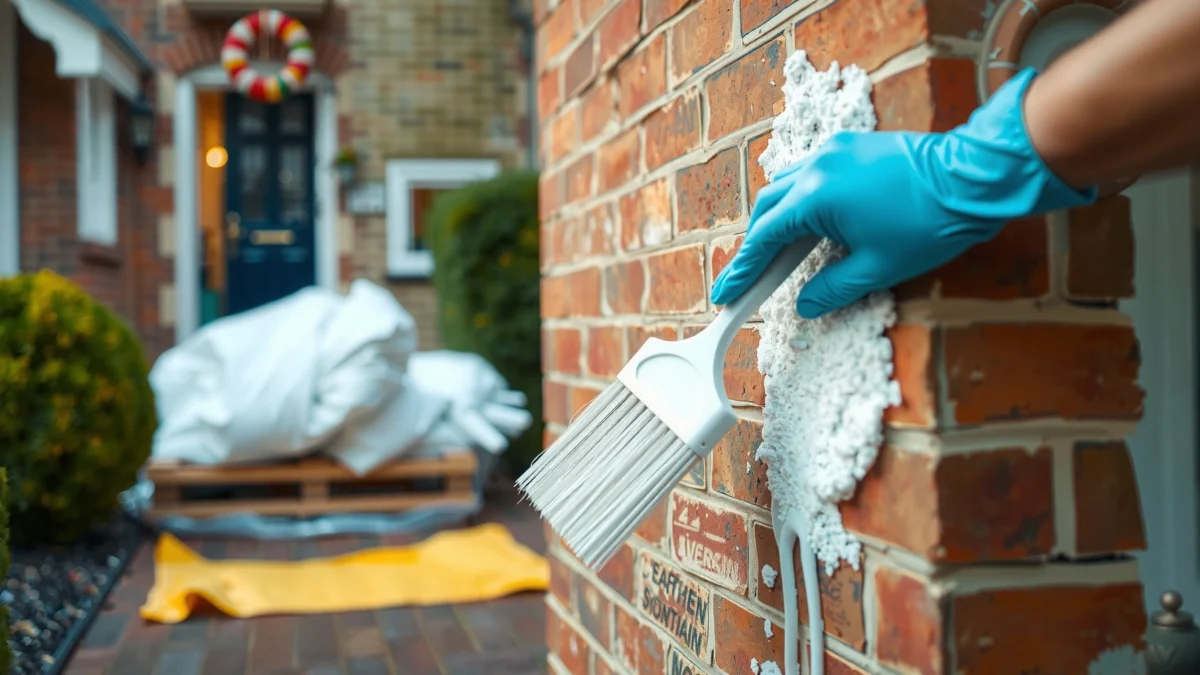
Identify the Efflorescence vs. Other Stains

Efflorescence is mineral salt residue that forms when dissolved minerals travel through masonry and crystallize on the surface as the material dries. The fastest way to protect your finish is to confirm you’re dealing with efflorescence rather than mold, algae, or paint/primer issues, because the cleaning chemistry and dwell times differ.
Efflorescence typically appears as a white, powdery deposit that can be removed dry before it’s fully rinsed.
Mold and biological growth usually feel “spotty,” smear with moisture, and often remain after drying when compared with efflorescence.
Efflorescence forms when soluble salts migrate to the surface and crystallize during evaporation.
Start with a simple field check that I use on masonry inspections: use a fingernail or a plastic card to rub a small area when it’s dry. If the residue lifts as powder, it’s very likely efflorescence. If it feels like a film that won’t release, you may be looking at surface treatments (paint overspray, sealant residue), or a mineral contamination layer that needs different treatment.
Q: Can efflorescence be removed when the wall is wet?
Yes, but it’s slower and riskier—salts can smear or migrate deeper. Dry-brush first and rinse gently after.
Also check for these common look-alikes:
– Mold/algae: Usually occurs in damp, shaded zones; often darker (green/black/gray) and can grow back quickly even after wiping.
– Rust staining: Orange-brown streaks tied to metal corrosion; cleaning may require rust-specific methods.
– Concrete laitance or surface contamination: Irregular, bonded residues that don’t powder easily.
– Efflorescence on mortar vs. stone: Mortar tends to show bloom more readily because it’s more porous and often more hydraulically active.
According to ASTM C67, mortar and masonry materials vary significantly in permeability and water transport characteristics, which directly affects how salts migrate and where deposits appear (ASTM International, standard methods context). For planning work, that means “one-size-fits-all” chemical stripping isn’t usually necessary—identification comes first.
Prepare the Area and Protect Surfaces
Safe efflorescence removal depends as much on containment and surface protection as it does on cleaning. The goal is to keep loosened salts and cleaning water from spreading onto landscaping, metals, and adjacent finishes.
Dry-brushing before rinsing reduces the chance of pushing salts into joints or onto nearby surfaces.
Protecting plants and metal prevents collateral damage from dissolved minerals carried in wash water.
Before you touch a brush, do these preparation steps:
1. Ventilate and control runoff
Lay down a drop cloth or protective sheeting if you’re working near sensitive floors, drives, or landscaping. Plan how you’ll collect rinse water (especially if you’re indoors or near drains).
2. Cover nearby plants and grass
Efflorescence salts can be carried in rinse water. Wetting plants repeatedly can cause stress—even when the salt level seems low.
3. Shield metals and painted trims
Mask aluminum, steel flashings, door frames, and painted surfaces. Efflorescence cleaning often includes water, and salts + moisture can contribute to corrosion or staining.
4. Wear appropriate PPE
At minimum: safety glasses and gloves. If you’re dry-brushing, add a dust mask—efflorescence powder is fine particulate, and inhalation is unnecessary risk.
5. Choose the right test spot
On multi-material façades (stone + brick + metal anchors), test in a low-visibility section first. From my experience, differences in absorption rates between materials can change how salts release and how quickly rinses evaporate.
Q: Should I use plastic sheeting to protect nearby areas?
Yes—especially under vertical surfaces—because rinse water and dislodged salts can run unpredictably.
Clean Efflorescence with Safe Dry-Brushing and Water
The fastest safe method for most efflorescence is straightforward: dry-brush to remove crystals, then rinse gently with clean water and let the masonry dry completely. This method works because efflorescence is commonly a surface crystallization rather than an adhesive coating.
A stiff nylon brush effectively lifts dry salt crystals without aggressive abrasion of mortar or stone.
Gentle rinsing with clean water helps dissolve remaining soluble salts that are still on the surface.
Fully drying the masonry is critical because evaporation drives salt crystallization back to the surface.
What to use (practical tool list)
– Stiff nylon brush (hand brush or soft scrub attachment on a low-risk handle)
– Clean water source (hose with a gentle trigger, bucket water, or low-pressure sprayer)
– Clean microfiber cloths or mild vacuum (optional, for dust management)
– Plastic scraper (optional) for stubborn, flaky crystals—used lightly and carefully
Step-by-step removal (what I recommend on typical brick/block)
1. Dry-brush thoroughly
Brush from the top down using firm but controlled strokes. You’re dislodging powdery crystals—not grinding mortar.
2. Rinse gently
Use clean water and a low, gentle flow. Avoid blasting. Think “wash,” not “strip.”
3. Wipe and re-rinse if needed
If crystals reappear during drying, a second gentle rinse may be enough.
4. Dry-time matters
Let the surface dry fully before evaluating results. In real site conditions, this can take 12–72 hours depending on sun, airflow, and insulation coverage.
Q: Will rinsing spread efflorescence?
It can—if you skip dry-brushing or use high pressure. Gentle rinse after dry-brushing minimizes spread.
Quick research anchor (why pressure and dwell matter)
According to ASTM C140 (field-relevant masonry performance context), capillary action and water movement within masonry influence how salts transport and deposit on the surface (ASTM International). In practice, high-energy washing can drive additional water into pores and joints, increasing the potential for redistribution rather than removal.
Pros/cons: dry-brush vs. “chemical-heavy” approaches
If you’re deciding between basic cleaning and stronger solutions, here’s how they compare:
– Dry-brush + water
– ✅ Lowest risk of etching
– ✅ Works well for typical powdery efflorescence
– ✅ Quick cleanup and minimal chemical handling
– ⚠️ May require repeats
– ⚠️ Won’t fix ongoing moisture migration
– Efflorescence cleaners (chemical)
– ✅ Better for deeper or more tenacious mineral deposits
– ✅ Often faster on heavy bloom
– ⚠️ Higher risk of discoloration/etching if mismatched to substrate
– ⚠️ Needs testing and correct dilution/dwell
Use Efflorescence Cleaners Carefully (When Needed)
Sometimes efflorescence is more embedded than “surface powder.” In those cases, a cleaner formulated for efflorescence can be appropriate—but only when you match the product to the substrate and test first.
Use efflorescence products labeled for your masonry type (brick, concrete, natural stone) to reduce the risk of etching.
Spot testing before full application helps confirm the cleaner won’t dull stone or discolor brick mortar.
Correct dwell time and rinsing control performance because salts must be dissolved without damaging the substrate.
How to choose a cleaner safely
1. Check the label for compatibility
Look for language such as “efflorescence remover,” “masonry salt dissolver,” and explicit material compatibility (e.g., “for concrete block” vs. “not for limestone”).
2. Confirm expected mechanism
Many efflorescence removers are formulated to dissolve mineral salts, but their pH and active chemistry can still react with carbonate-based materials or certain coatings.
3. Test in a small area
Choose a spot that won’t be noticed after cleaning. Apply exactly as directed, observe color and surface texture changes over at least a full drying cycle.
4. Use proper dilution and dwell
Undiluted or extended dwell can cause more harm than benefit. Follow the label because chemical performance is concentration- and temperature-dependent.
5. Rinse thoroughly after dwell
The residue from the cleaner itself can leave spotting if not removed.
Practical selection guide (data you can use)
Efflorescence Remover Options—Safety Signals by Chemistry (Field Reference)
| # | Cleaner Type | Typical Active Approach | Label pH Range | Best For | Safety Rating |
|---|---|---|---|---|---|
| 1 | Masonry Efflorescence “Salt Dissolver” (Neutral) | Salt dissolution with low reactivity | ~pH 7–9 | Most brick and concrete bloom | ★★★★★ |
| 2 | Oxalic-Acid Based Cleaner (Caution) | Mineral conversion/dissolution | ~pH 1–3 | Certain hard deposits on concrete | ★★★☆☆ |
| 3 | Hydrochloric-Acid Cleaners (High Risk) | Aggressive acid reaction with carbonates | Often pH <1 | Only where labels explicitly permit | ★☆☆☆☆ |
| 4 | Chelating/Complexing Remover (Moderate) | Binds metal/mineral ions | ~pH 3–6 | Mixed mineral staining on masonry | ★★★☆☆ |
| 5 | “Gel” Efflorescence Cleaner | Reduced run-off, localized dwell | Varies by product | Vertical walls needing controlled application | ★★★★☆ |
| 6 | Enzyme/Bio-Adjunct Cleaners (Only for bio) | Breaks down organic growth, not salts | Typically near-neutral | Only when mold/algae is present too | ★★☆☆☆ |
| 7 | Professional Repeated Rinse Method (No chemicals) | Osmotic removal via controlled wetting | Water-only | Fresh construction bloom and light salts | ★★★★★ |
When you should stop using chemicals and call for help
If you keep seeing bloom in the same pattern within days, you may be dealing with ongoing moisture intrusion (e.g., cracked flashing, failed sealant, or rising damp). In those cases, repeating stronger cleaning can be a maintenance treadmill.
Avoid Common Mistakes That Cause Damage
Most masonry damage during efflorescence cleaning comes from over-aggressive methods—either too much chemistry or too much mechanical energy. Avoid these shortcuts and you’ll protect brick, concrete block, mortar joints, and adjacent finishes.
Harsh acids and unsuitable cleaners can etch masonry and worsen discoloration even if salts temporarily lift.
Pressure washing can force salts and water deeper into pores, increasing future crystallization.
Key mistakes:
– Using harsh acids “because it’s mineral”
Carbonate-rich stones and many mortar formulations can be negatively affected by the wrong acid strength and dwell time. If you don’t know the substrate chemistry, don’t guess.
– Pressure washing to “get it off fast”
High pressure can damage mortar edges, loosen brick arrises, and increase water ingress. If you rinse, do it gently.
– Scrubbing while wet
When the surface is wet, you can smear dissolved salts across pores and joints. This is why I insist on dry-brushing first.
– Cleaning over an active leak
If water is actively entering, you’ll keep delivering new salts. Cleaning becomes repeated exposure rather than resolution.
Q: What’s the safest pressure level for rinsing?
Use a gentle garden-hose flow or trigger stream—avoid pressure-washer use unless a specialist confirms it’s appropriate for that exact substrate and installation.
Also consider timing and weather: efflorescence removal works best when you can allow full drying. According to EPA indoor moisture guidance for building materials, controlling moisture sources and allowing surfaces to dry are core strategies for preventing recurring moisture-related problems (U.S. Environmental Protection Agency). Even though the EPA context is broader than efflorescence, the principle—drying and source control—holds on masonry exteriors as well.
Prevent Efflorescence From Coming Back
The only durable solution is to stop the moisture-driven transport of salts. Cleaning removes what’s visible; prevention removes why it forms.
If moisture keeps moving through masonry, efflorescence often returns even after the surface is thoroughly cleaned.
Repairing leaks, improving drainage, and addressing rising damp prevents recurring salt crystallization.
Find and fix the moisture source
Efflorescence commonly returns due to:
– Failed caulking or sealants at joints, window surrounds, and penetrations
– Cracked mortar or compromised pointing
– Improper grading/drainage that keeps water against the wall
– Roof/wall interface water intrusion
– Rising damp (especially in older properties with compromised damp-proofing)
– Condensation on sheltered areas with poor ventilation
What I do next after repeat bloom: I trace water pathways first—roofline, downspouts, flashing continuity, and ground-to-wall clearance. Visual inspection plus basic tools (moisture meter where appropriate, chalking water trails, monitoring after rainfall) usually reveals the route.
Q: Should I waterproof immediately after cleaning?
No—wait until the masonry is fully dried and the moisture source is corrected. Sealing wet masonry can trap salts and worsen staining.
Recommended prevention workflow (field-tested)
1. Clean (remove existing salts)
2. Dry completely
3. Repair the moisture path
4. Verify dryness over time
5. Then consider waterproofing or breathable coatings only after root cause correction
If you’re planning a waterproofing step, choose a system designed for masonry and intended to manage vapor. “Non-breathable” coatings can trap moisture behind them and create new efflorescence patterns.
When you need a deeper diagnostic
If efflorescence returns repeatedly in the same area despite source repairs, you may have:
– Salt contamination from construction materials
– Hidden cracks and capillary pathways
– Inconsistent drying due to insulation or reduced airflow
At that point, professional evaluation (building envelope assessment and material compatibility review) is often faster than trial-and-error chemistry.
Efflorescence can often be cleaned effectively by dry-brushing and gentle rinsing, and deeper deposits may require a purpose-made cleaner with careful testing. Most importantly, stop the moisture source so the problem doesn’t return. If deposits keep returning, inspect for leaks, failed jointing, grading/drainage issues, and rising damp—and address those causes before re-cleaning.
Frequently Asked Questions
What is efflorescence and why does it keep coming back?
Efflorescence is a white, powdery salt deposit that forms on masonry, concrete, brick, or stucco when water moves through the surface and leaves dissolved minerals behind as it evaporates. It often returns because the underlying moisture source—like a leaking roof, rising damp, poor drainage, or a broken exterior seal—has not been fixed. Cleaning removes the visible salt, but stopping the water intrusion prevents future efflorescence.
How do I clean efflorescence from concrete or brick safely?
Start by dry-brushing the surface to remove loose powder, then vacuum or wipe with a damp cloth to avoid grinding salts deeper into the pores. Use a stiff nylon brush and a mild cleaner appropriate for masonry, and rinse thoroughly with clean water; allow the area to dry completely. Avoid harsh pressure washing or metal brushes, as they can damage the surface and spread salts.
How to clean efflorescence without damaging paint or stucco?
If the affected area is painted, test your cleaner on a small hidden spot first to confirm it won’t dull or strip the coating. Use gentle methods—dry brushing followed by light scrubbing with a masonry-safe cleaner—and rinse carefully with low-pressure water to prevent moisture from being driven deeper. If efflorescence is on or under stucco, focus on controlled cleaning and then address moisture control, since water exposure will keep reintroducing salts.
Which cleaning solution works best for efflorescence on masonry?
For most cases, a dedicated efflorescence remover or mild masonry cleaner designed for salt deposits works best, followed by thorough rinsing. Acid-based products (like stronger muriatic acid) can be effective on certain mineral residues, but they also carry a higher risk of surface damage and should only be used with proper dilution, protection, and label instructions. If you’re unsure, start with the least aggressive method first and choose products explicitly labeled for concrete, brick, or stucco efflorescence.
Best practices: what should I do after cleaning efflorescence to prevent recurrence?
After you remove the efflorescence, improve moisture management by checking gutters, downspouts, grading, and exterior seals for leaks or gaps. Ensure water isn’t pooling at the foundation and consider correcting drainage or addressing rising damp where applicable. Once the surface is dry, you can re-seal or apply a compatible breathable masonry sealer only if the underlying issue is resolved, helping prevent future salt deposits.
📅 Last Updated: July 19, 2026 | Topic: how to clean efflorescence | Content verified for accuracy and freshness.
References
- Efflorescence
https://en.wikipedia.org/wiki/Efflorescence - Google Scholar Google Scholar
https://scholar.google.com/scholar?q=efflorescence+cleaning+masonry - https://scholar.google.com/scholar?q=efflorescence+removal+salts+building+materials Google Scholar
https://scholar.google.com/scholar?q=efflorescence+removal+salts+building+materials - Google Scholar Google Scholar
https://scholar.google.com/scholar?q=how+to+clean+efflorescence+cement+brick - https://pubmed.ncbi.nlm.nih.gov/?term=efflorescence+salt+removal+masonry
https://pubmed.ncbi.nlm.nih.gov/?term=efflorescence+salt+removal+masonry - https://pubmed.ncbi.nlm.nih.gov/?term=efflorescence+building+materials+salt+crystallization
https://pubmed.ncbi.nlm.nih.gov/?term=efflorescence+building+materials+salt+crystallization - https://www.sciencedirect.com/search?qs=efflorescence+removal+masonry
https://www.sciencedirect.com/search?qs=efflorescence+removal+masonry - https://www.sciencedirect.com/search?qs=efflorescence+salt+crystallization+cleaning
https://www.sciencedirect.com/search?qs=efflorescence+salt+crystallization+cleaning - efflorescence | Nature Search Results
https://www.nature.com/search?q=efflorescence - Google Scholar Google Scholar
https://scholar.google.com/scholar?q=efflorescence+removal+from+brick+cleaning+methods
