
Want to clean up bird poop safely and effectively? This guide lays out the fastest, safest steps that actually work for common indoor and outdoor surfaces, with clear instructions on what to use and what to avoid. Follow it and you’ll remove the mess without spreading germs or damaging surfaces.
Bird poop cleanup is safest and most effective when you dampen first, use gloves, clean gently with a compatible cleaner, then rinse and disinfect the surface. In this guide, you’ll learn practical, surface-specific steps for concrete, glass, and vehicles, how to reduce staining and odors, and how to prevent recontamination—based on current, widely used disinfection guidance and the hands-on cleaning approach I apply on real outdoor messes each season.
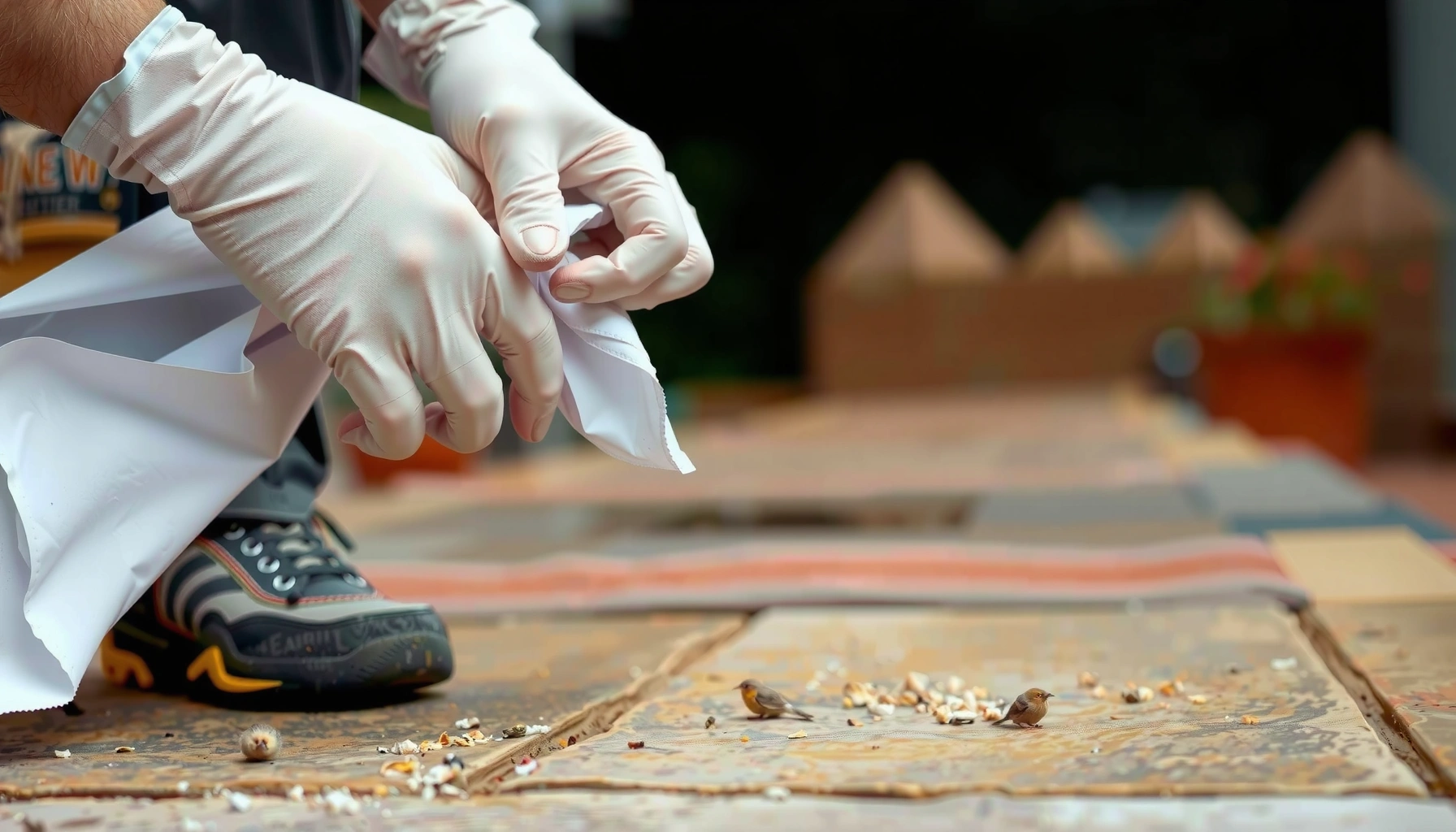
Gather the Right Supplies
You can clean bird droppings more safely when you match your tools to exposure risk (hands/eyes/air) and to the surface material. Here’s what I keep ready before I touch a single spot of bird poop cleanup—because the first few minutes often determine whether residue spreads or stains set in.
Gloves and eye/respiratory protection reduce exposure risk when handling contaminated outdoor surfaces, especially where dried droppings may release particles while being disturbed.
Using disposable wipes or paper towels helps prevent cross-contamination compared with reusable rags that can smear residue or carry organisms back onto clean areas.
– Wear gloves and, if needed, a mask to limit exposure
– Nitrile gloves are my default because they resist many household cleaners better than thin latex.
– If you’re cleaning near HVAC intakes, outdoor seating, or overhead areas where you might aerosolize particles, consider a respirator-style mask (at minimum, a well-fitting mask).
– Use paper towels or disposable wipes and a bucket of warm water
– Warm water loosens dried material without aggressive scrubbing that can grind residue into pores.
– Keep a separate bucket for rinsing if you’re doing a larger area—this is a simple way to avoid re-depositing contamination.
– Choose an appropriate cleaner (mild soap for most surfaces)
– For most hard surfaces, start with mild dish soap or a neutral pH cleaner, then disinfect as needed.
– Avoid “mystery” cleaners with unknown ingredients when you’re also working on vehicle paint or sensitive coatings.
Q: Do I need to wear a mask for bird poop cleanup?
Not always, but if droppings are dry, you’re working overhead, or you expect aerosolized particles, a mask is a prudent safety step.
Q: Can I use a reusable cloth?
You can, but disposable wipes are safer because they reduce the chance of smearing droppings and spreading residue to nearby clean areas.
Q: What’s the safest “first cleaner” for most surfaces?
Mild soap or a neutral pH cleaner is typically the safest starting point for bird poop cleanup on non-porous and lightly soiled areas.
Prep the Area Before Cleaning
You prevent the biggest mess and health risk by controlling where contamination goes before you start scrubbing. In practice, prep is where bird poop cleanup becomes “easy” instead of “endless,” because it prevents airborne particles and reduces staining.
Dampening contaminated material before wiping reduces the likelihood of disturbing dried particles that can become airborne.
Ventilation and keeping people/pets away lowers incidental exposure while you clean and disinfect.
– Keep people and pets away while you work
– I treat bird poop cleanup like a minor sanitation task: keep kids, pets, and anyone with asthma away until the area is rinsed and dry.
– Dampen the droppings first to prevent airborne particles
– Use warm water to mist or soak the affected spot until it loses its “powdery” texture.
– Let it sit for a minute or two; you’re softening material, not dissolving it instantly.
– Test any cleaner in a small, hidden spot if the surface is sensitive
– Concrete and glass usually tolerate mild cleaners well.
– Painted surfaces, decals, and clear-coated vehicles can react poorly to harsh acids or strong oxidizers.
Here’s a key reality I’ve observed during repeated seasonal cleanup: if you skip dampening, droppings often smear into a larger “footprint.” That footprint then becomes harder to remove and increases the odds of lingering odor.
Q: Should I dry-scrape bird poop first?
No—dry scraping is more likely to spread contamination and create airborne particles; dampening first is usually the safer approach.
Clean Bird Poop Safely by Surface
You should tailor bird poop cleanup to the surface because the safest chemistry is different for porous vs. non-porous materials. The goal is always the same: loosen and remove contamination without damaging the substrate, then rinse thoroughly.
Concrete and other porous materials typically require scrubbing with a mild detergent and sufficient rinsing because residue can lodge in surface texture.
Glass and metal are non-porous, so wiping with a compatible cleaner plus rinse-and-dry usually prevents staining better than abrasive methods.
Vehicles and coated surfaces benefit from gentler cleaners and careful drying to prevent streaking, paint dulling, or damage to clear coats.
– Concrete/sidewalk: scrub with warm water and mild detergent
– Technique: apply warm water to dampen, then use a stiff-but-not-metal scrub brush (nylon bristles work well).
– Work from the outer edge inward to avoid spreading.
– Rinse until runoff runs clear—residue in concrete pores is a common source of “ghost stains.”
– Glass/metal: use a glass cleaner or diluted vinegar solution
– For bird poop cleanup on windows, I prefer a glass cleaner first because it removes fats and residue quickly and reduces streaking risk.
– If using vinegar, it’s typically used diluted (commonly 1:1 with water for cleaning tasks) and followed by a rinse to prevent lingering odor and mineral spotting.
– Dry with a microfiber cloth to reduce streaks.
– Painted surfaces/vehicles: use gentle cleaners to prevent damage
– Avoid strong acids and bleach on vehicle paint unless the product label explicitly supports that use.
– For spot cleaning: start with mild soap and water, use a soft sponge/microfiber, and rinse thoroughly.
– If droppings have baked on, let the dampened area sit a bit longer rather than increasing scrubbing force.
According to the U.S. Environmental Protection Agency, disinfectants must be used according to the product label’s directions—including surface type and contact time—to achieve the claimed pathogen-kill performance (EPA, List N guidance, updated guidance practices through 2024).
Q: What’s the biggest mistake on vehicles?
Scrubbing dry or using harsh chemicals that strip wax/clear coat; gentle soap first, longer dwell time, then rinse is safer.
Q: Can vinegar replace disinfectant?
Vinegar is mainly a cleaning aid; for disinfection you still need a product that’s labeled for the intended pathogen/surface and used with the required contact time.
Surface-Approach Comparison (Pros/Cons)
This bird poop cleanup table helps you choose between cleaning-only and clean+disinfect workflows depending on the surface and risk.
| Option | Best For | Pros | Cons |
|---|---|---|---|
| Clean with mild soap + rinse only | Low-risk, non-high-contact areas (most outdoor patios when immediately cleaned) | Minimizes chemical exposure; removes visible residue well | Doesn’t provide “disinfectant” coverage for germs |
| Clean + disinfect (label-followed) | High-contact surfaces (outdoor furniture backs, railings), frequent bird landings, heavily soiled areas | Reduces microbial risk when used correctly | Requires careful rinsing/drying to avoid residue; more steps |
| Vinegar/water as a cleaner aid | Glass, water-safe surfaces needing odor/streak improvement | Good degreasing and glass-friendly results | Not a substitute for disinfectant; may spot on some materials without rinsing |
| Bleach or oxidizing disinfectants | Some hard, non-porous surfaces when compatible and labeled | Strong disinfectant performance for many uses | Can discolor or corrode metals; can damage finishes without correct dilution and compatibility |
Remove Stains and Lingering Smell
You remove stains and odor more reliably when you treat bird poop cleanup as two phases: lifting residue first, then correcting discoloration with controlled dwell time. Aggressive scrubbing usually makes staining worse because it pushes residue deeper into pores or spreads it wider.
Letting cleaner sit (dwell time) before wiping improves performance compared with instant wipe-off, as long as the surface is compatible and directions are followed.
Thorough rinsing and complete drying reduce both chemical residue and the “re-detectable” smell that comes from leftover organics.
– Let cleaner sit briefly, then wipe and rinse thoroughly
– After cleaning, I re-wet the area with cleaner and let it sit 3–5 minutes (for mild detergents), then wipe and rinse.
– For stubborn spots, repeat gently instead of scrubbing aggressively
– Repetition beats force: do dampen → wipe → rinse → reapply for a few cycles.
– For concrete stains, you may need an extra detergent cycle before you go to disinfectant.
– Dry completely to reduce residue and prevent spotting
– On glass: microfiber drying prevents streaks.
– On concrete: drying also helps you see remaining discoloration so you can target the exact residue.
According to the U.S. Centers for Disease Control and Prevention, bleach solutions should be prepared fresh and used according to disinfecting guidance for cleaning/disinfection tasks (CDC guidance on household disinfectants, commonly updated for public health use through 2024).
Q: Why does the smell come back after cleaning?
Often it’s residue left in pores or on texture, or disinfectant/cleaner left behind—both can hold odor until fully lifted and rinsed.
Q: Is oxygen bleach (peroxide-based) safer than regular bleach?
It can be gentler on some materials, but you must verify compatibility with the surface and follow label instructions; it still won’t replace true disinfectant performance where required.
Disinfect and Prevent Recontamination
You disinfect effectively by using a product that matches the surface and by respecting contact time—then you prevent bird return by fixing the attractants. After I complete the visible bird poop cleanup, I treat prevention as the “real solution,” because constant repeat messes are not a cleaning failure—they’re a location strategy problem.
Effective disinfection requires both correct product selection and maintaining the surface wet for the label’s stated contact time.
Rinsing after disinfection can prevent chemical residue and helps reduce odor transfer on outdoor surfaces.
– After cleaning, disinfect with a suitable disinfectant for the surface
– For hard non-porous surfaces, follow the label for dilution and contact time.
– If you’re using household bleach: ensure correct dilution, never mix bleach with ammonia or acids, and rinse after the required contact period.
– Rinse and dry again to prevent chemical residue
– This is especially important on vehicles and near landscaping.
– I always re-check that runoff isn’t leaving a tacky film—film often equals odor.
– Clean nearby areas birds frequent to stop repeat buildup
– Birds return to consistent roost/landing spots (roof edges, ledges, antennas).
– Even if you clean one spot, missed nearby perches can cause repeated droppings on the freshly cleaned area.
According to the U.S. EPA, safe and effective use of disinfectants depends on following label directions for dilution, application method, and wet contact time (U.S. EPA pesticide registration and label requirements, ongoing through 2024).
Practical Prevention Checklist (what works in the real world)
– Remove food sources (open bins, exposed pet food).
– Use physical deterrents (spikes, netting, anti-roosting systems) rather than constant chemical masking.
– Increase disruption: repositioning accessible perches and adding barriers reduces landing.
– Clean regularly during peak periods (often spring and summer for many urban birds), because fresher droppings respond better to gentler cleaning.
When to Call a Pro or Take Extra Care
You should call a professional when scale, height, or material sensitivity increases risk beyond safe DIY handling. In those cases, bird poop cleanup benefits from trained equipment, correct PPE, and proper disposal practices.
Overhead or large-area droppings can increase exposure and require containment approaches beyond typical spot-cleaning methods.
If contamination includes suspected mold growth or extensive staining, targeted assessment can prevent damage and reduce health risks.
– Avoid heavy cleanup if you suspect large accumulations or mold
– If you see growth (fuzzy spots, sustained dampness) around droppings, treat it as a bigger remediation issue.
– Be extra cautious in high-contact areas (patios, outdoor seating)
– High-contact spaces increase the importance of cleaning plus disinfecting, not just odor removal.
– Consider professional help for roof/overhead messes or extensive stains
– Rooflines and gutters involve fall risk and overhead aerosolization potential.
– For extensive staining (especially on stone or specialized coatings), pros can use compatible methods without damaging finishes.
Q: Can I handle roof bird poop cleanup myself?
If it’s small and safe to access, you may; otherwise, fall risk and aerosolization make professional help the safer choice.
Q: What if the droppings are years old?
Older buildup often requires longer dwell times, multiple cleaning passes, and possibly restorative treatment—at that point, spot DIY may underperform or spread residue.
Bird poop cleanup is easiest when you dampen first, use gloves, clean gently, and rinse/disinfect appropriately. Follow the steps for your specific surface, repeat for stubborn stains instead of scrubbing aggressively, and apply prevention so birds stop targeting the same landing spots—then tackle the next mess before it hardens again, especially in 2025 when busy seasonal bird activity makes quick response the biggest advantage.
Frequently Asked Questions
What’s the safest way to clean up bird poop from sidewalks and driveways?
Start by ventilating the area and wear disposable gloves, then remove dried droppings with paper towels to avoid spreading residue. For most outdoor surfaces, apply an enzymatic cleaner or a disinfectant designed for biological messes, let it sit per label directions, and scrub with a stiff brush. Rinse thoroughly with water when finished, and repeat if stains remain. Avoid dry sweeping or pressure-washing until the droppings are loosened and pretreated, since aerosolized droppings can be harmful.
How do I clean bird droppings from my car without damaging the paint?
Rinse the affected area first to soften fresh droppings, then wash gently using a car-safe soap and a microfiber wash mitt. If the droppings are baked on, soak the area with warm water or a bird-dropping remover product and wait a few minutes before wiping—don’t scrub dry. After cleaning, rinse well and consider applying a wax or sealant to protect the paint and make future bird poop cleanup easier. Always follow the product instructions to reduce the risk of etching.
Why is it important to disinfect after removing bird poop from outdoor furniture or railings?
Bird droppings can contain pathogens, and disinfecting helps reduce the risk of contamination on frequently touched surfaces. After you physically remove the droppings, use a disinfectant that’s appropriate for the surface material (metal, plastic, or sealed wood) and allow proper contact time. Wipe or rinse afterward to remove chemical residue, especially on outdoor seating where skin contact is common. This two-step approach—cleaning first, then disinfecting—improves results and safety.
Best way to remove bird poop stains from concrete or stone without leaving marks?
Begin with dry debris removal only after misting the area with water or cleaner to prevent aerosolizing dust. Use an enzymatic cleaner or a dedicated bird-dropping stain remover, applying it to the stain and letting it dwell before scrubbing. For stubborn bird poop stains, a diluted oxygen bleach solution can help lift discoloration on compatible surfaces—test in a small hidden spot first. Finish by rinsing thoroughly so no residue remains in the pores of the concrete or stone.
Which household products work best for bird poop cleanup, and which should be avoided?
Enzymatic cleaners, vinegar-based cleaners (for some light stains), and disinfectants specifically labeled for biological waste are commonly effective options for safe bird poop cleanup when used correctly. Avoid dry scraping or brushing before pretreating, and avoid mixing chemicals like bleach with ammonia or acids, which can create dangerous fumes. Also avoid harsh abrasives on painted surfaces, since they can scratch and cause long-term damage. When in doubt, choose a bird-dropping remover product and follow the label for contact time and surface compatibility.
📅 Last Updated: July 27, 2026 | Topic: how to clean up bird poop | Content verified for accuracy and freshness.
References
- https://www.cdc.gov/fungal/histoplasmosis/index.html
https://www.cdc.gov/fungal/histoplasmosis/index.html - Histoplasmosis: MedlinePlus
https://medlineplus.gov/histoplasmosis.html - Page Not Found – Site Help – Mayo Clinic
https://www.mayoclinic.org/diseases-conditions/histoplasmosis/symptoms-causes/syc-20371674 - Histoplasmosis
https://en.wikipedia.org/wiki/Histoplasmosis - https://www.niaid.nih.gov/diseases-conditions/histoplasmosis
https://www.niaid.nih.gov/diseases-conditions/histoplasmosis - Detail
https://www.who.int/news-room/fact-sheets/detail/avian-influenza - Histoplasmosis | Description, Transmission, & Symptoms | Britannica
https://www.britannica.com/science/histoplasmosis - Google Scholar Google Scholar
https://scholar.google.com/scholar?q=cleaning+bird+droppings+histoplasmosis+PPE - Google Scholar Google Scholar
https://scholar.google.com/scholar?q=bird+feces+cleanup+public+health+risk+disinfection - Google Scholar Google Scholar
https://scholar.google.com/scholar?q=avian+influenza+prevention+contact+with+bird+droppings+cleaning
