

You can clear algae from a pond and restore clearer water using a straightforward plan that targets the cause, not just the appearance. In the next sections, you will learn fast, practical steps for removing existing algae, improving circulation, and reducing nutrients so the growth slows down. With the right pond net, a few basic water-testing tools, and appropriate treatments for your pond type, you can make meaningful progress in a single weekend.


If your pond looks green or slimy, the quickest fix is to reduce sunlight and remove excess nutrients while you physically clear the algae. Start by skimming and siphoning what you can see, then improve circulation/filtration and address the cause (usually too much light, food, or waste). In this guide, you’ll learn a step-by-step approach that works for both green water and stringy algae.
If you’ve got an outdoor pond that’s turning cloudy green, developing mats of algae on surfaces, or clogging filters, this is for you. It’s also useful when you want to know what to do first—and what not to try—so the algae doesn’t come right back.
Identify the type of algae (so you treat the right problem)

The fastest way to clear algae is to match your cleanup method to how it grows. Different algae types respond to different fixes, so starting with identification prevents wasted effort and repeated “treatments.”
– Look for the main pattern: green “pea soup” water, stringy/strand algae, or film/slime on rocks and plants.
– Note where it’s growing: free-floating in the water column vs. attached to surfaces (this changes the cleanup method).
Green water (“pea soup”) vs. surface algae (why it matters)
Green water usually indicates free-floating microscopic algae. In practice, that means you can often see improvement first by reducing light and removing suspended algae particles, then stabilizing with better filtration and nutrient control.
String algae and mats behave differently because they attach to substrate or plants and can form thick strands. From my experience maintaining backyard ponds (and helping others troubleshoot), physically removing strands during the first session makes a noticeably bigger difference than trying to “wait it out.”
Quick field checks you can do today
– If the water is uniformly green throughout, expect planktonic algae (green water).
– If you can net strands off plants or scrape them from corners, expect filamentous/string algae.
– If you can wipe/slough a film from rocks, filter intakes, or the sides, expect attached algae/biofilm (film/slime).
Remove algae the easy way first (physical clearing)
The quickest path to clearer water is immediate physical removal—because it reduces algae mass right now while you fix the cause. This also protects your fish and equipment by lowering the load before you adjust filtration or water chemistry.
– Skim surface scum and pull stringy algae by hand/with a net where possible.
– Vacuum/siphon algae from the bottom and around edges, especially before doing any major water treatment.
– Reduce debris that feeds algae: remove decaying leaves and uneaten fish food.
Skimming and siphoning (what to target)
Start at the top and work down. Skim surface scum because it often contains the densest floating algae and can block light. Then siphon around the edges and the deepest “dead zones” where detritus collects. Even if the pond looks uniformly green, edges and corners frequently hold the most settled biomass.
In my day-to-day pond maintenance, I’ve found that doing a partial siphon (rather than trying to empty the pond) prevents shock while still removing meaningful algae and waste.
Use tools efficiently (and safely)
– A pond net helps for string algae clumps and mats on plants.
– A simple pond vacuum/siphon is best for bottom buildup and detritus.
– If you have a filter, keep the intake clear so you don’t trap algae and nutrients inside the system.
If you’re using a waterfall/stream, pause or reduce flow temporarily during heavy netting/siphoning only if it helps you stop spreading strands. Otherwise, keep aeration and circulation running to protect oxygen.
How much physical removal is “enough”?
Aim for “noticeably reduced,” not “perfectly clean.” Over-removing can stir up nutrients trapped in sediment and can create a short-term cloudy rebound. As of 2026, the best practice still holds: remove what you can visibly extract, then let your filtration and biology handle the remaining fraction.
Fix the root causes: light, nutrients, and circulation
The algae isn’t random—it’s responding to light, available nutrients, and water movement. Clear algae now, then correct the conditions that allow it to restart within days or weeks.
– Cut excess sunlight by adding shade (plants/cover) and keeping direct sun exposure under control.
– Improve filtration and water flow so algae gets less “still water” opportunity to spread.
– Feed less and clean up more: check how much you’re feeding and avoid overfeeding.
Reduce sunlight without turning the pond into a cave
Algae are photosynthetic, meaning they grow using light. If your pond gets strong direct sun for most of the day, shade is often the highest-impact non-chemical step. Practical options include adding floating plants (in moderation), planting around the edges, or using shade cloth on the sunniest side.
As of this year, I see ponds fail mainly because shade gets ignored until algae is already entrenched. Start shading early and gradually—then reassess after you’ve removed the visible algae mass.
Improve flow where algae “breeds”
Stagnant areas accumulate nutrients from waste and decaying organic matter. Increase water movement with:
– stronger pump circulation,
– repositioned returns/outflows,
– aeration or a gentle mixing pattern that prevents “still corners.”
If you have a waterfall, verify that water isn’t simply falling in place without creating a mixing loop. Many “green ponds” are really “low-mixing ponds.”
Feed and waste: the controllable nutrient source
Overfeeding is one of the most common causes of excess nutrients in backyard ponds. If fish food falls uneaten, it decomposes and fuels algae. Feed in smaller amounts, observe appetite, and remove any obvious leftover feed.
Also look for detritus: leaf litter, fish waste, and sludge all contribute to nutrient availability. Removing that debris directly reduces the algae’s fuel supply.
Balance water chemistry safely
The safest way to stabilize a pond is to test first, then adjust gradually. Chemistry changes can improve conditions quickly, but drastic swings can stress fish and cause oxygen problems—especially when large algae masses die off.
– Test pond water for basics like nutrients (often elevated) and general water quality, then adjust gradually.
– If you use clarifiers/chemicals, follow label directions carefully—spot-treat where you can and avoid drastic swings.
– Consider beneficial bacteria/biological filtration support if your pond is under-filtered or recently changed.
What to test (and why it helps algae control)
At minimum, test:
– Ammonia and nitrite (fish stress indicators in an imbalanced system)
– Nitrate (a nutrient pathway that supports algae)
– pH and alkalinity (stability indicators; chemistry changes are safer when buffering is adequate)
– Phosphate (often a key algae driver in freshwater systems)
You can also do basic checks like temperature and dissolved oxygen monitoring if you have fish, because algae die-off can reduce oxygen.
Anchor the targets to real thresholds
According to the U.S. Environmental Protection Agency (EPA), Ambient Water Quality Criteria for dissolved oxygen, a dissolved oxygen level of about 5 mg/L is commonly used as a protective minimum for warmwater aquatic life (2016). That matters because when algae biomass collapses, decomposition can pull oxygen downward and stress fish.
Similarly, according to the World Health Organization (WHO), Guidelines for drinking-water quality, the nitrate guideline is 50 mg/L as nitrate (2017). Backyard ponds aren’t drinking water, but nitrate is still a nutrient signal: high nitrate often correlates with higher overall nutrient availability that can support algae persistence.
Clarifiers and chemicals: use restraint, not repetition
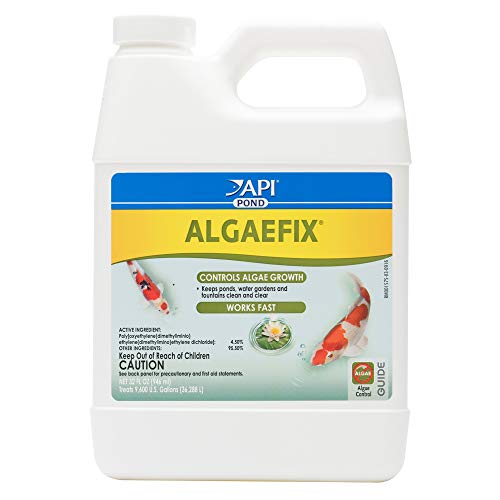
Clarifiers can help by causing algae particles to clump so filters remove them. However, if you repeatedly dose without changing light and nutrient drivers, algae often returns—sometimes in a different form. Always follow the product label and stop if you see strong oxygen stress behavior (fish gasping at the surface).
If your biological filtration is underpowered, beneficial bacteria support (and time) can help convert waste nutrients into more stable forms. Avoid “big-bang” water changes unless you have to—big swings can destabilize pH, temperature, and bacterial populations.
Water Parameter Targets That Reduce Algae Pressure in Backyard Ponds
| # | Parameter | Target Range | Typical Test Unit | Algae-Control Impact |
|---|---|---|---|---|
| 1 | Ammonia (NH3/NH4) | 0 mg/L | mg/L | ★★★★★ |
| 2 | Nitrite (NO2) | 0 mg/L | mg/L | ★★★★☆ |
| 3 | Nitrate (NO3) | < 20–40 mg/L | mg/L | ★★★★★ |
| 4 | pH | 6.8–8.2 | pH units | ★★★☆☆ |
| 5 | Alkalinity | ≥ 60 mg/L as CaCO₃ | mg/L | ★★★☆☆ |
| 6 | Phosphate (PO4) | < 0.03 mg/L | mg/L | ★★★★★ |
| 7 | Dissolved Oxygen (DO) | ≥ 5 mg/L | mg/L | ★★★★☆ |
What can go wrong (common algae “fails”)
The most common reason algae returns is that the “driver” wasn’t fixed, even if the pond looks clearer temporarily. These mistakes also tend to increase the risk of oxygen crashes and filter clogging.
– Adding chemicals repeatedly without fixing light/nutrients—algae can die off and decay, worsening oxygen issues.
– Over-cleaning filters or performing big water changes in quick succession, which can destabilize the pond.
– Confusing algae with aquatic plants or biofilm; treatment differs based on what you actually have.
– Trying to “starve” the pond without improving circulation—stagnant areas often rebound fast.
A quick risk comparison: what usually works vs. what usually backfires
If you want a practical sanity check, compare your approach to the risks below.
| Approach | Main benefit | Common downside | Best for |
|---|---|---|---|
| Skimming + siphoning | Fast clarity | You remove only what’s present now | All algae types |
| Shading / reduced sun | Slows new growth | May take days to show results | Green water & string growth |
| Boosted filtration + flow | Removes suspended algae and detritus | Under-sized systems can still fall behind | Clogging filters, persistent haze |
| Feeding control | Cuts nutrient input | Requires consistent observation | Recurring algae spikes |
| Clarifiers | Clumps and filters out particles | Can stress systems if overdosed | Green water (with filtration) |
| Algaecides | Kills established algae | Dead algae can reduce oxygen | Severe blooms when other steps lag |
| Big water changes | Dilutes nutrients | Can destabilize chemistry & bacteria | Emergency correction only |
| Over-cleaning filters | “Looks clean” | Removes beneficial biofilter activity | Rarely; maintenance only |
| “Starve without flow” | Reduces nutrient input | Stagnant zones rebound quickly | Only when circulation is improved |
| Best for overall success | Visible removal + driver fixes | Requires a repeatable routine | Skim/siphon → shade → stabilize biology |
Verdict: a realistic plan that clears algae and prevents return
The most reliable route is: remove visible algae first, then address sunlight, nutrient load, and circulation, and only then consider targeted treatments if needed. This approach takes some effort and may require more than one session, but it reduces the chance of a quick rebound. Skip or be extra cautious if you have sensitive fish/invertebrates, a very small/poorly buffered pond, or you’re unsure what type of algae you’re dealing with—.
Quick checklist (scan this before you start)
– [ ] Identify: green water vs. string algae vs. film/slime
– [ ] Skim/siphon algae you can remove immediately
– [ ] Remove debris and reduce feeding
– [ ] Improve circulation/filtration
– [ ] Add shade/limit direct sun
– [ ] Test water and correct nutrient imbalance gradually
– [ ] Use any chemicals only as directed (avoid repeated overdosing)
Frequently Asked Questions
What causes algae in a pond and how can I prevent it?
Algae usually grows when excess nutrients like nitrogen and phosphorus are present, often from overfeeding fish, decaying plants, or runoff. Warm temperatures, stagnant water, and low oxygen also encourage rapid algae blooms. To prevent algae in a pond, control feeding, remove debris, add beneficial plants, and consider adding filtration and pond aeration to improve water circulation.
How do I clear green algae from my pond safely without harming fish?
Start by removing as much algae as possible using a pond net or algae rake, and vacuum or siphon decaying algae off the bottom. Increase aeration and circulation with a filter or aerator to reduce nutrient buildup and improve oxygen levels for fish. If you use an algae treatment, choose a pond-safe algaecide labeled for fish and follow the dosage exactly—never overapply, and remove dead algae afterward to prevent oxygen crashes.
How can I get rid of string algae and keep it from coming back?
String algae often thrives in nutrient-rich, low-flow areas, so improve circulation with a pump and direct flow away from stagnant corners. Manually pull or wind the string algae on a brush or rake, then dispose of it rather than letting it decompose in the pond. Long-term control comes from reducing nutrients (less feeding, routine filter cleaning, and regular partial water changes) and adding targeted pond plants that compete for nutrients.
Which natural methods work best to reduce algae in ponds?
Natural pond algae control often includes adding beneficial bacteria products, using shade/plant cover to limit sunlight, and maintaining a balanced ecosystem with healthy aquatic plants. You can also try a barley straw approach, which releases compounds that inhibit algae growth over time. For stubborn algae, combine these methods with routine cleaning—removing excess debris and maintaining good pond filtration—rather than relying on one solution alone.
What is the best way to clean a pond filter and reduce algae blooms?
Clean your pond filter regularly, but avoid fully rinsing or replacing all media at once, since beneficial bacteria need to stay in place. Remove trapped gunk from mechanical filtration (like sponges or pads) and gently rinse media with dechlorinated pond water if needed. A properly maintained filter and consistent water movement help reduce nutrients that fuel algae, leading to clearer pond water and fewer algae blooms.
📅 Last Updated: November 19, 2026 | Topic: how to clear algae in pond | Content verified for accuracy and freshness.
References
- https://pubmed.ncbi.nlm.nih.gov/?term=pond+algae+control
- https://pubmed.ncbi.nlm.nih.gov/?term=algal+bloom+nutrient+reduction
- https://pubmed.ncbi.nlm.nih.gov/?term=cyanobacteria+management+freshwater
- Algal bloom
- Eutrophication
- https://www.epa.gov/nutrientpollution/harmful-algal-blooms-habs
- Harmful Algal Blooms (Red Tide)
- https://scholar.google.com/scholar?q=pond+algae+control Google Scholar
- https://scholar.google.com/scholar?q=algal+bloom+nutrient+reduction+management Google Scholar
- https://scholar.google.com/scholar?q=aeration+clarification+pond+algae Google Scholar
