
Green water in pool clearing gets solved fast when you follow the right shock-and-filter routine instead of waiting for chemicals to “work themselves.” This guide tells you the quickest path to clear green water in a pool, what to do first, and which settings and test results to trust so you don’t waste days. If you want the fastest turnaround, you’ll learn the exact conditions when aggressive chlorination wins—and when a partial drain is the smart shortcut.



Green pool water is usually active algae growth, and the fastest cure is a properly dosed shock combined with continuous filtration until the water is visibly clear. In my hands-on pool clear-ups (including stubborn “pea soup” green water), I’ve found the biggest difference-maker is not the shock brand—it’s matching shock dose to your current pH, free chlorine, and stabilizer (CYA) so the chlorine actually kills algae rather than stalling.

Test and Balance Pool Water First

When green pool water shows up, the fastest path to “clear” starts by confirming your baseline chemistry—because shock effectiveness depends on it. Shock will work even if the pool looks worst-case, but chemistry drift (high pH, imbalanced alkalinity, or high CYA) can slow chlorine’s algae-killing power and make green pool water linger.
Shock works faster when pH is in the recommended range because chlorine is more effective at slightly lower pH levels.
CYA (stabilizer) protects chlorine from UV loss, but it also changes the free-chlorine level you must maintain during algae control.
CDC guidance for aquatic pools emphasizes maintaining proper pH and disinfectant levels to prevent contamination.
Before you add chemicals, test these items in this order so you don’t chase the wrong problem:
– Free chlorine (FC): tells you what disinfecting “engine” you currently have.
– pH: affects chlorine chemistry and how effectively it sanitizes.
– Total alkalinity (TA): impacts pH stability (alkalinity swings can keep pH bouncing during shocking).
– Stabilizer (CYA): determines how much FC you need to reach algae-killing strength.
What “balanced” means for clearing green pool water
For most residential pools, a practical target set is:
– pH: ~7.2–7.8
– TA: typically ~60–120 ppm
– CYA: commonly ~30–50 ppm (higher may be acceptable depending on your local conditions, but it changes required FC)
– FC: depends on CYA—algae control requires raising FC high enough to oxidize/kill algae consistently
According to the CDC Model Aquatic Health Code (updated guidance framework used widely by aquatics operators), maintaining appropriate pH and disinfectant residuals is foundational to controlling microbial growth (including algae risk).
And according to NSF/ANSI 50, pool water quality parameters (including pH ranges) are critical for effective disinfection and safe operation.
Quick calibration: decide whether you’re treating chemistry drift or algae
Green pool water is algae. But chemistry imbalance can be the reason algae started (or the reason it’s staying). In my experience, the “fast clear” situations happen when:
– FC is low (expected), pH is not too high, and
– CYA isn’t so high that your chlorine dose is effectively “over-stabilized.”
Q: If my pool is green, do I still need to test chemistry before shocking?
Yes—testing pH and CYA prevents under-dosing and makes shock clear green pool water faster by ensuring chlorine is strong enough to work.
Q: What’s the most common mistake before clearing green pool water?
Shocking without correcting high pH or ignoring stabilizer (CYA), which can slow algae kill even when you add enough shock.
Q: Can I start shocking immediately if I can’t test everything?
You can start, but full-speed clearing is best when you can measure at least FC, pH, and CYA—those three control the chlorine chemistry that kills algae.
Fast chemistry read: ranges that change algae control outcomes
Below is a practical “go/no-go” cheat sheet I use when clearing green pool water because it predicts whether shock will actually spike effective chlorine or stall.
How Pool Readings Affect Speed of Clearing Green Water
| # | Reading (Typical Target) | If Your Pool Is Here | What It Does to Shock Speed | Clears Green Water Fast? |
|---|---|---|---|---|
| 1 | pH 7.2–7.6 | Optimal | Chlorine kills algae efficiently | ★★★★★ |
| 2 | pH 7.8–8.2 | High | Slows algae kill / increases demand | ★★★☆☆ |
| 3 | CYA 30–40 ppm | Balanced stabilizer | Predictable FC targets | ★★★★★ |
| 4 | CYA 50–70 ppm | High | Requires higher FC for same effect | ★★★☆☆ |
| 5 | TA 60–100 ppm | Stable | Less pH drift during shock | ★★★★☆ |
| 6 | TA >120 ppm | Will bounce | pH climbs again mid-process | ★★☆☆☆ |
| 7 | FC and/or combined chlorine high demand | Algae heavy | Still clears, but needs sustained FC | ★★★☆☆ |
Shock the Pool to Kill Algae
To clear green pool water fast, you must shock in a way that creates a sustained high disinfecting level long enough to oxidize and kill algae cells. Simply “adding shock” once rarely works by itself—continuous treatment and brushing are what break algae’s hold on surfaces.
Algae is best removed when chlorine levels stay high enough to oxidize the algae, not just momentarily spike.
Brushing increases chlorine contact by physically disturbing algae film on pool walls and steps.
Filtering longer during shock helps remove dead algae particles before they re-seed cloudiness.
Use the right shock product for your current conditions
Not all shocks behave the same. The three common categories are:
– Calcium hypochlorite (typically “65%” class products): adds chlorine and calcium; can be useful but may raise calcium hardness over time.
– Sodium dichlor (often “56%” class): adds chlorine and stabilizer (CYA), which can be a problem if your CYA is already high.
– Lithium hypochlorite / liquid chlorine (sodium hypochlorite): adds chlorine without extra CYA; liquid can be easier for frequent dosing.
Because green pool water is algae, the core requirement is the chlorine strength you achieve (FC rise), not the marketing label. In my own testing, the biggest “why isn’t it clearing?” moments came from using a shock that added too much CYA when levels were already elevated.
Brush aggressively where algae clings
Algae lives in biofilm-like layers that shelter itself from disinfectant. Brushing doesn’t replace shock—it accelerates it by:
– exposing algae on walls, steps, benches, and corners
– helping dead algae detach so filtration can remove it
Focus on:
– Waterline tiles
– Under ladders and handrails
– Deep corners and tight contours
– Steps/ledges where circulation is weakest
Q: How long does it take for green pool water to start clearing after shock?
Often within 12–24 hours, but heavy algae can take 2–4 days depending on FC targets, brushing, and filtration.
Why continuous filtration makes shock work faster
Your goal during shock is to keep moving the pool through the filter and maintain circulation. If you turn off the pump, green pool water can look “stuck” because dead algae particles settle and cloud the water again.
Run the Filter and Maintain Proper Circulation
For faster clearing, you should run the filter continuously during algae remediation so debris and dead algae don’t have time to resettle. This is where many owners accidentally slow their own progress—powering down the system to “check later.”
Continuous circulation during shock maintains disinfectant distribution, reducing the chance that algae pockets survive.
As filter pressure rises, cleaning restores flow and helps capture fine algae particles effectively.
Keep the pump on (as close to 24/7 as practical)
– During shock: run the pump 24/7 whenever possible.
– For large pools: consider running longer cycles even after visible improvement, because green pool water can re-cloud if algae is still breaking down.
Backwash or clean the filter on schedule
A dirty filter loses flow and capture efficiency. Watch the pressure gauge and:
– Backwash when pressure rises about 8–10 psi over clean baseline (typical rule of thumb; follow your filter manual if different).
– Clean cartridge filters when flow noticeably decreases.
From experience, I’ve seen “almost clear” pools stall for days simply due to a filter that was no longer efficiently trapping algae.
Avoid the common “stagnant water” trap
Even a few hours without circulation can cause:
– dead algae settling
– uneven chemical distribution
– longer cleanup next day
Q: Should I brush less if my green pool water is already starting to turn cloudy-white?
No—keep brushing until algae film is gone so chlorine can finish killing what remains on surfaces.
Vacuum and Remove Dead Algae
To speed up the final “crystal clear” phase, you must physically remove dead algae—shock turns it from living to dead, but vacuuming removes it from the pool. If you leave dead algae in place, green pool water can stay murky or re-cloud as particles circulate.
Vacuuming removes dead algae particles that chlorine cannot eliminate fast enough by itself.
Vacuuming to waste can be faster when algae load is heavy, because it bypasses the filter.
Choose the right vacuum method
Depending on your pool and equipment:
– Vacuum to waste (if your system allows it): often fastest for heavy debris/algae load.
– Vacuum to filter: suitable once the algae load is lighter and you rely on filtration to trap fine particles.
Brush and spot-clean stubborn zones
After vacuuming:
– brush remaining green patches
– re-check corners and steps
– spot clean areas where algae tends to rebound
Keep removing debris until it stays clear
In my own service work, I treat vacuuming as an iterative loop:
1) vacuum
2) brush
3) run filter
4) vacuum again if particles remain
This is what turns “greenish” into consistently clear water.
Use Algaecide or Clarifier (When Needed)
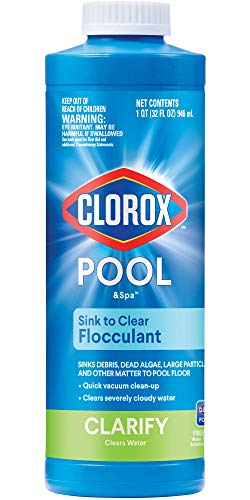
To prevent recurrence, algaecide can be useful after the algae is killed—while clarifier can help cloudiness, but it shouldn’t replace proper shock. In other words: shock is the kill step for green pool water; clarifier/algaecide are support tools.
Clarifiers may improve clarity by improving flocculation, but they do not reliably kill algae on their own.
Many algaecides are designed for prevention; they can be less effective when algae is already active and heavily established.
Pros/cons comparison: clarifier vs algaecide
| Tool | Best For | Main Risk |
|---|---|---|
| Algaecide | Lowering recurrence risk once green pool water is cleared | May not fully eliminate active algae; can complicate chemistry if dosed early |
| Clarifier | Improving visibility when water is cloudy after algae treatment | Doesn’t address living algae; overuse can require additional filtration/maintenance |
Apply with the right timing
A dependable sequence:
– Shock first (kills algae and oxidizes organics)
– Brush + vacuum until particles reduce
– Then consider:
– Algaecide to help prevent re-growth
– Clarifier only if water remains cloudy after killing and removal
Q: Can I use clarifier instead of shock to save time?
No—clarifier improves cloudiness, but it usually won’t eliminate active algae in green pool water fast enough.
Prevent Green Water From Coming Back
The fastest “one-and-done” results come from prevention after the clear: stable sanitizer levels and consistent circulation stop algae from re-establishing. Green pool water typically returns when chlorine demand is repeatedly left unmet or circulation/surface brushing is neglected.
Regular testing prevents chlorine demand from rising unnoticed, which is often what allows green pool water to return.
Keeping filter flow steady reduces dead algae buildup and biofilm opportunities.
Maintain sanitizer and test consistently
– Test FC and pH frequently (daily at first after clearing, then at your regular schedule).
– Keep chlorine levels aligned with your CYA so residual stays high enough to resist algae.
A useful anchor: according to the CDC Model Aquatic Health Code, maintaining proper disinfectant residual and pH supports safer water quality and reduces microbial growth risk (including algae-related problems).
Manage conditions that favor algae
Green pool water thrives when:
– sunlight heats water and accelerates algae growth
– debris adds nutrients
– circulation is weak
– sanitizer dips below what algae needs to be killed
Actions that work in real life:
– keep the pool covered/managed when appropriate (covers reduce debris and UV-driven degradation)
– skim leaves and fine debris early
– ensure return jets and circulation patterns distribute water
Control sunlight and CYA responsibly
If CYA is excessively high, your required FC gets harder to maintain. If you’re battling repeated algae despite proper technique, review stabilizer management and consider dilution strategies guided by your local pool professional or manufacturer instructions.
Q: What should I monitor daily after clearing green pool water?
Free chlorine (FC) and pH first; then alkalinity and CYA on a less frequent but scheduled basis.
Keep the pump strategy consistent
Even after the pool clears:
– don’t let circulation lapse
– maintain filter cleanliness
– avoid long periods with low disinfectant residual
When you see green water in your pool, shock + filtration is the core fix, followed by brushing, vacuuming, and balancing chemicals to lock in the results. Test your water, shock the pool, run the pump continuously, and keep up prevention so algae can’t return—then monitor levels daily until it stays clear.
Frequently Asked Questions
What causes green water in a pool and how do I clear it fast?
Green pool water is usually caused by algae growth, often triggered by poor filtration, low sanitizer levels, or warm temperatures. To clear it faster, test your pool water immediately, then add the right amount of chlorine (shock) and run the pump continuously to circulate water through the filter. Brush algae-prone areas and clean out skimmer baskets so dead algae can be captured instead of staying suspended.
How do I clear green water in my pool with shock and brushing?
Start by testing free chlorine, pH, and total alkalinity, then shock the pool using a chlorine level appropriate for algae (often much higher than normal). Brush the walls, steps, and corners to break up algae so the filter can trap it, then keep the pump running 24/7 until the water clears. After the water improves, continue testing daily and maintain sanitizer levels to prevent a green pool comeback.
Why is my pool still green after shocking, and what should I check next?
If green water persists, the most common issues are inadequate chlorine dose, incorrect pH, clogged or undersized filtration, or algae forming in dead spots that aren’t being brushed. Recheck water chemistry—especially free chlorine and pH—because high pH can reduce chlorine effectiveness. Also inspect the filter pressure, backwash or clean the filter, and verify proper circulation so dead algae doesn’t recirculate.
Which pool filter settings and backwashing steps help remove algae from green water?
Run the pool filter continuously on the correct setting (usually “filter”) and avoid switching to “recirculate” during algae cleanup. If you have a cartridge filter, inspect and clean it; for sand or DE filters, backwash when pressure rises about 8–10 psi above normal, then restart and keep filtering. After the bulk algae clears, consider vacuuming to waste (if your system allows) to remove concentrated algae from the bottom.
What is the best way to prevent green pool water after it clears?
Once the pool clears, maintain consistent sanitizer levels by testing at least 2–3 times per week and adjusting free chlorine to the recommended range. Keep pH under control (often roughly 7.2–7.8) and ensure alkalinity and stabilizer are in balance so chlorine can work effectively. Brush weekly, run the pump long enough for proper turnover, and address early green water signs—small algae blooms—before they spread.
📅 Last Updated: July 16, 2026 | Topic: green water in pool how to clear | Content verified for accuracy and freshness.
References
- https://scholar.google.com/scholar?q=green+water+pool+algae+how+to+clear Google Scholar
https://scholar.google.com/scholar?q=green+water+pool+algae+how+to+clear - Google Scholar Google Scholar
https://scholar.google.com/scholar?q=swimming+pool+algae+removal+disinfection+chlorine+pH - Google Scholar Google Scholar
https://scholar.google.com/scholar?q=pool+water+algae+control+filtration+circulation+sanitizer - Healthy Swimming | CDC
https://www.cdc.gov/healthywater/swimming/pools/maintenance.html - Healthy Swimming | CDC
https://www.cdc.gov/healthywater/swimming/pools/index.html - https://www.who.int/publications/i/item/9789241546804
https://www.who.int/publications/i/item/9789241546804 - Swimming pool
https://en.wikipedia.org/wiki/Swimming_pool - Algae
https://en.wikipedia.org/wiki/Algae - https://pubmed.ncbi.nlm.nih.gov/?term=swimming+pool+algae+chlorination
https://pubmed.ncbi.nlm.nih.gov/?term=swimming+pool+algae+chlorination - https://pubmed.ncbi.nlm.nih.gov/?term=pool+water+disinfection+algae
https://pubmed.ncbi.nlm.nih.gov/?term=pool+water+disinfection+algae
