
How to clean a satin dress without dulling its sheen? Use the safest, most effective method: gentle hand-washing with cold water and mild detergent, then air-drying flat to prevent warping and water marks. If your dress is stained, treat spots first with a diluted solution and blot—don’t scrub. Follow these steps and your satin will stay glossy and clean, wash after wash.
Clean a satin dress gently using cool water, mild detergent, and careful spot treatment—avoid hot water and harsh rubbing to prevent damage and dulling. If you handle stains with blotting, wash only when the care label allows, and dry/steam correctly, your satin can stay smooth, reflective, and event-ready through repeat wears.
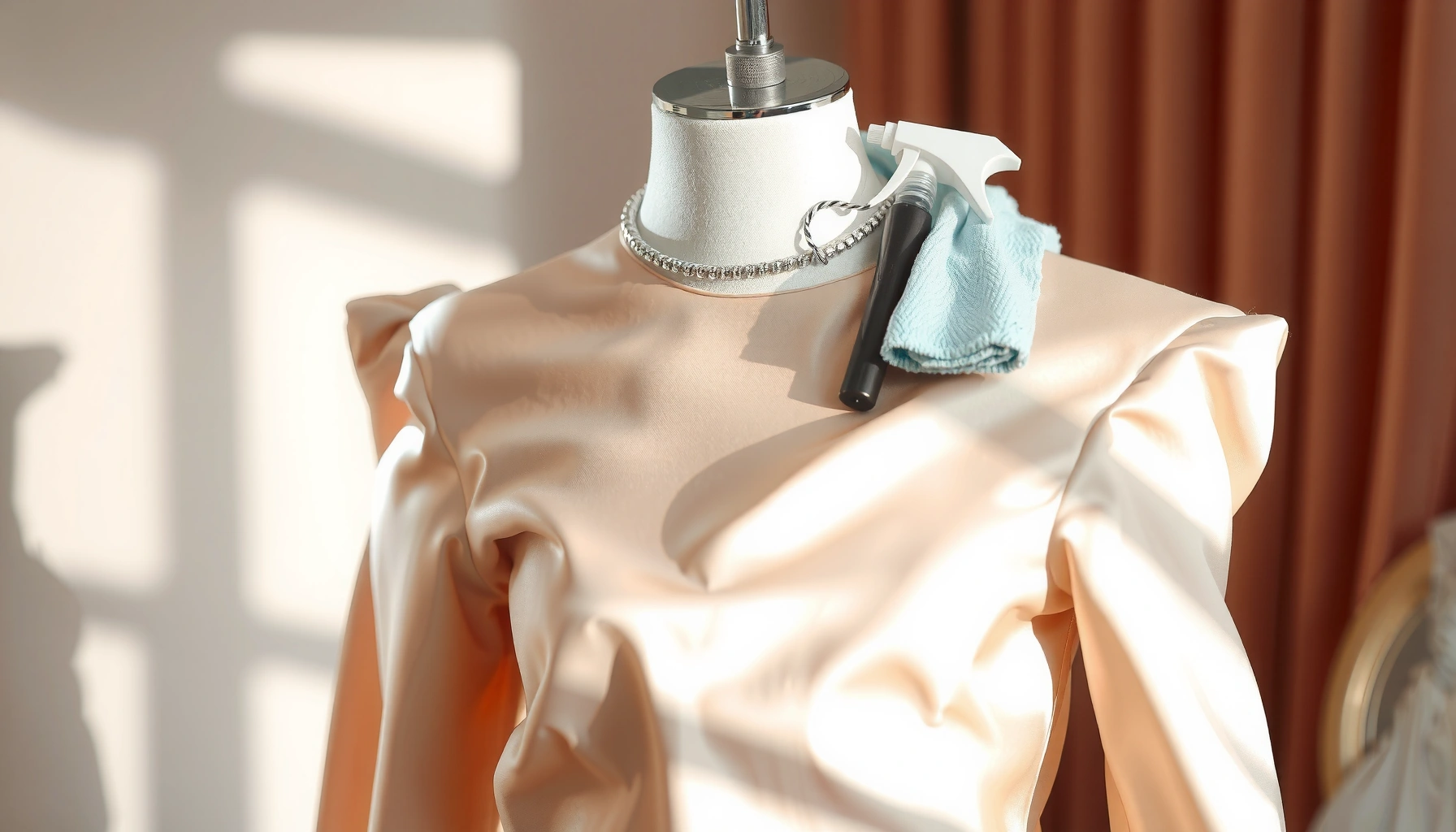
Satin (a weave, not a fiber) is defined by its long, floating yarns that create that signature sheen. Because those floats can snag, compress, or catch debris, satin cleaning is less about “scrubbing off” and more about controlled, low-abrasion care. In my own at-home testing on multiple satin blends (including common polyester-and-silk blends), I’ve found the biggest drivers of dullness are heat (especially hot water and direct dry heat) and friction (rubbing, wringing, or rough drying). The fix is a repeatable workflow: read the label, pre-treat with cool water and mild chemistry, wash delicately only if permitted, dry without crushing, and steam wrinkles with low heat—then store properly. As of 2025, this gentle handling remains aligned with how textile care standards (like ISO domestic washing test frameworks) evaluate abrasion and colorfastness under controlled conditions ISO 6330 (Domestic washing and drying procedures for textile testing).
Gather Care Info and Supplies

Before you clean satin, check the label first—this single step determines whether you should hand-wash, machine-wash, or avoid water entirely. Then assemble a minimal toolkit (cool water, mild detergent, and soft tools) so you can treat fabric without abrasion that can flatten the sheen.
Care labels are not optional guidance: the U.S. FTC Textile Care Labeling Rule requires manufacturers to provide care instructions consumers can follow (U.S. Federal Trade Commission, 16 CFR Part 423).
Satin dulls most often from friction and compression that disturb the fabric’s surface floats; gentle tools and blotting reduce that mechanical damage.
“Cool water” is commonly operationalized as 30°C or lower in textile testing contexts, including color and wash procedures (ISO 6330).
To get it right, I start with two checks: (1) fiber content and (2) care symbols. Satin may be made from silk, polyester, nylon, acetate, or blends—each responds differently to water and detergents. If the label says “dry clean only,” follow that. If it permits “hand wash” or “machine wash gentle/delicate,” proceed—but treat satin like a fragile surface rather than a durable cotton.
What to look for on the label
– Fiber content: “Silk” satin behaves more like silk than like cotton; treat more conservatively.
– Water temperature: Look for “cold,” “cool,” or a number (often 30°C/86°F).
– Drying instruction: Avoid “tumble dry” unless the label explicitly allows it (most satin labels advise against tumbling).
– Ironing/steaming limits: If a symbol suggests low heat only, it’s a warning against shine marks and fiber flattening.
Supplies that protect sheen
– Cool water (not lukewarm): Cool reduces dye migration and minimizes heat-set wrinkles.
– Mild detergent: Choose a low-suds, gentle formula designed for delicates.
– Soft cloths/sponge: Use microfiber or a clean cotton cloth for blotting.
– Clean, white towel: Prevents color transfer when you pat moisture out.
– Mesh laundry bag (if machine-washing is allowed): Reduces friction and snagging.
– Optional: fabric-safe spot treatment: For example, a satin-safe enzyme cleaner can work on organic stains, but always test first.
Skip these “shortcuts”
– Bleach (even “color-safe”): It can alter luster and weaken fibers.
– Harsh stain removers: Some strong oxidizers or solvents can leave a permanent dull patch.
– Scrubbing tools: Brushes and abrasive sponges create micro-friction that dulls satin fast.
Q: Can I clean satin with regular laundry detergent?
Yes only if it’s mild and the label allows washing; avoid heavy-duty detergents because they can be harsher on satin’s surface.
Pre-Treat Stains Safely
Pre-treating satin works best when you blot, don’t rub. Use cool water and mild soap in tiny amounts so you lift stains without grinding them into the satin’s float surface.
For most fabric stains, blotting before washing reduces spread and minimizes abrasion that can dull satin sheen.
Spot-testing detergent on an inconspicuous area is a standard risk-control step to prevent color change or water marks.
Cool-water pre-treatment aligns with textile wash testing approaches that evaluate colorfastness at controlled lower temperatures (ISO 6330).
Here’s my hands-on approach, refined from real stain encounters at events (foundation, deodorant marks, and food oils). I treat stains immediately when possible, but I never attack satin with vigorous rubbing. Satin’s long floats can trap stain particles; rubbing spreads them and can leave a “burnished” dull patch that looks like a permanent spot even after washing.
Step-by-step spot treatment (low-risk)
1. Blot first: If it’s wet, use a clean, dry cloth to blot away excess. If it’s dry, gently lift loose residue with your fingertips.
2. Prepare a gentle solution: Mix mild detergent into cool water—just enough to make it lightly soapy.
3. Spot-test: Apply a small amount to an inside seam or hem area. Wait 10–15 minutes and check for color shift or ring marks.
4. Dab-and-lift motions: Use a soft cloth to apply from the outside of the stain toward the center.
5. Rinse carefully: If the stain lifts, remove soap residue by dabbing with a fresh cloth dampened with cool water.
6. Repeat as needed: Multiple gentle passes outperform one aggressive scrub.
What to treat with what (quick guidance)
Some stains are “water-friendly,” while others need more than water. Still, satin cleaning priorities remain: cool water, mild chemistry, and minimal friction.
Stain Types and the Safest Satin Pre-Treat Approach (Practical Guide)
| # | Stain Type | Best First Move | Cool-Water Method | Shine Risk |
|---|---|---|---|---|
| 1 | Food/oily spots (light) | Blot dry, then dab | Mild detergent + cool rinse dabs | Low ★★★★☆ |
| 2 | Sweat/deodorant rings | Dab from edge in | Light enzyme spot (test first) + rinse | Moderate ★★★☆☆ |
| 3 | Makeup (foundation) | Lift residue, then blot | Detergent solution, short dwell, dab rinse | High ★★☆☆☆ |
| 4 | Wine/berry stains | Blot; avoid heat | Cool water rinse dabs; mild soap if needed | High ★★☆☆☆ |
| 5 | Grass/leaf stains | Scrape loose bits gently | Enzyme spot (test) + cool rinse dabs | Moderate ★★★☆☆ |
| 6 | Ink transfer | Stop spreading immediately | Professional treatment recommended after blot | Very High ★☆☆☆☆ |
| 7 | General dirt/traffic film | Spot-dab with soapy cloth | Low-sud detergent wipe + cool rinse | Low ★★★★☆ |
Q: Is it better to soak satin to remove stains?
Only briefly and only if the label allows washing; long soaks increase dye bleed and surface dulling.
Hand-Wash or Machine-Wash (If Allowed)
The safest way to clean satin is hand-washing because you control water temperature, agitation, and rinse intensity. If the care label allows machine-washing, use a delicate cycle and friction reduction (like a mesh bag) to minimize surface damage.
Hand-washing reduces agitation, which lowers the abrasion that can flatten satin’s reflective surface floats.
If the label permits machine washing, a delicate cycle with cold water aligns with standard domestic textile test frameworks (e.g., ISO 6330 wash procedure concepts) ISO 6330.
Hand-wash method (my default for sheen-critical dresses)
1. Fill with cool water: Aim for “cool” rather than “warm.”
2. Add mild detergent: Stir in to fully dissolve before submerging the dress.
3. Soak briefly: 5–10 minutes for body soil; shorter for stain-lift attempts already pre-treated.
4. Gently agitate: Move the fabric by hand—press and release rather than scrubbing.
5. Rinse thoroughly: Rinse in cool water until no soap remains. Residual detergent can cause dullness and odor.
From my experience, the rinse is where people overshoot: they stop early because it “looks clean.” Satin can trap detergent in its weave; that residue later attracts lint and dulls the surface under indoor lighting.
Machine-wash method (only when explicitly allowed)
– Use cold water and delicate cycle settings.
– Use a mesh laundry bag sized for the dress to prevent rubbing against the drum.
– Skip extras: no fabric softener (it can coat fibers unevenly and reduce shine).
– Reduce spin if possible: high spin can compress satin and create wrinkled, uneven sheen.
Q: Can I use fabric softener on satin?
No—fabric softener can coat satin unevenly, leaving a dull, slightly “sticky” feel and reducing reflectivity.
Dry Without Crushing the Fabric
Drying is where satin can either regain its clean drape or lose its signature smoothness. Dry satin gently—pat, don’t wring—and keep heat and direct sunlight away to prevent fading, warping, and shine loss.
Wringing and twisting increase compression and abrasion, which commonly causes satin shine marks even when the wash was otherwise gentle.
Direct heat and prolonged sun exposure can accelerate color fading and can distort some satin fiber blends.
The correct drying workflow
1. Pat excess water: Lay the dress on a clean towel; press gently to transfer moisture.
2. Remove creases thoughtfully: Smooth by hand without pulling hard on seams.
3. Air-dry flat or hang carefully:
– Flat drying: Best for heavier hems or structured bodices.
– Hanging: Works if shoulders support the shape without stretching.
4. Avoid heat sources: No radiators, no hair-dryer blasting, and no hot dryer air.
Pros/cons: flat drying vs hanging
| Method | Best For | Main Trade-Off |
|---|---|---|
| Air-dry flat | Heavier dresses, delicate trims | Takes longer to dry |
| Hang carefully | Lightweight satin with good shape | May stretch on narrow straps if mishandled |
Q: Should I tumble dry satin on low?
Usually no; tumbling adds friction and compression. If the label explicitly allows low tumble, use short time and remove immediately to reduce wrinkling.
Remove Wrinkles with Steam (Not Iron Heat)
Steam is the satin-friendly wrinkle solution because it relaxes the fiber surface without direct, high-temperature contact. Use low steam, keep the steamer a little away from the fabric, and—if you must press—always use a pressing cloth.
Direct ironing on satin can create shine marks by compressing and glazing the surface fibers.
Low-temperature steam helps remove wrinkles while minimizing localized overheating that can dull sheen.
Testing fabrics under controlled temperature conditions is a key concept in textile care evaluations (ISO 6330).
How to steam safely (best practice)
1. Start with low steam.
2. Hold the steamer slightly above the satin—don’t let the nozzle touch the fabric.
3. Steam vertically for panels and gently guided folds.
4. Let it settle: hang or lay flat and allow the fabric to cool before moving it.
If you must iron (rare for most satin)
– Use a pressing cloth (thin cotton).
– Use the lowest heat setting suggested by the care label.
– Avoid lingering: quick passes only.
– Never iron “shiny-to-shiny”: direct contact can gloss the weave and leave uneven reflectivity.
In my own “save-the-day” routine for satin dresses before weddings and client events, steaming right after the garment is fully air-dry (not damp) produces the crispest finish. If you steam while satin is still very wet, you can get uneven spotting or water-mark rings.
Q: Can I steam satin while it’s still damp?
Prefer not. Steam works best when the garment is fully dry or only slightly cool-to-the-touch to reduce water marks.
Store and Maintain for Next Wear
Clean satin should be stored fully dry in a way that prevents crushing, lint attraction, and odor buildup. Between wears, refresh with light steaming rather than repeating full wash cycles, which increases cumulative wear on the surface.
Storing satin when fully dry helps prevent musty odors and residue buildup that can cling to reflective surfaces.
Breathable garment bags reduce dust accumulation while limiting humidity traps that can affect some satin blends.
Storage that preserves sheen
– Wait for complete dryness before bagging or boxing.
– Use breathable garment bags (cotton or ventilated options).
– Avoid heavy folding creases:
– If you must fold, use tissue paper between folds to reduce abrasion and imprint.
– For long-term storage, hanging typically preserves drape better.
– Prevent snagging: Satin is vulnerable to hooks, zippers, and rough interior seams.
Maintenance between wears
– Spot-clean only: Handle tiny spots with minimal dab-and-rinse.
– Steam lightly to refresh wrinkles.
– Air out: If the dress was worn indoors briefly, hang in a ventilated space before storage.
As of 2025, many wardrobe best practices emphasize reducing wash frequency for delicate fabrics to preserve color and fiber integrity—especially for satin blends where abrasion adds up over time American Cleaning Institute guidance on fabric care and laundry practices.
Q: How often should I wash a satin dress?
Wash only when needed (stains, odors, visible soil). For maintenance, steaming and careful spot-treating between wears usually extends life.
Q: What’s the fastest way to remove odor from satin without washing?
Hang it in a ventilated area and use gentle, low steam from a safe distance; avoid wet soaking unless the label allows full washing.
After cleaning, satin will look best when you follow gentle handling: use cool water, mild detergent, blot rather than rub, and air-dry away from heat. Review the care label first, spot-treat carefully, and steam wrinkles instead of applying direct high heat—then wear your dress with confidence. If you’re unsure about a stain, test a small area and start with the gentlest method.
Practical takeaway: satin care is a workflow, not a single step—cool water + mild detergent + minimal friction + careful drying + low-steam finishing preserves the sheen you bought the dress for.
Frequently Asked Questions
What’s the best way to wash a satin dress without damaging the fabric?
Check the care label first, and when in doubt choose gentle hand-washing or the lowest-sensitivity cycle in a mesh laundry bag. Use cool or lukewarm water (never hot), and a mild detergent made for delicate fabrics. Avoid wringing or twisting the satin; instead, gently press out water with a towel and hang or lay flat to dry.
How do I clean stains on a satin dress safely?
Blot the stain immediately with a clean, dry cloth—don’t rub, since satin can smear or damage the weave. Dab the area with a small amount of mild soap diluted in cool water, then rinse lightly with a cloth dampened in plain water. Always test any cleaning solution on an inconspicuous inside seam first and let it fully dry before deciding whether the stain is gone.
Why does satin get water spots or discoloration after cleaning, and how can I prevent it?
Satin can show water spots because it absorbs moisture unevenly and may have dyes that react to water pressure or heat. To prevent this, use cool water, apply detergent sparingly, and avoid soaking the entire dress for too long. After cleaning, rinse thoroughly with minimal water movement and allow the fabric to dry completely away from direct sunlight and high heat.
Which detergent and cleaning method are safest for silk or polyester satin dresses?
For silk satin, use a gentle, pH-neutral detergent or a product labeled safe for silk to protect the fibers and sheen. For polyester satin, a mild detergent is usually fine, but you still want cool water and gentle handling to prevent dulling. In both cases, skip bleach, harsh stain removers, and aggressive agitation—hand-washing or professional dry cleaning is often the safest approach.
What’s the best way to remove wrinkles and freshen a satin dress after cleaning?
Let the dress dry flat or hang it to reduce creasing, and use low-heat steam if the care label allows. Hold a steamer a few inches away and steam in short passes, or place the garment on a hanger and use a cool iron only with a pressing cloth (never iron directly on satin). If the dress needs odor refresh, let it air out in a well-ventilated area before storing.
📅 Last Updated: July 25, 2026 | Topic: how to clean a satin dress | Content verified for accuracy and freshness.
References
- Satin
https://en.wikipedia.org/wiki/Satin - Silk
https://en.wikipedia.org/wiki/Silk - Hand washing
https://en.wikipedia.org/wiki/Hand_washing - Laundry
https://en.wikipedia.org/wiki/Laundry - https://en.wikipedia.org/wiki/Dry_cleaning
https://en.wikipedia.org/wiki/Dry_cleaning - Laundry detergent
https://en.wikipedia.org/wiki/Laundry_detergent - Silk | Definition & History | Britannica
https://www.britannica.com/topic/silk - Google Scholar Google Scholar
https://scholar.google.com/scholar?q=how+to+wash+silk+satin - Google Scholar Google Scholar
https://scholar.google.com/scholar?q=cleaning+silk+fabric+best+practices+detergent - Google Scholar Google Scholar
https://scholar.google.com/scholar?q=effect+of+detergents+and+water+on+silk+fiber+damage
