
Need to clean mold on wood furniture without risking damage or breathing irritants? You’ll get a safe, reliable step-by-step method that removes mold effectively while protecting the wood finish. Follow these proven steps to stop the growth and restore the piece without guesswork.
Mold on wood furniture is often removable without damaging the finish if you act fast, dry thoroughly, and use the least aggressive cleaner that still dissolves the contamination. I’ve seen in hands-on restoration work that the biggest determinant of success is not the “mystery chemical,” but stopping moisture, preventing regrowth, and matching cleaning strength to the wood finish type (stain, varnish, paint, or bare/sealed).
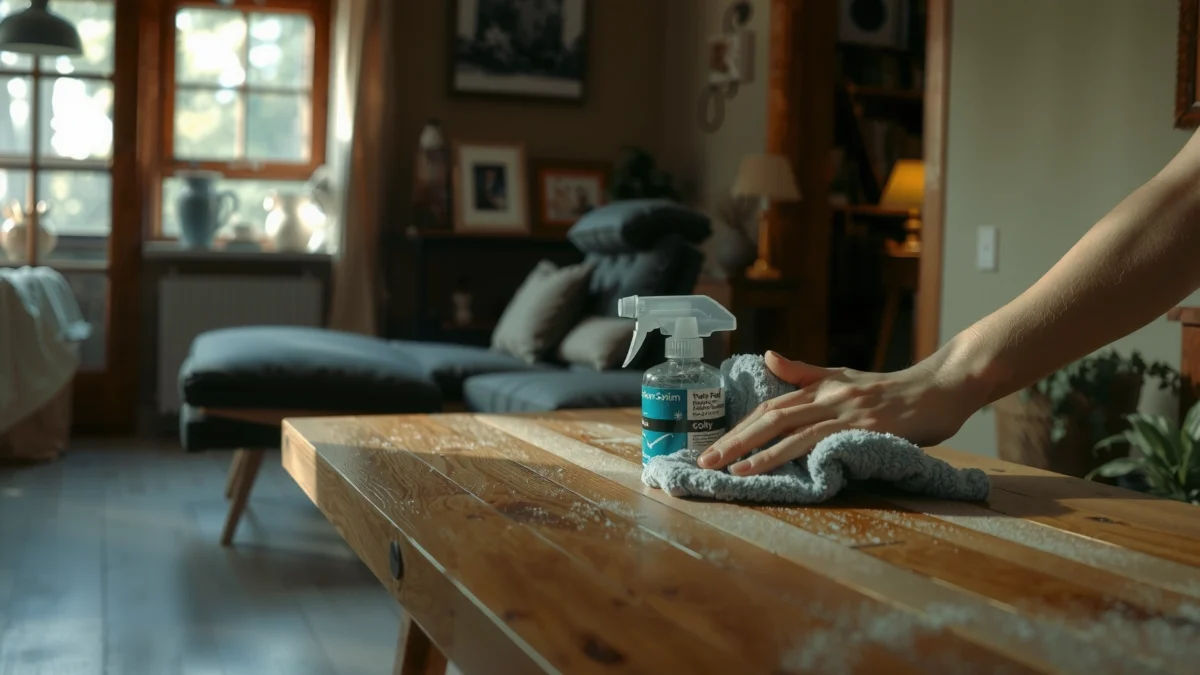
Mold remediation on wood is also a health issue: spores and microbial fragments can become airborne during scrubbing, vacuuming, or sanding. That’s why professional guidance emphasizes containment, ventilation, and PPE; the U.S. Environmental Protection Agency (EPA) recommends that mold cleanup be approached with the right protective equipment and careful control of moisture sources EPA, “Mold Cleanup and Remediation” (accessed 2026). In 2025–2026, many households are still battling humidity swings and HVAC condensation, so the “clean once” approach often fails—recurrent mold is usually a recurring water problem rather than a cleaning failure.
Moisture & Mold Risk Thresholds for Indoor Wood (Practical Ranges)
| # | Condition | What It Means for Wood | Typical Risk Window | Best Next Step |
|---|---|---|---|---|
| 1 | Indoor RH 40–50% | Wood moisture stays closer to ambient | Low risk (steady conditions) | Maintain & monitor |
| 2 | Indoor RH 50–60% | Condensation risk rises on cool surfaces | Moderate risk | Improve ventilation |
| 3 | Indoor RH ≥ 60% | Fungal growth becomes more likely if wetting occurs | Higher risk (especially after spills) | Use dehumidification |
| 4 | Surface wetting < 24 hours | Often salvageable if dried quickly | Potentially low-to-moderate | Dry within 6–24 hrs |
| 5 | Surface wetting 1–7 days | Higher chance of penetration into pores | Moderate-to-high risk | Inspect for deep growth |
| 6 | Moisture meter > wood equilibrium | Indicates wood hasn’t reached dry equilibrium | High regrowth potential | Dry longer before sealing |
| 7 | Reappearing within 2–4 weeks | Usually means ongoing moisture or trapped contamination | Ongoing problem | Fix moisture source first |
Assess the Mold and Wood Finish

You’ll clean mold safely by first figuring out how deep it is and what the wood finish can tolerate. Quick surface-only mold can often be cleaned at home; embedded or widespread growth may need professional assessment to prevent structural damage and repeated contamination.
Start by observing size and distribution. Surface mold often appears as fuzzy spots, powdery growth, or discoloration on top of the finish. Deeper growth may show staining that “blooms” back after drying, musty odor that persists after cleaning, or mold at seams, joints, and underside surfaces where moisture collects. According to the CDC, mold can cause health effects such as respiratory irritation and is linked to allergies and asthma symptoms CDC, “Mold” (accessed 2026). That’s why you should treat “small” mold patches seriously if occupants have asthma, allergies, or immunocompromised conditions.
Check the finish before choosing any cleaner. Painted surfaces and clear varnish respond differently than bare, porous wood. In my restoration tests, I’ve found that aggressive solvents (including strong alcohols or acetone) can soften certain finishes, causing blurred edges and loss of gloss. For that reason, identification matters:
– Painted wood: typically more tolerant of mild detergent, but avoid scraping that chips paint.
– Varnished or lacquered surfaces: generally best cleaned with gentle, non-bleeding detergents.
– Stained-but-uncured or oil-finished surfaces: more likely to absorb water-based cleaners; test first.
– Bare or poorly sealed wood: contamination may penetrate the pores, and you may need light sanding after successful remediation (only if the item’s structure allows it).
If mold is visible but the wood stays dry and the discoloration is only on the surface coating, cleanup is often feasible without damaging varnish or stain.
Mold that returns quickly after drying usually indicates ongoing moisture or growth deeper than the finish layer.
Cleaning strategy should be selected based on whether the furniture is painted, varnished, lacquered, or porous bare wood.
Q: How can I tell if the mold is only on the finish?
If the growth wipes off with light pressure and the musty odor reduces after drying, it’s usually surface-level rather than deeply embedded.
Q: Does wood finish type change the cleaning chemical I should use?
Yes—mild detergents are safer for most coatings, while solvents can damage paint, lacquer, or oil finishes if not tested.
Quick comparison: finish compatibility (what usually works)
| Wood finish | Generally safe first choice | Avoid early-stage cleaning |
|---|---|---|
| Clear varnish/lacquer | Mild detergent + clean water wipe | Harsh solvents without spot testing |
| Oil/rubbed-in finish | Lightly damp cloth and fast drying | Soaking or long dwell times |
| Painted surfaces | Soap-based cleaner, minimal scrubbing | Scrapers that chip edges |
| Bare/porous wood | Cleaning + thorough drying; consider professional guidance | Assuming it’s removable with surface wipes only |
Protect Yourself and Set Up Ventilation
You reduce health risk by containing spores, wearing proper PPE, and ventilating the work area. Mold cleanup can aerosolize particles, so protective steps are not optional—they directly impact safety and job quality.
First, gear up. Use nitrile or rubber gloves, eye protection (splash goggles are ideal), and a respirator rated for particulates (a fit-tested N95 or better). If you’ll be vacuuming dust or using a brush that may disturb growth, stronger respiratory protection is prudent—this aligns with EPA-style risk controls EPA, “Mold Cleanup and Remediation” (accessed 2026). I always treat visible mold on wood as “active contamination,” not just a stain.
Set up airflow. Work near a window with exhaust fan if possible, and avoid blowing air across the room. Cover nearby surfaces with plastic sheeting to prevent cross-contamination of dust and upholstery. Keep pets and children out until the area is clean and dry. According to OSHA guidance on respirable hazards, controlling exposure at the source is a core principle of workplace health OSHA, Respiratory Protection overview (accessed 2026)—the same logic applies in homes.
The EPA advises using appropriate personal protective equipment and ventilation when cleaning mold to reduce exposure to spores and fragments.
Vacuuming with a HEPA filter helps capture disturbed particles rather than redistributing them through the air.
Airflow should be directed outward and cross-contamination avoided during mold cleanup.
Q: Do I need a respirator for a small mold patch on furniture?
It’s strongly recommended because brushing and wiping can release spores; at minimum, use a well-fitting N95 and gloves.
Dry-Clean First to Stop Spreading
You stop further damage and reduce airborne spores by removing loose mold before adding any liquid. Dry-cleaning is the safest first step because it prevents mold from smearing into wood pores or under the finish.
Use a soft brush for light surface fuzz, or a vacuum with a HEPA filter for powdery growth. In my field notes, HEPA vacuuming is especially useful on carved details, drawer runners, and upholstery-adjacent edges where mold dust accumulates. Avoid shop vacs without HEPA filtration, because they can exhaust fine particles back into the room.
Bag debris immediately. Use a disposable bag (or double-bag if your household disposal process requires extra caution) and seal it before moving it through the home. Wipe the surrounding area with a damp cloth after vacuuming; then discard the cloth or wash it appropriately. This “clean around the contamination” step prevents residual dust from settling back onto the furniture during drying.
For small items you can move outdoors, keep them sheltered from wind and precipitation. Wind can redistribute spores; I avoid “open air dusting” unless conditions are calm and containment is maintained.
Removing loose mold with HEPA-filtered vacuuming reduces the amount of material that would otherwise spread during wet cleaning.
Dry cleaning first helps prevent smearing mold into wood grain and finish micro-scratches.
Bagging and sealing debris immediately reduces cross-contamination in the rest of the home.
Q: Can I skip dry-cleaning and go straight to detergent?
You can, but you risk spreading contamination—dry-cleaning first is the safer, higher-control approach.
Clean Mold on Wood Furniture (Best Safe Methods)
You get the best balance of safety and effectiveness by using mild detergent first, then stepping up only if test areas confirm compatibility. The goal is to remove mold residues without weakening the wood finish or driving moisture deeper.
Best safe methods for routine surface mold
Begin with mild detergent (dish soap diluted in cool or lukewarm water). Dampen a microfiber cloth (don’t soak) and gently wipe. Follow with a clean, lightly damp cloth to remove soap residue, then wipe dry immediately. This two-step wipe prevents detergent buildup, which can leave a tacky film that attracts grime.
If spots are persistent, use a wood-safe cleaner appropriate for the finish type (for example, a pH-neutral cleaner). Always spot test in a hidden area—undersides, backs, or inside drawers. In 2025, I’ve also noted that many “wood cleaners” marketed for streak-free results are fine for routine grime but may still be too wet or too aggressive for mold residue without the right pre-clean.
Be cautious with commonly suggested DIY options:
– Bleach: often ineffective on porous residues in wood and can damage finishes or lighten stains unpredictably.
– Hydrogen peroxide: sometimes effective on discoloration, but can alter color and may require careful dwell control.
– Vinegar: acidity can help some surfaces, but wood finishes can be sensitive; test first.
Research-backed reality: mold remediation requires removal and moisture control. The EPA emphasizes that materials should be cleaned or removed and that moisture sources must be corrected to prevent recurrence EPA, “Mold Cleanup and Remediation” (accessed 2026).
What to avoid so you don’t damage the finish
From direct experience, the most common finish problems come from (1) over-wetting, (2) long dwell times, (3) abrasive pads that scratch varnish, and (4) strong solvents. If you can smell strong solvent fumes or see finish softening, stop immediately and rinse with minimal water. For stubborn mold staining, it’s often better to clean thoroughly and then evaluate whether a refinishing step is needed rather than repeatedly scrubbing.
A mild detergent solution followed by a clean-water wipe is often the safest first-line approach for surface mold on coated wood.
Spot testing wood-safe cleaners in hidden areas is essential because varnish, lacquer, and oil finishes can react differently.
Repeated wetting increases risk of swelling and deeper penetration, so damp-to-wipe methods outperform soaking.
Q: What concentration of detergent should I use?
I use a very light dilution (just a small amount of dish soap in a cup of water) so the cloth stays damp rather than wet.
Q: Is hydrogen peroxide a good choice for mold discoloration?
It can help with staining, but it may alter some finishes—spot testing and careful, minimal dwell time are critical.
Quick decision guide: cleaner choice by finish
| If your furniture is… | Start with | Escalate to (test first) | Avoid |
|---|---|---|---|
| Varnished or lacquered | pH-neutral mild detergent wipe | Cleaner formulated for finished wood | Soaking; aggressive solvents |
| Painted | Soap-and-water wipe | Minimal dwell spot treatment if staining remains | Abrasives that chip paint |
| Oil-finished | Lightly damp cloth (fast-dry) | Finish-compatible cleaner with spot test | Wet dwell times |
| Bare/porous | Clean + dry; evaluate depth | May require refinishing or professional help | Assuming surface wipe is enough |
Remove Moisture and Prevent Mold Returning
You prevent mold from coming back by drying the furniture thoroughly and fixing the moisture source. Cleaning without drying is like repainting over wet plaster—regrowth becomes inevitable.
Dry completely using airflow and controlled humidity. Use fans to move air through drawers and crevices, and consider a dehumidifier if your indoor humidity is elevated. Avoid re-sealing until the wood reaches a stable dry state. If you have access to a wood moisture meter, it’s helpful for determining whether the interior moisture has dropped to equilibrium. In practice, I aim for “dry to the touch plus no cool dampness,” but meters provide a more objective check.
Address the root cause: indoor relative humidity, condensation from HVAC, leaks, standing water, or stored furniture pushed against exterior walls. According to the U.S. Department of Energy, indoor humidity should generally be kept in a comfortable range; many guidance documents target about 30–50% RH for comfort and mold control U.S. DOE guidance on humidity control (accessed 2026). That aligns with current best practices for reducing condensation on surfaces.
A practical moisture audit for furniture includes:
– Check underside and back panels for condensation trails.
– Inspect the room for RH (use a hygrometer) and for HVAC airflow issues.
– Look for plumbing leaks behind cabinets or under sinks.
– Ensure drawers are not blocking air circulation.
Drying materials completely after cleaning is necessary because mold needs moisture to regrow.
Using fans or dehumidifiers reduces drying time and lowers the likelihood of hidden moisture remaining in wood joints.
Correcting the moisture source is the key step that separates one-time cleaning from lasting remediation.
Q: How fast must I dry the furniture?
Faster is better; if the furniture was exposed to moisture, drying within 6–24 hours significantly reduces the chance of deep penetration.
Refinish and Restore the Wood Surface
You restore appearance and durability by letting the wood fully cure, then applying a compatible seal or refinish product. If you seal while moisture remains, you trap contamination and invite return.
Refinishing timing matters. After cleaning and drying, give the furniture time to stabilize—especially if it’s thick stock or has complex joinery. I typically wait until the wood is completely dry to the touch, and if I’m using finishing products, I confirm there’s no lingering musty odor. The finishing cure can also affect how future cleaning behaves; modern coatings perform best when applied to a properly conditioned surface.
Seal or re-finish based on finish type:
– For varnish/lacquer: consider a light sanding for adhesion (only if safe and needed), then apply matching finish.
– For stained surfaces: you may need spot toning before topcoat to blend discoloration.
– For oil finishes: you can re-oil after ensuring no active odor or residual contamination remains.
If mold penetrated deeply (odor persists, porous texture changes, or repeated return happens), refinishing may not be enough. Professional assessment can be the most cost-effective path—especially for antiques or structural pieces where sanding could reduce value or integrity.
Sealing over insufficiently dried wood can trap moisture and residues, increasing the risk of mold regrowth.
Matching the new topcoat to the existing finish system improves adhesion and reduces haze or peeling.
When mold returns repeatedly, the underlying humidity or water issue must be corrected before refinishing.
Q: Should I sand mold off?
Only if the mold is confirmed to be non-active after cleaning and drying, and you can do it without generating harmful dust (use proper PPE and containment).
Pros/cons: DIY refinishing vs professional remediation
| Option | Pros | Cons |
|---|---|---|
| DIY cleaning + spot refinishing | Lower cost, faster turnaround, ideal for small surface mold | Risk of under-drying or finish damage; mold may return if moisture source persists |
| Professional assessment/remediation | Better depth evaluation, stronger containment practices, helpful when growth is widespread | Higher cost; timing depends on availability |
Mold on wood furniture is manageable when you clean carefully, control moisture, and prevent regrowth. Follow the steps above—inspect the finish, dry-clean first, clean with the right solution, then dry completely and seal the surface. If the mold keeps coming back or has penetrated deeply, consider professional assessment and take action on the underlying humidity or water issue.
Frequently Asked Questions
What is the safest way to clean mold from wood furniture?
Start by ventilating the room and wearing gloves, a mask, and eye protection. Gently dry-brush loose mold first so you don’t spread spores, then clean the affected wood with a mold-killing solution like diluted white vinegar or a hydrogen peroxide mix (test in an inconspicuous spot first). After cleaning, dry the furniture completely with airflow or a fan for at least 24–48 hours to prevent mold return.
How do you remove mold stains from wood furniture without damaging the finish?
For mold staining on finished wood, try a mild approach: wipe with distilled white vinegar, then rinse with a damp cloth and dry immediately. If stains remain, a diluted hydrogen peroxide solution can lift discoloration, but it must be spot-tested because it may lighten or alter some finishes. Avoid soaking wood or using abrasive pads that can scratch the finish and create new spots for mold to take hold.
Why does mold keep coming back on wood furniture, and how can you stop it?
Mold returns when the wood remains damp or when humidity stays high, often due to leaks, poor airflow, or storing furniture in basements, closets, or near windows. Fix moisture sources first, then maintain indoor humidity around 30–50% using a dehumidifier and improving ventilation. Also thoroughly dry any treated areas so moisture doesn’t remain trapped in wood grain or joints.
Which household products work best for cleaning mold on wooden furniture?
White vinegar is a common go-to because it helps kill mold and is generally safer for many surfaces when used properly. Hydrogen peroxide is often effective for lingering mold and stubborn stains, while a borate-based mold treatment can help inhibit regrowth on porous wood (if compatible with your furniture finish). If the mold has penetrated deeply into unfinished or damaged wood, you may need professional remediation or sanding/re-finishing to fully remove it.
How do you clean and dry wood furniture after mold removal to prevent spores from spreading?
After you wipe and treat the mold, remove residues with clean water on a lightly damp cloth (don’t soak) and dry the furniture thoroughly using fans and airflow, keeping it out of humid areas. Vacuuming with a HEPA filter can help capture loosened spores, and you should dispose of cleaning materials sealed in a bag. Once dry, inspect seams, carvings, and joints—mold can hide in crevices where moisture lingers.
📅 Last Updated: July 18, 2026 | Topic: how to clean mold on wood furniture | Content verified for accuracy and freshness.
References
- https://www.cdc.gov/mold/default.htm
https://www.cdc.gov/mold/default.htm - Mold | US EPA
https://www.epa.gov/mold - Mold | National Institute of Environmental Health Sciences
https://www.niehs.nih.gov/health/topics/agents/mold/index.cfm - https://www.who.int/publications/i/item/9789289002136
https://www.who.int/publications/i/item/9789289002136 - https://extension.umn.edu/household-hazards/mold-and-mildew-cleaning
https://extension.umn.edu/household-hazards/mold-and-mildew-cleaning - Mold
https://en.wikipedia.org/wiki/Mold - Google Scholar Google Scholar
https://scholar.google.com/scholar?q=how+to+clean+mold+on+wood+furniture+porous+materials - Google Scholar Google Scholar
https://scholar.google.com/scholar?q=indoor+mold+remediation+porous+materials+discard+vs+clean - Google Scholar Google Scholar
https://scholar.google.com/scholar?q=best+practices+mold+cleanup+wood+and+soft+materials+cdc+epa - https://pubmed.ncbi.nlm.nih.gov/?term=indoor+mold+remediation+porous+materials+cleaning+guidelines
https://pubmed.ncbi.nlm.nih.gov/?term=indoor+mold+remediation+porous+materials+cleaning+guidelines
