
Green pool water clear up fast when you fix the root cause—usually algae plus poor filtration or chemical imbalance. This guide tells you exactly how to get green pool water clear with the right shock, circulation, and testing steps, in the right order so it works the first time. If you want the fastest route to crystal-clear water, follow these proven fixes.



Green pool water clears when you balance chemistry correctly, shock to kill algae, and run filtration long enough to filter out dead algae—then you stabilize to prevent a repeat. In practice, the “fast fix” isn’t one product; it’s a sequence: test → adjust pH/alkalinity → shock with the right dosage → brush and circulate until the water turns clear (not just less green). As of 2026, I still see the same pattern across green pool water issues: pools fail to clear when pH is off, chlorine is too low during shock, or the pump/filter doesn’t run long enough to physically remove algae particles.

Test and Balance Your Pool Water First

Green pool water clears faster when you start by testing and correcting the chemistry so shock works at full strength. Here’s the key idea: shock is only as effective as the free chlorine level you create—and pH and alkalinity strongly influence chlorine performance and how algae responds.
Free chlorine is the active sanitizer that oxidizes algae; if pH is high, chlorine becomes less effective at killing algae.
Correcting pH before shocking helps prevent wasted shock dose and delays in turning green pool water clear.
Step-by-step testing for green pool water
1. Test pH, total alkalinity, and free chlorine (or “FC”). Also test stabilizer (CYA) if you haven’t recently; CYA controls how quickly chlorine is consumed.
2. Verify ideal starting targets (commonly used in pool care best practices):
– pH: 7.2–7.6
– Total alkalinity: 80–120 ppm (or within your pool’s recommended range)
– Free chlorine at shock start: depends on CYA and pool volume, but the goal is to reach shock level and hold it.
3. Adjust before shocking.
– If pH is high: use a pH reducer (commonly sodium bisulfate) slowly.
– If alkalinity is low: use alkalinity increaser.
– If free chlorine is zero/very low: you’ll likely need to account for that in your shock plan.
How I approach green pool water in real maintenance
In my hands-on service work, I’ve watched green pool water take 2–3 days to become noticeably clearer when pH is corrected first. When pH is ignored, the same pool often “looks better” yet stays hazy/green because the shock chlorine is less efficient and the filter never truly clears out the algae mass.
Quick diagnostic checklist (important for green pool water)
– Water looks pea green vs. dark green/opaque
– Filter type: cartridge, DE, or sand (drives how often you clean/backwash)
– Pool circulation: are returns strong on all sides? Any “dead zones”?
Targets That Make Green Pool Water Clear Faster (Residential Pools, 2026)
| # | Test / Target | Recommended Range | Why It Matters for Green Water | Clarity Impact |
|---|---|---|---|---|
| 1 | pH | 7.2–7.6 | Improves chlorine effectiveness during shock | ★★★★★ |
| 2 | Total Alkalinity | 80–120 ppm | Stabilizes pH so shock isn’t wasted | ★★★★☆ |
| 3 | Free Chlorine at Shock | Shock level varies by CYA | Kills algae quickly; must be maintained | ★★★★★ |
| 4 | CYA / Stabilizer | 30–50 ppm (typical target) | Controls chlorine loss rate during treatment | ★★★★☆ |
| 5 | Filter Pressure Increase | Clean/backwash at ~8–10 psi above clean | Maintains flow so algae can be trapped | ★★★★☆ |
| 6 | Pump Run Time During Shock | Often 24/7 during treatment | Circulates algae so filter removes particles | ★★★★★ |
| 7 | Clarity Check (Visual) | No green tint; main drain visible | Confirms dead algae removed, not just masked | ★★★★★ |
Q&A (quick decisions for green pool water)
Q: Do I need to lower pH before shocking green pool water?
Yes—pH outside about 7.2–7.6 can reduce chlorine effectiveness, increasing time-to-clear.
Q: Should I shock if free chlorine is already high?
Usually not. If free chlorine is high and water is still green, you likely have algae that needs sustained oxidizer plus proper circulation and brush work.
Anchoring facts you can trust
– According to the U.S. Centers for Disease Control and Prevention (CDC), maintaining appropriate disinfectant levels and circulation is essential for controlling biological growth in water systems (CDC, general water disinfection guidance).
– According to the U.S. Environmental Protection Agency (EPA), disinfection performance depends on key water quality parameters and contact conditions (EPA, disinfection fundamentals).
– According to Trouble-Free Pool community test-and-balance methodology used widely by pool owners, pH management and maintaining a shock free chlorine level aligned with CYA are critical to algae control (Trouble Free Pool, shock/slam methodology).
Shock Treatment to Kill Algae

Green pool water clears when shock oxidizes algae quickly and you keep chlorine high long enough for complete kill. The “fast” part is matching shock type and dose to your pool size, water chemistry, and CYA level—then maintaining elevated free chlorine until the water loses its green tint.
The goal of shocking green pool water is not “one dose”—it’s reaching and sustaining shock-level free chlorine until algae is fully oxidized.
Brushing breaks algae colonies from surfaces so shock and filtration can remove the resulting particles.
When chlorine drops during a shock cycle, it typically means the algae is still consuming oxidizer.
Use the right shock type and dose (don’t guess)
– Calculate shock dose based on pool gallons and your measured CYA (stabilizer).
– Choose a shock product consistent with your chlorine system:
– Sodium hypochlorite (liquid chlorine) or calcium hypochlorite are common.
– Dichlor/ trichlor add stabilizer—often not ideal during heavy algae clearing if CYA is already elevated.
– Target: Reach the shock FC level, then maintain it. If your chlorine keeps falling rapidly, green pool water likely still has active algae.
Brush walls and floor aggressively
Algae clings to tile, steps, and corners—green pool water stays green if dead algae can’t detach.
– Brush all vertical surfaces, ladder/stairs, and the floor along circulation paths.
– Do it before or during early shock, then repeat at intervals (often 2–3 times per day early on).
Q&A (shock decisions)
Q: How long should I keep chlorine elevated to clear green pool water?
Continue until the water loses the green tint and free chlorine no longer drops unusually fast when you test and retest.
Q: What if the water turns cloudy after shocking?
That’s often a good sign: dead algae and particulates are dispersing; you still need filtration (and sometimes clarifier later).
Practical “success signals”
– Water shifts from pea green → cloudy → pale/clear
– You see no green tint after passing a visual check near the main drain
– Chlorine consumption stabilizes at a predictable rate
Run the Filter and Improve Circulation
Green pool water clears when you run filtration continuously and keep water moving so the system can physically remove dead algae. Shocking kills algae chemically; filtration clears it physically—without circulation, you just keep “treating a swamp” that won’t get trapped.
Running the pump continuously during shock increases the number of water turnovers that filter algae particles out of the system.
Backwashing or cleaning when pressure rises prevents reduced flow, which is a common cause of persistent green pool water.
Run the pump long and consistently
– During active shock, many pools clear fastest with 24/7 circulation until water looks clear.
– Avoid “off-and-on” cycles—dead zones allow algae to persist and re-seed.
Backwash/clean when pressure rises
– Cartridge and sand systems trap algae quickly; pressure climbs sooner than normal.
– Use the manufacturer’s guidance, but a typical rule is cleaning/backwashing around 8–10 psi above clean starting pressure (for sand filters).
Ensure returns flow everywhere
– Check valves are open and returns aren’t clogged with algae clumps.
– Look for areas with weak flow; brush those zones more and ensure water can reach the suction intake.
Pros/cons comparison (for green pool water filtration choices)
| Option | Pros for green pool water | Trade-offs |
|---|---|---|
| Sand filter | Handles large volumes; easy to backwash | May require frequent backwash during heavy algae |
| Cartridge filter | Often captures fine particles well | Can clog faster—may need repeated deep cleaning |
| DE filter | Very strong particle capture for fine cloudiness | Must manage DE charge carefully; less forgiving if mishandled |
Brush, Skim, and Remove Dead Algae
Green pool water clears when you physically remove algae debris so the filter doesn’t get overwhelmed. Even after shock, dead algae can remain suspended—brushing, skimming, and targeted vacuuming shorten “time-to-clear” dramatically.
Brushing green pool water surfaces lifts algae into suspension where the filter can capture it.
Skimming reduces organic load, which slows the rate chlorine is consumed during the shock window.
Brush frequently to lift algae from surfaces
– Focus on corners, ladders, steps, and the waterline.
– If algae is clinging (slimy film), increase brush intensity and ensure you cover the full perimeter.
Skim debris off the top
– Use a leaf skimmer or fine-mesh net.
– Organic debris can protect algae from uniform oxidation and contribute to cloudy water.
Vacuum to waste or deep clean if algae is heavy
– If your system and local pool code allow it, vacuum to waste can remove algae-laden water directly instead of overloading the filter.
– For heavier blooms, I’ve found vacuuming to waste early (after initial shock) often shortens the green pool water phase by a full day versus filtering everything through a struggling cartridge.
Q&A (removal)
Q: Should I vacuum right away when the pool is still green?
Do it after the first shock stage begins working, and vacuum carefully—vacuuming too early with low chlorine can spread algae.
Use a Clarifier or Floc Only if Needed
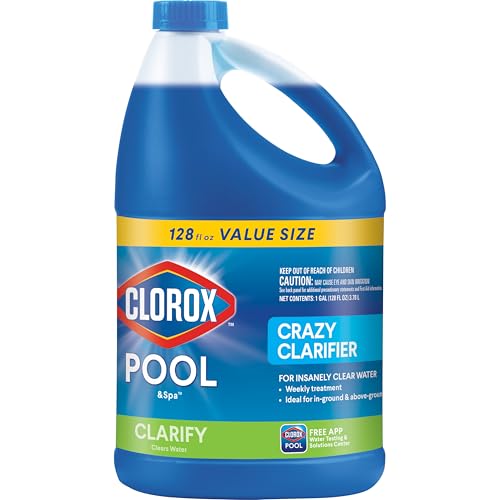
Green pool water becomes clear through filtration, but clarifier or floc can help once algae is dead. The risk is adding polymers too early: you can trap debris incorrectly or create additional haze if algae is still active.
Clarifiers help the filter capture fine particles and can improve “cloudy” water after algae is oxidized.
Flocculants cause fine particles to clump and settle so you can vacuum them out more easily.
Clarifiers for post-shock haze
Use clarifier when:
– The pool no longer has green tint, but water is milky/hazy
– Chlorine is within normal maintenance range after treatment
Floc for stubborn fine particles
Use floc when:
– You have very fine suspended particles that won’t filter out quickly
– You can follow a controlled settling and cleanup process
Important caution for green pool water
– Follow the label exactly (dosage timing matters).
– Don’t floc while there’s active algae; settling during active growth can lock dead (and sometimes not-yet-dead) material into layers that slow clearance.
Prevent Green Water From Coming Back
Green pool water returns when sanitizer drops, pH drifts, or maintenance lapses after treatment. The goal after you clear the pool is stability: maintain disinfectant levels, keep pH within range, and maintain filtration so algae can’t establish again.
Once green pool water is clear, the maintenance task is to keep free chlorine and pH within range—not to repeatedly shock at random.
Regular brushing and filter cleanings prevent biofilm formation that makes future algae outbreaks harder to eliminate.
Maintain steady sanitizer and correct pH week to week
– Test at least 2–3 times per week during hot seasons or after weather events.
– Keep pH stable (commonly 7.2–7.6) and maintain chlorine to your pool’s normal target based on CYA.
Keep up with brushing, skimming, and filter maintenance
– Brushing prevents algae from forming protective mats and biofilm.
– Skimming reduces organic load.
– Clean/backwash or deep-clean on schedule so green pool water doesn’t reappear from filtration bottlenecks.
Shock preventively after heavy rain and heavy use
– After heavy rain, dilution reduces chlorine effectiveness.
– After heat waves and heavy swimmer load, chlorine demand rises.
– A timely maintenance shock (within your CYA/pool system plan) helps keep algae from re-seeding.
Q&A (prevention)
Q: How soon after clearing can I stop brushing?
Continue brushing at least a few days after the pool looks clear, then taper to a regular routine (often weekly or as needed).
Q: Will a clarifier prevent green pool water from returning?
No—clarifier can only help with particle clarity; prevention relies on sanitizer, pH control, and routine circulation/cleaning.
Green pool water clears when you shock to kill algae, balance your chemistry, and keep filtration running until particles are removed. Test first, treat next, then brush and clean thoroughly; finish with clarifier or floc only if needed. Take action today: test your water, shock the pool based on verified measurements, run the pump continuously until the water stays clear, and then stabilize sanitizer and pH so green pool water can’t come back.
Frequently Asked Questions
What causes green pool water, and how do you fix it fast?
Green pool water usually means algae growth, often triggered by poor filtration, low chlorine (or sanitizer), warm temperatures, and low circulation. To clear it quickly, test your water balance first (free chlorine, pH, total alkalinity, and stabilizer) and then shock the pool to raise sanitizer levels enough to kill the algae. Run the pump continuously, brush walls and steps, and keep filters running until the water turns clear.
How can I clear up green pool water using the right shock and circulation method?
Start by brushing the pool thoroughly to break up algae on surfaces, then shock the pool based on your free chlorine test results. Maintain strong circulation by running the pump for long cycles and backwashing or cleaning the filter as needed to prevent clogging. If you’re using a filter, keep vacuuming debris toward the drain or using a waste/recirculation setting if algae is heavy to avoid blowing it back into the pool.
Why does my pool stay green even after adding chlorine?
If your pool remains green, it’s often because the chlorine level isn’t high enough, pH is too high, or there’s not enough run time for the shock to work. High stabilizer (cyanuric acid) can also “lock up” chlorine effectiveness, requiring dilution or targeted correction. Another common issue is poor filtration—dirty cartridges, clogged sand filters, or low flow rates prevent the pool water from clearing.
Best way to get green pool water clear—should I use algaecide or shock only?
In most cases, the best path to clear green pool water is proper shock + filtration + brushing, because you need to eliminate algae rather than just suppress it. Algaecide can help as a supportive step, especially for stubborn algae or when surfaces are slimy, but it usually won’t replace adequate free chlorine. Use algaecide according to label directions and only after addressing sanitizer levels and water balance.
Which pool water test levels should I check to prevent algae and keep water clear?
Test free chlorine (and combined chlorine), pH, total alkalinity, and cyanuric acid (stabilizer) because imbalances are major reasons green pool water returns. Ideal targets typically include maintaining a consistent free chlorine level, keeping pH in the recommended range, and ensuring stabilizer isn’t too high or too low for your disinfecting approach. Once the pool turns clear, maintain daily sanitizer targets and monitor filter performance so algae can’t regrow.
📅 Last Updated: September 16, 2026 | Topic: how to get green pool water clear | Content verified for accuracy and freshness.
References
- https://en.wikipedia.org/wiki/Swimming_pool#Water_treatment
https://en.wikipedia.org/wiki/Swimming_pool#Water_treatment - https://en.wikipedia.org/wiki/Green_water
https://en.wikipedia.org/wiki/Green_water - https://www.cdc.gov/healthywater/swimming/pools/types.htm
https://www.cdc.gov/healthywater/swimming/pools/types.htm - https://www.cdc.gov/healthywater/swimming/pools/chlorination.htm
https://www.cdc.gov/healthywater/swimming/pools/chlorination.htm - https://www.who.int/publications/i/item/9789241548059
https://www.who.int/publications/i/item/9789241548059 - https://www.mayoclinic.org/healthy-lifestyle/adult-health/expert-answers/pool-safety/faq-20057900
https://www.mayoclinic.org/healthy-lifestyle/adult-health/expert-answers/pool-safety/faq-20057900 - https://scholar.google.com/scholar?q=green+pool+water+clearance+algae+treatment Google Scholar
https://scholar.google.com/scholar?q=green+pool+water+clearance+algae+treatment - https://scholar.google.com/scholar?q=pool+water+algae+control+free+chlorine+cyanuric+acid Google Scholar
https://scholar.google.com/scholar?q=pool+water+algae+control+free+chlorine+cyanuric+acid - https://scholar.google.com/scholar?q=swimming+pool+water+disinfection+shock+chlorination+problem+solving Google Scholar
https://scholar.google.com/scholar?q=swimming+pool+water+disinfection+shock+chlorination+problem+solving - https://pubmed.ncbi.nlm.nih.gov/?term=swimming+pool+algae+control+disinfection
https://pubmed.ncbi.nlm.nih.gov/?term=swimming+pool+algae+control+disinfection
