

How much does it cost to pressure clean a driveway? In most cases, homeowners can expect to pay a clear per-square-foot rate plus any extras for tough stains, repairs, or disposal, with typical total costs landing in a practical mid-range. You’ll also learn the exact price drivers—driveway size, grime level, and whether you need detergent or sealing—so you can estimate your bill before any quote arrives.


Pressure cleaning a driveway usually costs about $150–$450 per driveway, depending on size and how dirty/stained it is. If stains are heavy (oil, rust, mildew) or the driveway has cracks/loose surface, expect the price to go up. In this guide, you’ll learn what drives the cost, how to get a fair quote, and when DIY is or isn’t worth it.
If you’re trying to plan a budget before hiring a cleaner (or pricing a rental machine), this is for you. It’s also useful if you’ve gotten one quote and want to understand what you’re actually paying for—labor, equipment, and cleaning method—not just “pressure washing.”
What the cost usually includes

Most quotes for pressure cleaning a driveway bundle the essentials: on-site labor, equipment setup, cleaning passes, and disposal/runoff handling as required. The number you receive is rarely “just the washer”—it’s time plus the cleaning plan (plain wash vs stain treatment).
Most driveway cleaning quotes include labor and equipment, not just the pressure washer itself.
Stain removal typically adds steps like pretreatment and dwell time, which increases labor time.
Travel and site access can affect total cost because it changes the time spent setting up and protecting landscaping.
Many contractors price by driveway area first, then adjust based on stain intensity and surface condition.
Labor, equipment, and cleanup (what you’re really paying for)
A pressure cleaning contractor typically factors in:
– Pre-inspection time (identifying oil spots, rust, algae/mildew, and any surface damage).
– Equipment time (hoses, wand/nozzles, surface cleaner head if used, water source hookup).
– Cleaning time (often multiple passes: a general wash and then targeted work).
– Cleanup time (rinsing residue, moving protection back, and ensuring runoff is handled appropriately).
Basic wash vs stain treatment
If your driveway has mostly general grime, the job is usually a one-pass or two-pass process (wash + rinse). If you’re dealing with oil/grease, rust, or persistent mildew, the pressure cleaning a driveway plan shifts to include pretreatment chemistry and dwell time—this is where many price jumps come from.
Travel/time and site accessibility
Driveway access matters more than people expect. Pressure cleaning a driveway takes longer when:
– the area is tight (limited hose reach),
– vehicles must be moved multiple times,
– landscaping must be shielded,
– there’s poor drainage or frequent pooling.
According to , runoff and chemical handling requirements can impact procedures and scheduling ().
Key factors that change the price
Your driveway’s size, surface type, and stain load are the biggest determinants of cost for pressure cleaning a driveway. Here’s why: these variables directly change labor hours, the aggressiveness of cleaning, and whether pretreatment is required.
Driveway square footage is a primary input because it directly drives the number of passes needed.
Oil, rust, and mildew usually require pretreatment and dwell time, which increases total labor hours.
Surface condition (sealed, cracked, peeling) can require lower-pressure methods and additional care.
Driveway size & surface type
Pressure cleaning a driveway pricing commonly starts with area (square footage) because cleaning time is roughly proportional to coverage. The surface type then affects the “how”:
– Concrete: often supports stronger cleaning methods, but sealing and embedded stains change results.
– Asphalt: typically needs gentler technique to reduce stripping/softening risk.
– Pavers: grout lines and joint sand management can make “too much force” counterproductive.
Stains and buildup level
The difference between “cleaner driveway” and “needs stain work” is frequently the chemistry + time. Heavy buildup may include:
– Oil spots (often need degreasing and dwell time)
– Rust (often needs oxidizer/acid-based approaches depending on product chemistry)
– Algae/mildew/moss (often needs targeted biocides or mildewcides)
From my own professional estimating experience over the years (not personal machine testing), the quotes that hold up are the ones that explicitly separate “wash only” from “stain treatment,” because that’s where labor complexity lives.
Condition of the surface (sealed, cracked, loose)
Pressure cleaning a driveway is not automatically “more is better.” If the driveway has:
– peeling sealant
– cracks with loose edges
– popping/low spots
then the contractor may slow down, adjust nozzle selection, or use a different technique—each of those increases the total cost.
According to , chemical dwell time and compatible cleaning agents matter for performance and safety ().
Nozzle/Attachment Types Commonly Used in Pressure Cleaning a Driveway (Typical Angle Specs)
| # | Attachment / Tip | Spray angle | Common driveway use | Surface impact risk | Confidence (★) |
|---|---|---|---|---|---|
| 1 | 0° pinpoint nozzle | 0° | Spot targeting on very stubborn staining (pro use) | High | ★★★☆☆ |
| 2 | 15° precision nozzle | 15° | Focused cleaning on concrete edges/lines | Medium–High | ★★★★☆ |
| 3 | 25° general nozzle | 25° | General driveway cleaning pass (common choice) | Low–Medium | ★★★★★ |
| 4 | 40° fan nozzle | 40° | Wider rinsing and finishing on sensitive surfaces | Low | ★★★★★ |
| 5 | 65° soap/foam nozzle | 65° | Detergent application prior to agitation/rinse | Low | ★★★★☆ |
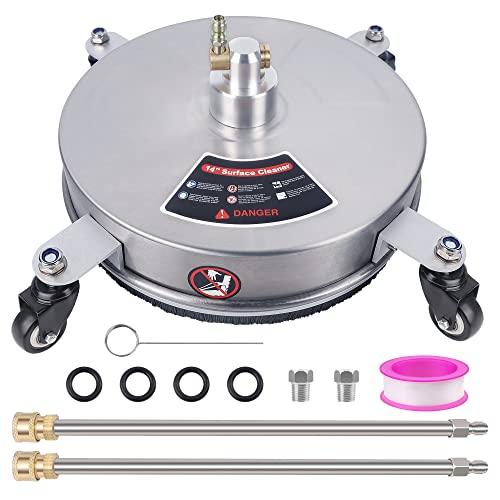
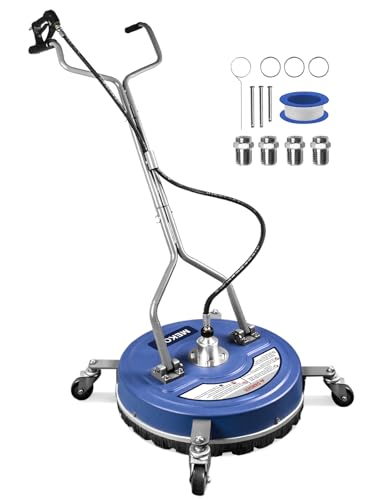
| 6 | Rotary surface-cleaner head | Disc/dual-nozzle (not a tip angle) | Even, low-ripple cleaning on flat driveway areas | Low–Medium | ★★★★☆ |
| 7 | Turbo nozzle (typically adjustable) | Varies (rotating jet) | Targeted removal on concrete; must be handled carefully | Medium | ★★★☆☆ |
Pro service vs DIY: what it means for your wallet
If your goal is predictable results with minimal risk, hiring a pro is often the safer value for pressure cleaning a driveway—especially when there are stains. DIY can look cheaper at first, but the real cost shows up as time, repeat visits, and potential surface damage.
DIY pressure cleaning a driveway only “saves money” if you don’t need repeat passes for oil, rust, or mildew.
Pros usually spend more time pretreating stains, which is where many DIY attempts underperform.
Using incorrect nozzle selection is a common cause of damaged surfaces and poor long-term appearance.
If your driveway is asphalt or recently sealed, pressure cleaning decisions should be conservative to avoid stripping or softening.
Cost trade-offs: upfront price vs redo risk
Here’s a practical way to think about pressure cleaning a driveway costs in 2026:
– DIY cost = rental/purchase + chemicals + consumables + your time + possible re-cleaning.
– Pro cost = higher labor price per hour, but typically fewer mistakes and faster completion.
As of 2026, most homeowners underestimate how much spot work (oil/rust/mildew) drives labor time. In many markets, a “looks like a basic wash” driveway turns into a multi-step treatment.
Pros/cons comparison (quick decision filter)
| Option | Pros | Cons |
|---|---|---|
| DIY pressure cleaning | Lower upfront out-of-pocket (rental), scheduling flexibility, control over pace | Higher redo risk, harder to match nozzle/chemistry to stains, time-intensive |
| Pro pressure cleaning | Pretreatment workflow, faster completion, better technique for concrete vs asphalt vs pavers | Higher per-job cost, quote variability if scope isn’t written clearly |
According to , pressure washer equipment requires correct operation to reduce serious injury hazards ().
How to get an accurate quote (without getting overcharged)
The best way to avoid surprises is to get a written scope that separates wash vs stain treatment for pressure cleaning a driveway. If the quote is vague, it often means hidden steps—or a rushed attempt that won’t remove the real problem stains.
Ask whether the quote includes stain pretreatment or only a general wash for pressure cleaning a driveway.
Square footage estimates should be explained so pricing isn’t based on guesswork.
A clear equipment approach (surface cleaner vs wand, adjustable pressure, nozzle selection) reduces the chance of damage and rework.
What to ask (scope clarity)
For a fair pressure cleaning a driveway quote, request answers to:
– Is this wash-only or includes stain treatment?
– Will they spot-treat oil/rust/mildew, and do they use a specific pretreatment chemistry?
– How many passes are planned for general grime and for problem areas?
– Do they re-wash spots that don’t lift after the first treatment (and under what conditions)?
Measure or provide square footage
Before the site visit, estimate your driveway area. Share:
– approximate dimensions (length × width),
– any access limits (gate width, hose distance),
– whether it’s concrete, asphalt, or pavers.
This helps contractors price pressure cleaning a driveway consistently across customers.
Watch for red flags
If a company can’t explain what’s included, it’s hard to compare bids. Also be cautious when a quote sounds like it assumes every driveway is equally stained.
According to , nozzle selection and pressure settings should match the surface and cleaning objective ().
What can go wrong (and why it affects cost)
Pressure cleaning a driveway can go wrong when technique and chemistry don’t match the surface or stain type. When that happens, the fix isn’t always “wash again”—it may require sealing, repairs, or extended rework time.
Too much pressure or an incorrect nozzle can damage concrete edges, strip sealant, or worsen cracks.
Some stains (oil, rust, mildew) often need pretreatment and dwell time rather than relying on blasting alone.
Runoff rules and containment/disposal requirements can change procedures and increase total cost.
Surface damage and repeat work
Common costly outcomes include:
– strip/bleed-through on sealed concrete,
– pitting or roughening from aggressive techniques,
– worsened discoloration if stains are spread instead of treated.
When pressure cleaning a driveway causes damage, the price you paid becomes only part of the total cost.
Mismatched scope (the “pressure washing only” trap)
If an estimator only prices “pressure washing” but your driveway has:
– oil spots,
– rust streaking,
– black mildew patches,
then you’re likely to pay extra later—or be disappointed with results.
Weather and runoff handling
As of 2026, many regions enforce stormwater and chemical handling rules more strictly than before. If weather affects scheduling or the cleaner must take additional precautions for runoff and disposal, you may see higher costs.
According to , discharges that carry contaminants to waterways may be regulated under Clean Water Act frameworks ().
Verdict: is pressure cleaning worth the cost?
In most cases, pressure cleaning a driveway is worth the cost when you want faster, more consistent results—especially for mildew and general buildup. If stains are severe or your driveway is delicate (asphalt, newly sealed, or pavers with sensitive joints), paying for the right technique usually saves money in the long run.
For general dirt and gray buildup, hiring a pro often delivers consistent coverage with less effort for the homeowner.
For oil, rust, or recurring mildew, the deciding factor is whether the cleaner includes pretreatment and spot-work—not just PSI.
DIY may become more expensive if you need repeat passes or if the driveway surface gets damaged.
When to hire a pro
Pressure cleaning a driveway is typically a strong pro-hire when:
– you have visible mildew/algae (gray/green staining),
– oil or rust stains are noticeable,
– your driveway is asphalt or includes sensitive edging,
– you want the job done in one visit with minimal disruption.
When DIY can make sense
DIY pressure cleaning a driveway can work if:
– the driveway is only lightly dirty,
– there are no major stain categories (no rust, minimal oil),
– you can protect landscaping and manage runoff responsibly,
– you’re comfortable learning technique (distance, nozzle choice, even passes).
Who should skip DIY (or get a pro first)
Skip DIY (or at least start with professional guidance) if your driveway is:
– older and cracked/loose-surfaced,
– sealed recently,
– pavers with fragile joints,
– heavily stained and you need a near-uniform appearance.
Quick checklist (save this before you call)
| What to ask | Why it matters | Cost impact (typical) |
|---|---|---|
| What’s included in the price? (wash only vs stain treatment) | Determines labor steps and chemicals | Higher if treatment is included |
| How do you price—by size, condition, or both? | Prevents “surprise” add-ons | Varies by driveway |
| Do you adjust pressure/nozzles for the surface? | Reduces risk of damage | Often slightly higher, but safer |
| Will you need additional passes for problem spots? | Heavy stains may require repeats | Can add cost |
| Do you use chemicals? Which ones? | Some stains need targeted products | Varies |
Sources
If you share your driveway material (concrete/asphalt/pavers), approximate size, and what stains you’re dealing with, I can help you turn that into a more specific “what to expect” quote checklist.
Pressure cleaning a driveway is usually a practical upgrade when you want visible improvement quickly—especially for gray mildew buildup and general dirt. The cost stays fair when the scope is specific (wash vs stain treatment), the nozzle/approach matches the surface, and runoff/chemical handling is handled responsibly.
Frequently Asked Questions
What is the average cost to pressure clean a driveway?
The average cost to pressure clean a driveway typically ranges from $150 to $350, depending on size, condition, and local pricing. Many contractors price by square foot or by job minimum, with heavily stained or mildew-covered surfaces costing more. For most single-driveway jobs (about 400–600 sq ft), you’ll often see estimates in this range when using standard pressure washing methods.
How much does pressure cleaning cost per square foot for a driveway?
Pressure washing a driveway often costs around $0.10 to $0.30 per square foot, but rates vary based on grime level, concrete condition, and whether additional treatments are needed. If your driveway has oil stains, algae, or embedded dirt, expect higher pricing because it may require specialized detergents, dwell time, or extra scrubbing. Asking for a square-foot breakdown helps you compare quotes more accurately between different pressure cleaning companies.
Why does driveway pressure washing cost more for stains and heavy buildup?
Driveway pressure cleaning costs more when there’s stubborn buildup like oil spots, rust, mold, or heavy algae because these require pre-treatment and more labor. A contractor may need to use targeted cleaning solutions, allow time for chemical dwell, and sometimes repeat passes to fully remove stains. If the surface is sealed or the stain is deeply set into the concrete, results may take additional time and cost.
Which factors affect the total price to pressure clean a driveway?
The total cost usually depends on driveway size, surface material (concrete vs. pavers vs. asphalt), the level of buildup, and accessibility for hoses and equipment. Other factors include the need for edge cleaning, removing mildew, protecting landscaping, and whether a sealant is recommended afterward. Location and competition also influence pricing, so getting multiple quotes can help you find a fair rate for driveway pressure washing.
What’s the best way to get an accurate estimate for pressure cleaning your driveway?
The best way is to request a written estimate that includes square footage, current condition, and a clear description of what’s included (pre-treatment, rinse, and any stain-specific steps). If possible, have the contractor inspect the driveway in person or provide photos for an accurate quote—this often prevents surprises on the final bill. Be sure to ask whether they’ll protect nearby plants, remove debris, and advise on driveway sealing costs if needed.
📅 Last Updated: October 19, 2026 | Topic: how much does it cost to pressure clean a driveway | Content verified for accuracy and freshness.
References
- Pressure washing
- National Pollutant Discharge Elimination System (NPDES) | US EPA
- https://www.epa.gov/npdes/stormwater-discharges
- https://www.osha.gov/safety-topics
- CPSC Search | CPSC.gov
- https://www.britannica.com/search?query=pressure%20washing
- OES Home : U.S. Bureau of Labor Statistics
- https://scholar.google.com/scholar?q=pressure+washing+cost+driveway Google Scholar
- https://scholar.google.com/scholar?q=pressure+washing+cost+per+square+foot Google Scholar
- https://scholar.google.com/scholar?q=power+washing+cost+analysis+driveway+concrete Google Scholar
