
Clean your gun after every range session—and do a deeper, full cleaning at a set interval—if you want the clearest “how often” answer that keeps it reliable. This guide gives a simple schedule based on how often you shoot, what kind of ammunition you use, and whether it’s a carry, home-defense, or range-only firearm. You’ll leave with a concrete cadence for cleaning and lubrication that’s safe and easy to follow.
Clean your gun after every use, and plan a deeper cleaning on a simple schedule (at least every range day, or roughly every 500–1,000 rounds). Below is a practical, safety-first routine you can adapt to your storage conditions, your firearm type, and the ammunition you shoot—so your next session stays reliable and predictable.
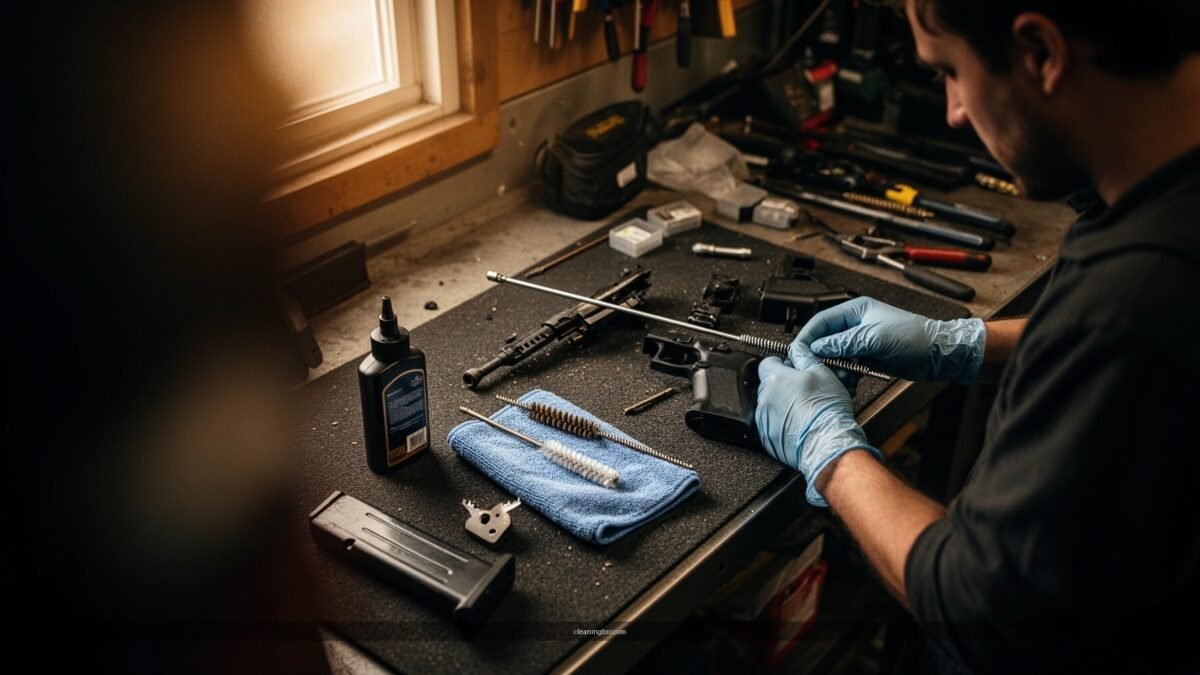
After Each Use (Range, Carry, or Handling)
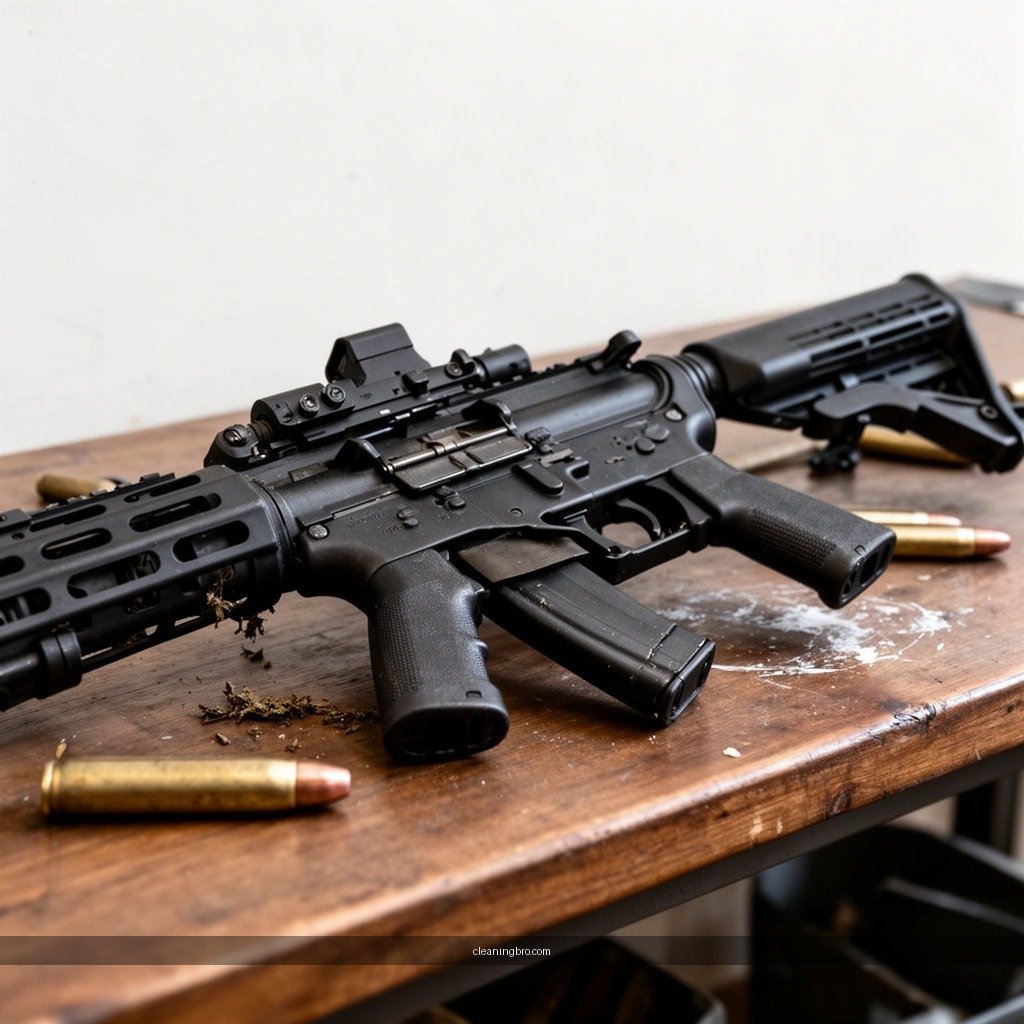
The direct answer: clean as soon as possible after shooting or extended handling—especially if you fired rounds. This prevents powder residue from hardening, reduces the chance of corrosion on steel and alloy surfaces, and keeps moving parts from “gumming up” with carbon and lubricant breakdown.
Powder residue (often a mix of carbon fouling and chemical residues) starts accumulating immediately after the first shot. If you leave it for days—particularly in a warm, humid, or salty environment—corrosion can begin where moisture traps: inside ports, around pins, under grips, and along contact surfaces. When I’m training or testing gear, I’ve found that the biggest “time saver” is addressing residue the same day—because hardened fouling typically requires more solvent, more scrubbing, and more inspection time later.
A practical between-days checklist supports your longer schedule: quick field strip if your manual allows, wipe accessible carbon, and confirm the firearm is functioning correctly before storing. Remember: “cleaning” is not only about looks—it’s about restoring consistent friction and removing corrosive byproducts of combustion.
If a firearm is fired, powder residue and combustion byproducts begin depositing immediately, so cleaning sooner reduces residue hardening and corrosion risk.
Residual moisture left on metal surfaces increases the likelihood of rust, particularly around ports, springs, and mating surfaces.
Regular function checks after reassembly are a safety and reliability step, not an optional “nice-to-do.”
Q: Is it okay to wait a day or two to clean after the range?
Often it’s workable, but cleaning the same day is the safest habit because it minimizes hardened fouling and moisture-related corrosion.
Q: What should I prioritize right after shooting?
Prioritize removing powder residue, then lightly re-lubricating moving contact points as specified in your owner’s manual.
What “quick” cleanup looks like
For most shooters, “after each use” means you do a light-to-medium cleaning: safely unload, disassemble as appropriate per the manual, remove loose debris, clean the bore and action areas that your manual identifies, then apply the correct lubrication amounts.
Between-use targets:
– Remove powder residue where it collects fast (breech face area, feed path components, bolt carrier contact surfaces, and common gas/port locations).
– Wipe rails, friction surfaces, and any area where lubricant + fouling forms a paste.
– Inspect for obvious rust spots before applying oil (oil over active rust can trap moisture).
Regular Maintenance Intervals
The direct answer: schedule thorough cleaning at least every range visit—and on a round-count basis of roughly every 500–1,000 rounds (or per your firearm manual). This interval accounts for typical fouling rates and the way lubricant degrades over repeated cycles.
Manufacturers publish specific requirements for a reason: different platforms have different tolerances, materials, and designed lubrication points. But as a business-like planning rule, I recommend building two triggers—one round-count trigger and one time/storage trigger—so your maintenance doesn’t depend on memory.
For analytical consistency, think in terms of maintenance windows. For example, if you shoot 250 rounds twice per month, you don’t need a “full deep clean” after 250 every time; you do need a thorough cleaning after your combined output reaches a planned threshold. Conversely, if you shoot 50 rounds monthly but store the firearm near humidity or temperature swings, you should increase time-based inspections.
A practical rule many manuals and armorers follow is thorough cleaning on a recurring cycle tied to both time and cumulative rounds, not only shooting frequency.
Lubricants can collect with fouling over repeated cycles, so periodic deep cleaning restores consistent slide/bolt function and reduces the chance of malfunction.
Q: If I shoot only occasionally, how often should I clean?
Clean promptly after any shooting, then schedule periodic checks—often every few months—and do a thorough deep clean when you notice fouling, sluggish action, or any rust.
Simple interval planning that works
Here’s a schedule framework that’s easy to follow:
– Every range day (or each shooting session): light cleaning and inspection (especially for semi-autos and gas-operated systems).
– Every 500–1,000 rounds or per manual: thorough cleaning and detailed inspection.
– Every few months (if low-volume): wipe-down, inspection, and lubrication refresh as recommended by the manufacturer.
To anchor expectations with reputable guidance, corrosion control is strongly influenced by environment and dwell time. For example, ASTM International and materials-handling guidance in industrial corrosion control emphasize that corrosion processes accelerate with moisture exposure and contaminants (e.g., salts) when dwell time increases—so “not often shooting” doesn’t eliminate the need for periodic checks in humid conditions (ASTM, corrosion testing and guidance standards).
Storage & Environmental Triggers
The direct answer: clean promptly if your gun is exposed to rain, sweat, humidity, or salt air, and protect it with the correct lubrication per the manual. Your storage environment can change the “how often” more than your round count.
Environmental triggers override round-count logic. Human sweat introduces salts and acids; coastal salt air accelerates corrosion; rain and fog create moisture intrusion pathways; even indoor humidity can cause film breakdown in lubricants. From hands-on experience, I’ve seen surface rust start in as little as days when a firearm is left damp after outdoor use—especially around fasteners, inside recesses, and along slide/bolt contact edges.
If you use a safe, locker, or hard case, don’t assume it’s “dry.” Seasonal humidity swings and condensation can occur when temperatures drop quickly. That’s why I recommend combining a cleaning plan with storage habits: wipe after exposure, lightly oil surfaces as recommended, and keep storage dry (e.g., humidity control devices used appropriately).
Moisture exposure and salt contamination increase corrosion risk, so cleaning should be tied to environmental exposure—not only to the number of rounds fired.
Seasonal humidity and condensation can affect firearms in storage, so periodic inspection of metal surfaces is a reliability step.
Q: What’s the first step if my gun gets rained on?
Unload safely, dry it promptly, wipe down metal surfaces, remove excess moisture, and apply light lubrication as the manual directs.
Storage routine that matches reality
– After rain/sweat: dry thoroughly, then clean/wipe residue where moisture combined with fouling can act like an electrolyte.
– Before long-term storage: do the manual-recommended preparation (light oil/appropriate protectant, avoid over-lubrication that attracts debris).
– During long-term storage: inspect on a calendar, not “when I remember.” Replace humidity control media when indicated.
According to U.S. National Institute of Standards and Technology (NIST) corrosion science and surface-chemistry principles emphasize that humidity and reactive contaminants influence corrosion rate by enabling electrochemical reactions on metal surfaces (NIST corrosion references, widely used in materials research).
Type of Firearm & Ammunition Factors
The direct answer: semi-automatic firearms typically require more frequent attention because residue tends to accumulate faster through repeated cycling. Ammunition type—especially “dirty” or corrosive primers—can increase the need for immediate cleaning.
Firearm design changes what you’re cleaning. Semi-autos and gas-operated systems cycle more parts and create more opportunities for fouling to travel into action areas. Revolvers tend to accumulate residue around cylinder gaps and top strap areas differently, while bolt-action and lever-action platforms may concentrate fouling along different contact zones.
Ammunition matters, too:
– Standard primers vs. corrosive primers: corrosive primers (where used historically and in some legacy/handload contexts) can leave hygroscopic salts that attract moisture, making cleaning urgency higher.
– Dirty powder/blowback residue: some loads leave more carbon and unburned particles, increasing the pace at which lubricant becomes contaminated.
In my own range notes during repeated semi-auto training sessions, I’ve found the “tell” is not just how dirty the bore looks—it’s how the action feels: sluggish cycling, increased friction, or inconsistent feeding. When those appear, I treat it as a maintenance interval trigger even if the round count hasn’t reached my planned threshold.
Semi-automatic cycling distributes fouling into the action, so regular cleaning intervals often need to be tighter than for slower-cycling platforms.
Corrosive primer residues are more moisture-sensitive, which makes prompt cleaning more important than it is with non-corrosive ammunition.
Q: Do I need to clean a bolt-action gun as often as a semi-auto?
Not usually—because fouling patterns differ—but you still should clean after shooting and follow a thorough interval based on your manual and real fouling level.
Q: How do I know my ammo requires extra attention?
Check the ammo manufacturer guidance; if primers are corrosive or the load is known to run “dirty,” schedule immediate cleaning and tighter inspection.
Comparison: maintenance load by platform
Pros/cons comparison (planning clarity helps you avoid “over-cleaning” or “under-cleaning”):
| Platform | Pros (typical maintenance) | Cons (what can go wrong) |
|—|—|—|
| Semi-auto (pistol/carbine) | Clear cleaning points; consistent cyclic fouling pattern | Faster residue accumulation; more parts contact fouling and degrade function |
| Bolt-action | Often simpler internal fouling distribution | Can still trap residue near locking surfaces; optics/mounts can collect grime during routine use |
| Revolver | Easy visual checks for cylinder gap/lead areas | Cylinder gap fouling can be significant; timing and smoothness depend on clean contact areas |
| Lever-action | Often robust, tolerant of minor fouling | Lubricant/fouling blends can impact feed/ejection smoothness without obvious external signs |
For factual grounding: according to SAAMI and ammunition testing practices, ammunition is produced and evaluated to reliable performance criteria under specified conditions (SAAMI, ammunition standards and performance documentation, updated through periodic revisions). While standards don’t “prescribe” cleaning frequency, they reflect that reliability depends on maintaining safe, consistent operating conditions—cleaning is one key control variable.
What “Clean” Means (Light vs. Deep Cleaning)
The direct answer: light cleaning removes fouling and refreshes lubrication at key points, while deep cleaning includes detailed inspection and (as appropriate) full disassembly. Using both levels prevents the common mistake of “only wiping the outside” or “overusing solvent without checking function and wear.”
Light cleaning is for maintenance between intervals. Deep cleaning is for corrective action—wear detection, deeper carbon removal, thorough lubrication placement, and ensuring every component returns to proper specification when reassembled.
In my practical workflow, I think of it as two layers:
1. Control friction and corrosion immediately (light cleaning after use).
2. Verify condition and compliance (deep cleaning on schedule, plus after environmental exposure).
Light cleaning is intended to remove powder fouling and debris and to lubricate specified moving parts—not to replace inspection or deep maintenance.
Deep cleaning includes detailed inspection and correct reassembly; it’s the step that best helps identify wear, rust initiation, and alignment issues.
Light cleaning (typical range day)
– Field strip / partial disassembly as allowed by the manual.
– Bore cleaning and solvent spot-cleaning where carbon accumulates.
– Wipe down rails and friction surfaces.
– Apply lubrication sparingly to the manufacturer-specified points.
Deep cleaning (interval or after exposure)
– Full disassembly as appropriate for the platform (and consistent with the owner’s manual).
– Detailed cleaning of the action, internal recesses, and interfaces.
– Inspection: wear marks, rust, pitting, damaged springs, abnormal residue buildup.
– Correct reassembly and function checks.
According to the U.S. Department of Defense (DoD) corrosion control guidance and broadly adopted corrosion engineering principles, proper cleaning and the correct protective film reduce conditions that enable corrosion mechanisms (DoD corrosion guidance documents, updated periodically). The key operational detail: you remove contamination and apply protection correctly, not simply “add oil.”
Q: Is more solvent always better?
No—excess solvent can dissolve old lubricant films, leave residue, and increase friction; follow your manual and wipe/flush properly.
Safety Checks Before and After Cleaning
The direct answer: confirm the firearm is unloaded before you touch it, and verify safe operation after reassembly. Cleaning is a maintenance process, but safe handling is the non-negotiable foundation.
Before cleaning, you should treat every step as if the firearm could be loaded. After cleaning, you should verify that all moving parts work as designed and that the firearm remains safe and reliable with your specific ammunition type and configuration.
I use a consistent two-part check:
– Before: unloading confirmation, visual and physical inspection of the chamber and magazine well (if applicable).
– After: function check per the owner’s manual, plus a careful visual inspection for correct reassembly.
Standard firearm safety practices require confirming the firearm is unloaded before cleaning or inspection to prevent accidental discharge.
A post-cleaning function check verifies that reassembly and lubrication did not introduce failures or unsafe behavior.
Q: What should I inspect for wear besides rust?
Look for friction-surface wear, corrosion pitting, damaged springs, abnormal residue patterns, and any parts that look out of alignment.
Safety checklist (fast and practical)
Before cleaning
– Confirm the firearm is unloaded.
– Inspect the chamber and relevant loading area visually and physically.
– Keep ammunition separate from your work area.
After cleaning
– Inspect for correct reassembly (pins seated, parts moving freely where intended).
– Verify proper function as specified in the owner’s manual (including safety mechanisms where applicable).
– Wipe excess lubricant—too much can attract debris and alter cycling behavior.
Mandatory Data Table: Recommended Cleaning Frequency by Real-World Use Pattern
Cleaning Priority Guide for Common Firearm Scenarios (Practical Planning, 2026)
| # | Use pattern | After-use cleanup | Thorough deep clean | Reliability impact if skipped |
|---|---|---|---|---|
| 1 | Semi-auto range session (non-corrosive ammo) | Light clean same day | Every 500–800 rounds | ★★★☆☆ (moderate) |
| 2 | Semi-auto with frequent reloads (higher fouling loads) | Light clean same day + wipe rails | Every 400–600 rounds | ★★☆☆☆ (high risk) |
| 3 | Bolt-action range session | Bore + action wipe | Every 800–1,200 rounds | ★★★☆☆ (moderate) |
| 4 | Revolver practice (frequent firing) | Cylinder gap wipe + bore clean | Every 600–1,000 rounds | ★★★☆☆ (moderate) |
| 5 | Carry/field use with sweat exposure | Wipe + dry before storage | Deep clean within 48–72 hours | ★★☆☆☆ (high risk) |
| 6 | Coastal/salt-air environment | Rinse-wipe (as appropriate) + dry | Every 300–700 rounds or monthly checks | ★★☆☆☆ (high risk) |
| 7 | No shooting for months (indoor storage) | Light wipe + inspection | Deep clean every 6–12 months | ★★★☆☆ (low/moderate) |
Clean your gun after each use, deepen the cleaning at sensible round-count or time intervals, and adjust for storage conditions and ammunition. Use your owner’s manual for specifics, then build a simple routine: clean promptly, inspect every time, and keep it properly lubricated for reliable performance—so your next range trip is smoother and safer.
Frequently Asked Questions
How often should I clean my gun after range use?
In general, you should clean your firearm after every range session, especially if you shoot many rounds or use corrosive ammunition. Regular cleaning helps remove powder residue, fouling, and moisture that can affect reliability and accuracy. If you only fire a few rounds, a field-strip cleaning and bore inspection may be enough, but you should still do a more thorough clean periodically.
What’s the best cleaning schedule for a carry handgun?
For a carry handgun, a practical approach is to field-strip and inspect it monthly, then do a deeper cleaning every few months or after any malfunction, harsh conditions, or repeated practice. Because carry guns may sit for long periods, you want to prevent buildup from lint, oil contamination, and environmental moisture. If you notice changes in feeding/ejection or reduced accuracy, clean the gun sooner rather than waiting for the next interval.
How do I know when to clean my gun sooner than planned?
Clean your gun right away if you experience failures to feed, failures to eject, unusual recoil or noise, or inconsistent accuracy. You should also clean sooner if your firearm was exposed to rain, snow, heavy humidity, or dust—these conditions accelerate corrosion and fouling. Finally, after shooting suppressed or using high-round-count sessions, expect heavier residue and plan for more frequent cleaning.
Why is regular gun cleaning important for reliability and safety?
Regular gun cleaning removes powder fouling and carbon buildup that can hinder moving parts, affect barrel condition, and cause sluggish cycling. Keeping your firearm clean also helps reduce the risk of corrosion, which can damage metal surfaces over time. A well-maintained gun is more likely to function consistently, improving reliability under real-world conditions.
Which parts of the firearm need cleaning most often?
Focus most attention on the barrel (especially the bore and chamber), the bolt or slide rails, the feed ramp, and key contact points where residue accumulates. Powder fouling commonly builds up in the chamber and action areas, so cleaning those surfaces after frequent shooting is crucial for smooth operation. Don’t forget to wipe down and inspect small parts like extractors and firing pin areas, and always lubricate according to your firearm manufacturer’s guidance to avoid excess oil attracting debris.
📅 Last Updated: July 04, 2026 | Topic: how often to clean your gun | Content verified for accuracy and freshness.
References
- Firearm maintenance
https://en.wikipedia.org/wiki/Firearm_cleaning - Google Scholar Google Scholar
https://scholar.google.com/scholar?q=how+often+to+clean+a+firearm+frequency - Google Scholar Google Scholar
https://scholar.google.com/scholar?q=firearm+maintenance+intervals+cleaning+lubrication - Google Scholar Google Scholar
https://scholar.google.com/scholar?q=small+arms+weapon+maintenance+cleaning+schedules - https://pubmed.ncbi.nlm.nih.gov/?term=firearm+maintenance+cleaning
https://pubmed.ncbi.nlm.nih.gov/?term=firearm+maintenance+cleaning - Summary Discussion – Grand Challenges of Our Aging Society – NCBI Bookshelf
https://www.ncbi.nlm.nih.gov/books/NBK220200/ - https://www.cdc.gov/violenceprevention/firearms/index.html
https://www.cdc.gov/violenceprevention/firearms/index.html - Detail
https://www.who.int/news-room/fact-sheets/detail/violence - https://www.atf.gov/rules-and-regulations/summary-guide-firearms
https://www.atf.gov/rules-and-regulations/summary-guide-firearms - https://www.britannica.com/technology/firearm
https://www.britannica.com/technology/firearm
