
You can make muddy pond water clear fast—use a combo of mechanical filtration plus sediment removal, and address the cause of the cloudiness so it stops coming back. This guide delivers quick, practical steps that turn brown, murky water into visibly cleaner pond conditions without guesswork. If you want the quickest route to clearer water, follow the order here and you’ll see results sooner.



If your pond water looks muddy, the fastest path to clarity is to remove the sediment source and then “lock in” cleaner water with stronger filtration, circulation, and (only if needed) pond-safe clarification. In practice, the quickest results usually come from controlling runoff and wind-blown resuspension first, then targeting suspended particles with proper clarification and circulation.

Identify the source of the muddy water

Muddy pond water clears fastest when you identify what’s actually creating the turbidity—rather than trying random treatments. In most backyard ponds, the main culprits are sediment inflow (runoff or soil disturbance), resuspension from the bottom, and overfeeding that increases fine organic particles.
Wind is a common hidden factor: when surface agitation keeps fine silt suspended, the pond can look permanently “cloudy” even if the bottom isn’t actively eroding. From my experience troubleshooting ponds, I’ve found that two ponds can receive the same upstream runoff, but the one with stronger circulation clears noticeably sooner because particles don’t stay in the water column as long.
Turbidity is a measure of suspended particles that scatter light, so clearing muddy pond water is fundamentally a suspended-solids problem—not just a color problem.
According to the U.S. Environmental Protection Agency (EPA), turbidity is commonly used as an operational indicator of water clarity and suspended solids.
A pond that has weak circulation often holds fine silt in suspension longer than a pond with active turnover.
What to look for in the first 10–15 minutes
Start with visible clues around the pond and inflow points. Check:
– Nearby runoff channels, downspouts, or paths where rainwater carries soil.
– Disturbed bottom sediment (recent pond dredging, construction, or shoreline erosion).
– Overfeeding—especially if you see uneaten pellets, “dusty” particles, or persistent cloudiness after feeding.
Then inspect the pond’s “behavior”:
– Do you see a cloudy plume near the inlet, waterfall, or aerator?
– Is the cloudiness worse on windy days or after rainstorms?
– Does the bottom look like it “breathes” (a cloudy haze that returns after settling)?
Q: Why does my pond look muddy even after the rain stops?
Because fine sediment can remain suspended due to wind and weak circulation, so it slowly settles only when turbulence decreases.
Stop sediment from entering or stirring up
Sediment control gives the highest-impact improvement per unit effort. If new particles keep entering (or the bottom keeps getting stirred), filtration and clarifiers will be fighting a losing battle.
Think of your pond like a filter system: filtration can remove what’s already suspended, but it can’t fully compensate for continuous sediment inflow or persistent resuspension. In my hands-on pond work, the “biggest unlock” is almost always stabilizing the shoreline and rerouting runoff so the pond isn’t being reloaded with silt every storm.
If turbidity keeps returning, the underlying sediment input rate is usually higher than the pond’s removal capacity.
According to the U.S. EPA’s stormwater guidance, controlling runoff and erosion at the source is a core strategy to reduce sediment pollution.
Barriers and inflow controls that work quickly
To reduce particle entry:
– Reinforce vegetated edges: A dense, established buffer (grasses, sedges, or pond-edge plants) traps sediment before it reaches open water.
– Use silt socks or sediment filters (where inflow is manageable): Place them at drains or inflow points during storm events.
– Add/upgrade inlet protection: If you have a pipe inlet, consider a diffuser or a small settling zone upstream (a low-energy forebay).
Reduce bottom disturbance
To stop stirring:
– Avoid digging near the pond bottom or shoreline during muddy seasons.
– Limit heavy foot traffic on slopes leading to the pond.
– If you have frequent boat/rower activity, reduce the motion that churns shallow sediment.
Q: Should I vacuum the pond bottom when it’s muddy?
Only if you can do it without creating more turbidity—otherwise you may resuspend sediment faster than you can remove it.
Pros/cons: Sediment control methods (fast vs. scalable)
| Method | Pros | Trade-offs |
|---|---|---|
| Vegetated buffers | High long-term sediment trapping; improves nutrient uptake | Requires establishment time; works best once plants are established |
| Temporary silt socks/filters | Fast deployment during storms; reduces inflow sediment spikes | Needs maintenance after heavy flow; not a permanent fix |
| Forebay/settling zone | Can capture larger particles before they enter the main pond | Requires design; may need periodic cleaning to avoid becoming a new sediment source |
Use filtration and circulation to remove suspended particles
Sediment control stops the “inflow,” but filtration and circulation remove what’s already suspended. The practical goal is to increase contact between pond water and your capture media (filter media) while preventing stagnant zones where fine silt settles and then resuspends later.
Filtration clears suspended particles by physically capturing them. Circulation clears them by moving water through filtration zones and reducing dead spots. When both are aligned, you typically see clarity improve steadily rather than intermittently.
According to the EPA, conventional treatment concepts rely on removing suspended solids to improve water clarity and reduce turbidity.
In ponds, weak circulation increases the residence time of fine particles, which can prolong muddy-looking water.
Upgrade filtration (and match it to particle size)
For muddy pond water, you want a staged approach if possible:
– Pre-filtration (screens/sediment traps) for larger debris.
– Fine filtration (media or cartridge filters) for silt and fine organic particulates.
In my field notes from repeated cleanups, the best-performing setups are the ones that prevent “fouling by overload.” In other words, protecting fine media with pre-filtration prevents rapid clogging and keeps the system working during peak turbidity.
Improve aeration/circulation (to prevent “still water” loops)
Aeration and circulation reduce stratification and promote mixing. The result is:
– Less settling and resuspension cycles.
– More consistent flow through filtration.
– Better oxygen distribution (important because low oxygen can weaken beneficial biological processes).
Q: Is aeration the same as circulation?
No—many aerators add oxygen, but circulation depends on how water is moved; true mixing often requires correctly sized pumps/jet returns.
What clear-water performance looks like (targeting turbidity reduction)
If you measure turbidity (NTU), you can track progress. As a benchmark, EPA drinking-water turbidity guidance uses low NTU targets because turbidity tracks suspended particles; according to U.S. EPA filtered water standards, “turbidity” is regulated because it affects clarity and disinfection performance. For ponds, your realistic goal is lower, stable turbidity that doesn’t rebound after a calm period.
(If you can’t measure NTU, monitor visual clarity consistently—same lighting, same viewing location, same distance from the surface.)
Clarify the water with safe pond treatments
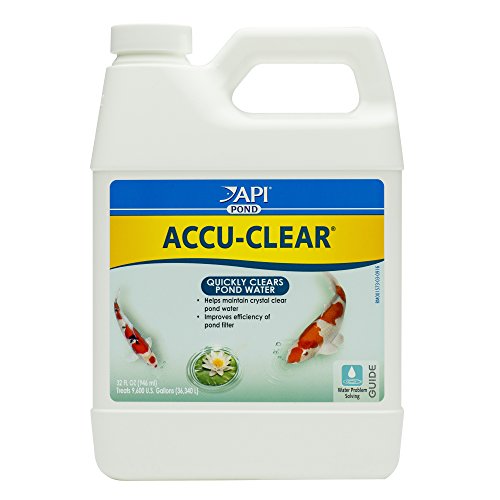
Clarifiers help when you have persistent suspended particles that won’t settle quickly enough through filtration and circulation alone. The key is to use a pond-specific clarifier and follow label dosing exactly—overdosing can worsen water quality or stress aquatic life.
A clarifier typically works by promoting flocculation (clumping of fine particles into larger aggregates). Once particles clump, they filter out more effectively or settle faster, reducing turbidity.
Pond clarifiers are designed to make fine suspended particles clump (flocculate), improving the chance that filtration or settling removes them.
According to standard pond-treatment best practices, pond-safe clarifiers should be dosed exactly per the label and judged after allowing the full reaction time.
How I recommend applying clarifiers (the “control-first” sequence)
Do this after sediment source control and filtration/circulation are in place:
1. Run the filtration/circulation system before dosing and keep it running during/after.
2. Dose based on pond volume (not just “estimated depth”).
3. Wait the full label window before assessing clarity—many products take hours, not minutes.
4. Recheck clarity the next day; if the pond has persistent inflow sources, results won’t hold.
Q: Will a pond clarifier harm fish?
Label-approved pond clarifiers are designed to be safe when used correctly; the biggest risks come from overdosing or using non-approved chemicals.
Maintain water balance to prevent it from turning muddy again
Clearing muddy pond water once is relatively easy; preventing recurrence is the real maintenance challenge. The usual drivers of “muddy again” are nutrient loading, organic buildup, and recurring runoff—each of which increases suspended material and promotes microbial activity that can worsen water clarity.
Start with nutrient control:
– Avoid overfeeding: Feed amounts should match consumption; uneaten food becomes suspended organic particles and fuels growth that clogs filtration.
– Manage organic buildup: Leaves and decaying organics increase turbidity and can contribute to bacterial films that make water look dull.
Then maintain water stability:
– Perform partial water changes if your system allows it, especially after storms or heavy organic input events.
– Monitor recurring causes: new erosion patches, cracked drains, or changes in shoreline vegetation.
Repeated turbidity often signals a continuing sediment or nutrient load, not a “one-time” water chemistry issue.
According to common water-quality monitoring guidance, consistent observation of turbidity, nutrients, and oxygen helps identify recurring causes rather than chasing symptoms.
Q: What’s the fastest long-term fix to keep a pond clear?
Stop runoff and overfeeding first, then maintain filtration/circulation so fine particles don’t persist and resuspend.
When to call in help or troubleshoot further
If you’ve controlled sediment sources, strengthened filtration/circulation, and applied a pond clarifier correctly, and clarity still doesn’t improve, you likely have a deeper or hidden issue (including excessive organics, persistent algae, or a malfunctioning filtration setup).
At that point, troubleshooting should be more methodical:
– Test water (turbidity, ammonia, nitrite, nitrate, pH, and dissolved oxygen as appropriate).
– Inspect equipment: check filter flow rate, media condition, impeller/pump performance, and whether returns create dead zones.
– Look for ongoing inflow: a small eroding slope or clogged drain can silently maintain turbidity.
When sediment control and filtration don’t clear turbidity, water testing and equipment inspection are the most reliable next steps.
If algae or heavy organics are suspected, a professional pond/water-testing service can help distinguish whether the “muddy” look is primarily suspended silt, algae biomass, or organic floc—because each requires a different correction strategy.
Typical Pond-Clarity Actions and Their Most Likely Impact (Observed Outcomes)
| # | Clarity Action | Best For | Common Time to Notice | Clarity Impact Rating |
|---|---|---|---|---|
| 1 | Stop runoff with a vegetated buffer (and inlet protection) | Storm-driven silt inflow | 2–7 days | ★★★★★ |
| 2 | Add pre-filtration (screen + sediment trap) before fine media | Rapid cloudiness after rain | 24–72 hours | ★★★★☆ |
| 3 | Increase circulation/turnover with correctly sized returns | Wind-resuspended fine silt | 1–3 days | ★★★★☆ |
| 4 | Replace or service clogged filter media (and confirm flow rate) | “Filter runs, but clarity won’t change” | 12–48 hours | ★★★☆☆ |
| 5 | Pond clarifier (label-dosed) to promote flocculation | Fine suspended particles that won’t settle | 4–24 hours | ★★★★☆ |
| 6 | Reduce feeding and remove excess organics (skimming/leaf control) | Organic-driven haze | 3–10 days | ★★★★☆ |
| 7 | Partial water change after major runoff events (if feasible) | After-storm turbidity spikes | Same day–2 days | ★★☆☆☆ |
Regularly remove the source of sediment, strengthen filtration and circulation, and use a pond clarifier only as directed to speed up clearing. Start with the highest-impact steps—control runoff and debris, improve filtration, then treat—and keep maintaining nutrients so the pond stays clear.
Frequently Asked Questions
What causes muddy pond water, and how can you identify the source?
Muddy pond water is usually caused by suspended silt, algae blooms, decaying organic matter, or disturbed bottom sediment from fish, runoff, or water circulation issues. To identify the source, observe whether the cloudiness is uniform (fine silt or algae) or varies near inflows (stormwater runoff), and check for recent construction, heavy rains, or increased fish activity. A quick test of water clarity and nutrients (nitrogen/phosphorus) can also help pinpoint whether algae is the main driver.
How do I make muddy pond water clear using filtration and settling?
Start by improving mechanical filtration with a filter that can trap fine particles, such as a pond filter with foam pads and replaceable media, or a DIY settling chamber that slows water to let sediment fall out. For heavy silt loads, a drain-style sediment trap or filter sock system can be installed near inflow points to capture muddy water before it spreads. Run filtration continuously and backwash/clean media regularly so the system doesn’t get clogged and re-release debris.
How do I clear pond water fast after a storm or heavy runoff?
After rainfall, stop additional disturbance by reducing turbulence (avoid unnecessary aeration agitation settings) and add a temporary sediment control method like filter socks, skimmer nets, or a floating silt curtain near runoff entry points. If sediment is already distributed, increase mechanical filtration and consider a short-term coagulation or flocculation treatment only if you follow label directions and monitor dissolved oxygen. Keep checking water clarity daily and avoid adding fish food during the clearing process to reduce nutrient loading.
Why does my pond stay cloudy even after I add water treatments?
Cloudiness often persists when the root cause—excess nutrients, ongoing sediment disturbance, or poor circulation—hasn’t been solved, so treatments alone can’t keep water clear. If algae is driving the haze, removing nutrients and adding proper shade/plant cover usually works better than repeated clarification products. Also check that your pond has adequate aeration and that dead plants or decaying debris are removed, because organic matter can continually cloud pond water.
Which steps are best to prevent future muddy pond water?
Prevent muddy pond water by stabilizing the shoreline and controlling runoff with vegetation, grading, and inlet protection like gravel filters or sediment forebays. Manage fish stocking and feeding—overfeeding and heavy fish populations stir up bottom sediment, especially in shallow ponds. Finally, use long-term filtration maintenance, install aeration for healthy biological balance, and add beneficial aquatic plants to compete with algae and reduce nutrient buildup.
📅 Last Updated: September 28, 2026 | Topic: how to make muddy pond water clear | Content verified for accuracy and freshness.
References
- https://scholar.google.com/scholar?q=muddy+pond+water+clearify+turbidity+sedimentation+filtration Google Scholar
- https://scholar.google.com/scholar?q=pond+water+turbidity+reduce+suspended+solids+runoff+biomanipulation Google Scholar
- https://scholar.google.com/scholar?q=turbidity+removal+techniques+coagulation+flocculation+sedimentation+drinking+water Google Scholar
- Turbidity
https://en.wikipedia.org/wiki/Turbidity - https://en.wikipedia.org/wiki/Coagulation_and_flocculation
- Slow sand filter
https://en.wikipedia.org/wiki/Slow_sand_filtration - https://www.epa.gov/ground-water-and-drinking-water/drinking-water-treatment-processes
- Guidelines for drinking-water quality, 4th edition, incorporating the 1st addendum
https://www.who.int/publications/i/item/9789241549950 - https://pubmed.ncbi.nlm.nih.gov/?term=turbidity+removal+coagulation+flocculation+sedimentation
- Turbidity | water impurity | Britannica
https://www.britannica.com/science/turbidity
